
The nested horizon
Agate
Patterned, commonly banded chalcedony, a fine-grained silica material.
Patterned or colored microcrystalline silica aggregate
Agate is patterned fine-grained silica, commonly recognized by visible bands and some translucency. A slice can expose repeated outlines around a former cavity. Locality names and visual pattern names are useful for comparison, but do not create additional mineral species.
Geology · Human history · Attributed traditions
Explore the specimen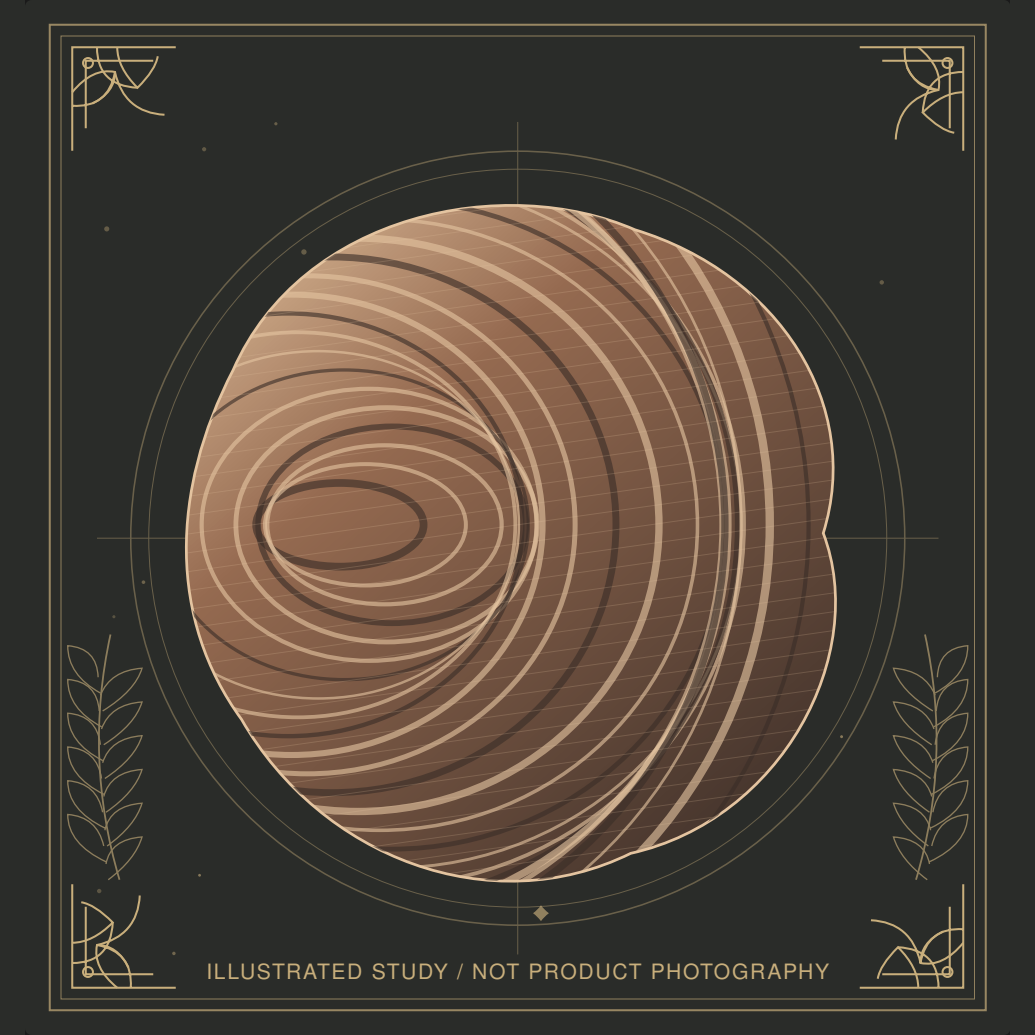
Traditions
Sandra Kynes’s 2018 article includes agate in balance-oriented home correspondences. [5]
In this guide
Visual identity
Earth story: geology and formation
Silica-bearing fluids and successive deposition can create contrasting layers. Agates differ in their host setting and texture, so an individual pattern should not be assigned one universal growth timeline. Cutting across layers reveals rings; a different orientation can make those same layers appear straighter. The Australian Museum records agate, chalcedony and jasper at Australian localities including Nundle. Vapriikki also describes fine-grained silica material from Finnish impact-crater regions. These demonstrate that one broad family can occur in different geological contexts. They should not become a claim that every agate formed in a volcanic geode. A host cavity, a vein and a detached weathered nodule preserve different context; a thin decorative slice can omit most of it. [1][2]
Fine-grained silica differs visually from a single clear quartz crystal: its tiny crystallites and inclusions scatter light and produce a waxy or softly glassy surface. The Australian Museum gives microcrystalline quartz a hardness around 6.5, refractive indices of approximately 1.530–1.539, and specific gravity around 2.57–2.64. These are reference ranges, not a certificate for every rock sold under a related trade name. Many fine-grained silica materials accept artificial color because their microstructure can admit a staining solution. The visible pattern, the aggregate structure and any treatment must therefore be considered together. A highly polished surface reveals contrast in a cut section; it does not show the complete shape in which the material originally formed. [1]
Agate belongs to the fine-grained silica branch of the catalogue. Its banding can record differences between successive deposits, including color-bearing material and the amount of translucent chalcedony. Some examples contain a central open space lined by larger quartz crystals; others are solid. The cavity, the filling and the eventual slice are therefore separate features. Calling every agate a geode would confuse a possible hollow internal architecture with the broader name for a banded material. [1][3]
Varieties and lookalikes
These names describe different levels of information: a mineral species, a visual variety, a crystal habit or a retail label. The distinctions below keep the recognizable shop vocabulary alongside its material explanation.
An agate slice can be described along several independent axes: concentric or more irregular banding, translucency, inclusion pattern and optical behavior. A dendritic appearance refers to branching inclusions, while lace refers to an intricate pattern. Fire agate produces reflected iridescence and iris agate reveals spectral color in transmitted light. These effects should be named for the conditions in which they appear. A colorful photograph taken with backlighting may show a real feature that is much less visible when the specimen sits on an opaque shelf. [4]
- Banded, fortification and lace agate
- Banded agate is the broad recognizable material, fortification describes angular or concentric band patterns and lace emphasizes intricate layered design. These terms concern appearance within fine-grained silica rather than separate mineral formulas. A cut can expose only part of the layering, and a thin slice may show translucency concealed in the intact nodule. Dyeing is a separate question even where the pattern itself is natural. [1][4]
- Botswana, Indian and crazy lace/Mexican lace agate
- Botswana and Indian are geographical-style labels whose actual source should be supported by the offered piece’s record. Crazy lace emphasizes a complex visible band pattern, and Mexican lace adds a source-related suggestion. None supplies an independent mineral species or a treatment declaration. A clear listing can preserve the familiar term, describe the bands and distinguish documented provenance from a market name repeated without a traceable collection or supply history. [1][4]
- Moss, plume and flower agate
- Moss, plume and flower labels concern inclusion shapes or patterns seen through silica. Branching, feathery or blossom-like appearances are visual comparisons, not evidence of fossil plants. The included material can require microscopy or analysis for a component identification. Moss and dendritic material receive separate parent articles in this catalogue because their patterns are familiar and substantial; the geological explanation remains tied to confirmed minerals rather than the image the viewer perceives. [1][4]
Human story: history and naming
Vapriikki documents the long use of chalcedony names and modern lapidary material. GIA’s account of chalcedony carving refers to Theophrastus’s ancient treatise On Stones and later carving industries. Those are histories of describing and working stone; a specific talismanic belief still needs its own source. [4]
The mineral name preserves an old geographical explanation: classical authors connected it to Sicily’s Achates River. GIA’s historical discussion cites Theophrastus and Pliny, whose accounts also show changing perceptions of availability and value. That literary history concerns agate as recognized by those writers, rather than a proof that every present-day lace, moss or fire-agate trade category existed in antiquity. Modern geological classification and ancient material naming are overlapping records whose boundaries should remain visible. [4]
Meaning and practice: attributed traditions
Sandra Kynes’s 2018 article includes agate in balance-oriented home correspondences. Her list is a contemporary spiritual practice, not a geological property. The visual repetition of bands can offer a personal image of balance without turning every locality variety into an ancient universal correspondence. [5]
Tracing one band slowly is an optional visual meditation. Its changing width provides an observation, while any personal meaning is chosen by the viewer.
Material identity and trade terminology
Dyed agate is common, and a saturated blue, purple or pink color does not establish untreated origin. A country name cannot authenticate locality. Fire agate’s optical appearance differs from a heat-cracked quartz product marketed with fiery color; pattern, host identity and treatment must be separated. [1][2]
A particularly saturated color calls for a treatment question, because chalcedony can accept introduced color. GIA illustrates blue-dyed landscape agate and explains that vivid pink, blue and green agates are often enhanced. That is a warning about a known trade practice, not a diagnosis made from brightness alone. A useful label identifies the base material and the enhancement together. Dyed agate is still an agate host, while dyed glass sold under the same familiar name has a different material identity. [4][6]
Sources and related specimens
The references below distinguish mineral identification and physical properties from historical interpretation and practitioner symbolism. A cited material category describes a kind of stone; it does not certify the identity, treatment or provenance of an untested individual retail specimen.
- Quartz
Australian Museum · Geological, gemological or documented material-history evidence · Accessed October 9, 2026
- Chalcedonies
Vapriikki Mineral Museum · Geological, gemological or documented material-history evidence · Accessed October 9, 2026
- Handbook of Mineralogy: Quartz
Mineralogical Society of America · Mineral composition, structure, physical properties and occurrence · Accessed October 9, 2026
- Gem Cutters Reveal the Beauty of Chalcedony
Gemological Institute of America · Geological, gemological or documented material-history evidence · Accessed October 9, 2026
- Sandra Kynes: 365 Days of Crystal Feng Shui for Your Home (2018)
Llewellyn Worldwide · Contemporary practitioner symbolism and retailer terminology; distinct from mineralogical evidence · Accessed October 9, 2026
- GIA: An Introduction to Gem Treatments
Gemological Institute of America · Geological, gemological or documented material-history evidence · Accessed October 9, 2026