
Pale blue lace
Blue Lace Agate
Pale blue-and-white banded chalcedony.
Patterned or colored microcrystalline silica aggregate
Blue lace agate combines pale blue chalcedony with white lace-like bands. The soft blue and repeated waves distinguish its visual character from an unbanded blue tumble. A small polished piece may show only a fragment of a much larger pattern.
Geology · Human history · Attributed traditions
Explore the specimen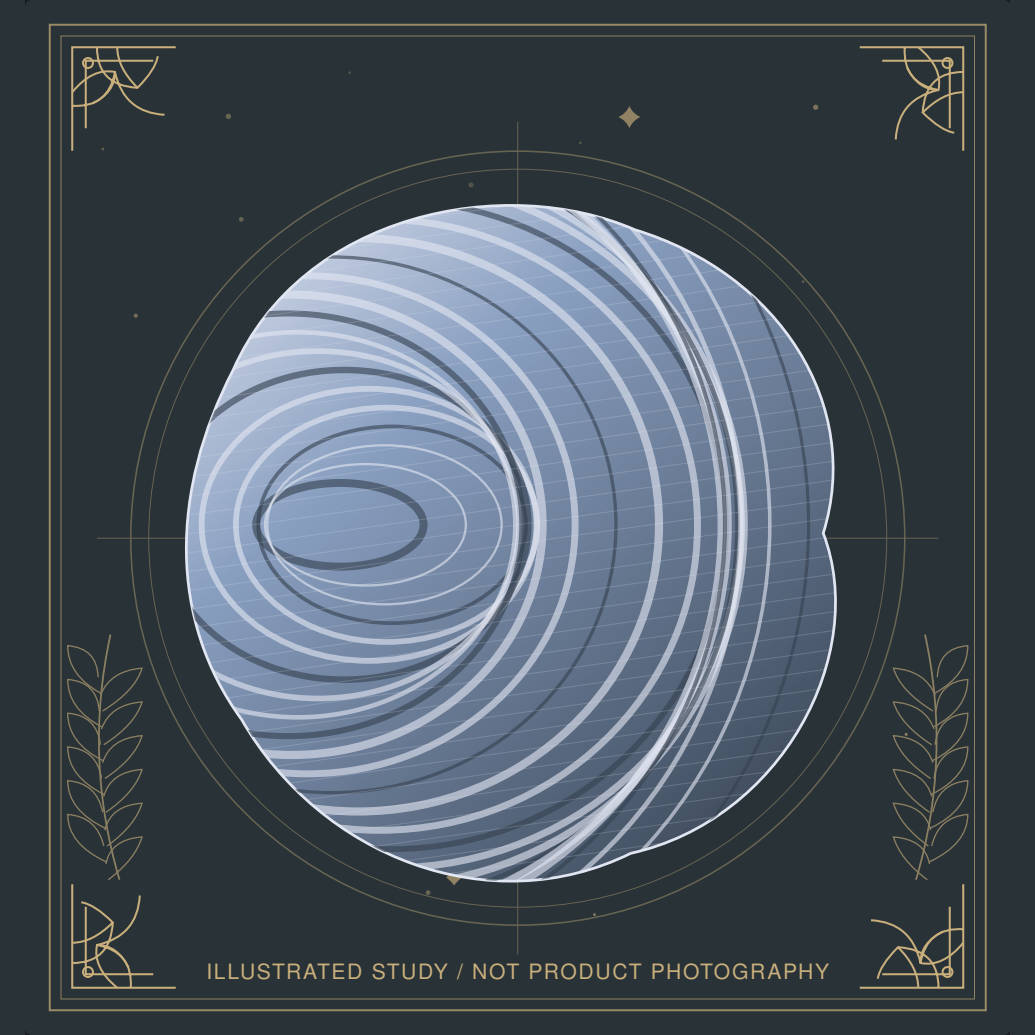
Material
Pale blue-and-white banded chalcedony. [1]
Family
Chalcedony and related silica [1]
Appearance
Fine curving bands [1]
Traditions
Margaret Ann Lembo’s 2013 chart places blue lace agate within a throat-centered symbolic group concerned with communication, expression and speaking up. [5]
In this guide
Visual identity
Blue lace agate combines pale blue chalcedony with white lace-like bands. The soft blue and repeated waves distinguish its visual character from an unbanded blue tumble. A small polished piece may show only a fragment of a much larger pattern. [1]
The blue-and-white lace appearance is a pattern within chalcedony. Individual ribbons can be narrow, clouded or nearly white, and curved bands give polished pieces a softer rhythm than straight-edged onyx layering. The Australian Museum includes blue lace agate among its patterned chalcedonies. This gives the name an intelligible mineral setting without turning the pale color into a separate mineral species. The outline of a bead, heart or tower describes the carver’s object, while the bands describe the material inside it. [1]
Earth story: geology and formation
The Australian Museum explicitly lists blue lace agate as blue material with white lacy bands. Its fine-grained silica framework relates it to other chalcedonies. The bands are mineral structures exposed by a cut surface, not drawn decoration; identifying natural color or origin remains a separate question. [1]
Fine-grained silica differs visually from a single clear quartz crystal: its tiny crystallites and inclusions scatter light and produce a waxy or softly glassy surface. The Australian Museum gives microcrystalline quartz a hardness around 6.5, refractive indices of approximately 1.530–1.539, and specific gravity around 2.57–2.64. These are reference ranges, not a certificate for every rock sold under a related trade name. Many fine-grained silica materials accept artificial color because their microstructure can admit a staining solution. The visible pattern, the aggregate structure and any treatment must therefore be considered together. A highly polished surface reveals contrast in a cut section; it does not show the complete shape in which the material originally formed. [1]
Because the material is fine grained, its growth is read through layers rather than through large visible quartz terminations. A polished band can contain variations in translucency that are distinct from its blue hue. Quartz-rich material may be accompanied by small amounts of color-bearing or opaque matter, but a view of the pattern does not identify each microscopic component. The silica-family account provides the host framework; a detailed explanation of a particular blue specimen’s color mechanism needs a more specific analysis. [1][2]
Varieties and lookalikes
These names describe different levels of information: a mineral species, a visual variety, a crystal habit or a retail label. The distinctions below keep the recognizable shop vocabulary alongside its material explanation.
A uniformly colored blue chalcedony cabochon and a blue lace agate cabochon can share the same broad host family while displaying different patterns. Blue glass can also resemble either at a glance. Layered appearance is useful description, but it is not an independent test for natural color or a particular mine. A heavily patterned stone should retain its accurate pattern name; a plain blue stone should not gain the lace designation simply because a seller groups all calming blue materials together. [1][3]
- Blue lace agate
- Pale blue color and white lacy bands are the defining visual combination in the museum description. A polished window reveals their relationship. [1]
- Ellensburg blue comparison
- A locality-like name needs provenance and an individual material description; it should not replace a banding-based identification. [1]
- Dyed blue agate comparison
- Artificially intensified blue is a treatment question. A vivid color neither proves nor disproves the presence of fine-grained silica. [1]
Human story: history and naming
Vapriikki includes pale blue lace agate among appearance-named varieties used in modern lapidary work. This provides a history of material naming. It does not establish an ancient communication rite merely because modern practitioners associate blue stones with speech. [4]
Meaning and practice: attributed traditions
Margaret Ann Lembo’s 2013 chart places blue lace agate within a throat-centered symbolic group concerned with communication, expression and speaking up. This is a contemporary color-correspondence system. The meaning can supply a personal reminder to communicate thoughtfully without promising a physiological effect. [5]
An optional communication prompt is to write one sentence you want to express clearly, using the repeated bands as a reminder to pause before speaking.
Lembo’s light-blue group includes both blue lace agate and other materials with very different compositions, including aquamarine, angelite and amazonite. Her organizing principle is symbolic color and the theme of expression. This makes the association legible as a modern practitioner’s system: pale blue is used to suggest gentleness, truth or communication. A reader may choose to use the banded specimen as a reminder to listen carefully. The geology does not imply a physical communication mechanism or validate promises of effortless reconciliation. [5]
Material identity and trade terminology
Unbanded blue chalcedony and intensely dyed blue agate should not be silently identified as blue lace agate. Ellensburg blue is a locality-associated comparison, not a universal synonym. The appearance, mineral identity, any treatment and documented source answer different questions. The useful distinction between a banded blue material and uniformly colored blue chalcedony is visible pattern, not an automatic difference in the broad silica framework. Dye treatment is another question again. A photograph can be valuable for seeing lacy bands, but lighting, white balance and background influence the apparent shade. Comparing the actual piece under neutral light is consequently more informative for appearance than treating a highly saturated promotional image as identification. [1]
Treatment disclosure is particularly useful when a familiar pale variety appears in an unusually vivid suite of matching beads. Agate dyeing is documented, and retail uniformity can result from sorting as well as treatment. Neither explanation can be settled from a screen image alone. The meaningful information is the seller’s material description, enhancement declaration and any identification evidence. The fragile edge of a thin slice also deserves attention: quartz-family hardness concerns abrasion, whereas a thin worked object can still chip under impact. [6][2]
Sources and related specimens
The references below distinguish mineral identification and physical properties from historical interpretation and practitioner symbolism. A cited material category describes a kind of stone; it does not certify the identity, treatment or provenance of an untested individual retail specimen.
- Quartz
Australian Museum · Geological, gemological or documented material-history evidence · Accessed October 9, 2026
- Handbook of Mineralogy: Quartz
Mineralogical Society of America · Mineral composition, structure, physical properties and occurrence · Accessed October 9, 2026
- GIA: An Introduction to Gem Treatments
Gemological Institute of America · Geological, gemological or documented material-history evidence · Accessed October 9, 2026
- Chalcedonies
Vapriikki Mineral Museum · Geological, gemological or documented material-history evidence · Accessed October 9, 2026
- Margaret Ann Lembo: Colors, Enlivening the Rainbow Body (2013)
Llewellyn Worldwide · Contemporary practitioner symbolism and retailer terminology; distinct from mineralogical evidence · Accessed October 9, 2026
- Gem Cutters Reveal the Beauty of Chalcedony
Gemological Institute of America · Geological, gemological or documented material-history evidence · Accessed October 9, 2026