
A pale blue network
Larimar
Blue pectolite trade material from the Dominican Republic.
Gem variety of pectolite; source designation requires provenance
Larimar is trade language for blue pectolite material from the Dominican Republic, not a separate mineral species.
Geology · Human history · Attributed traditions
Explore the specimen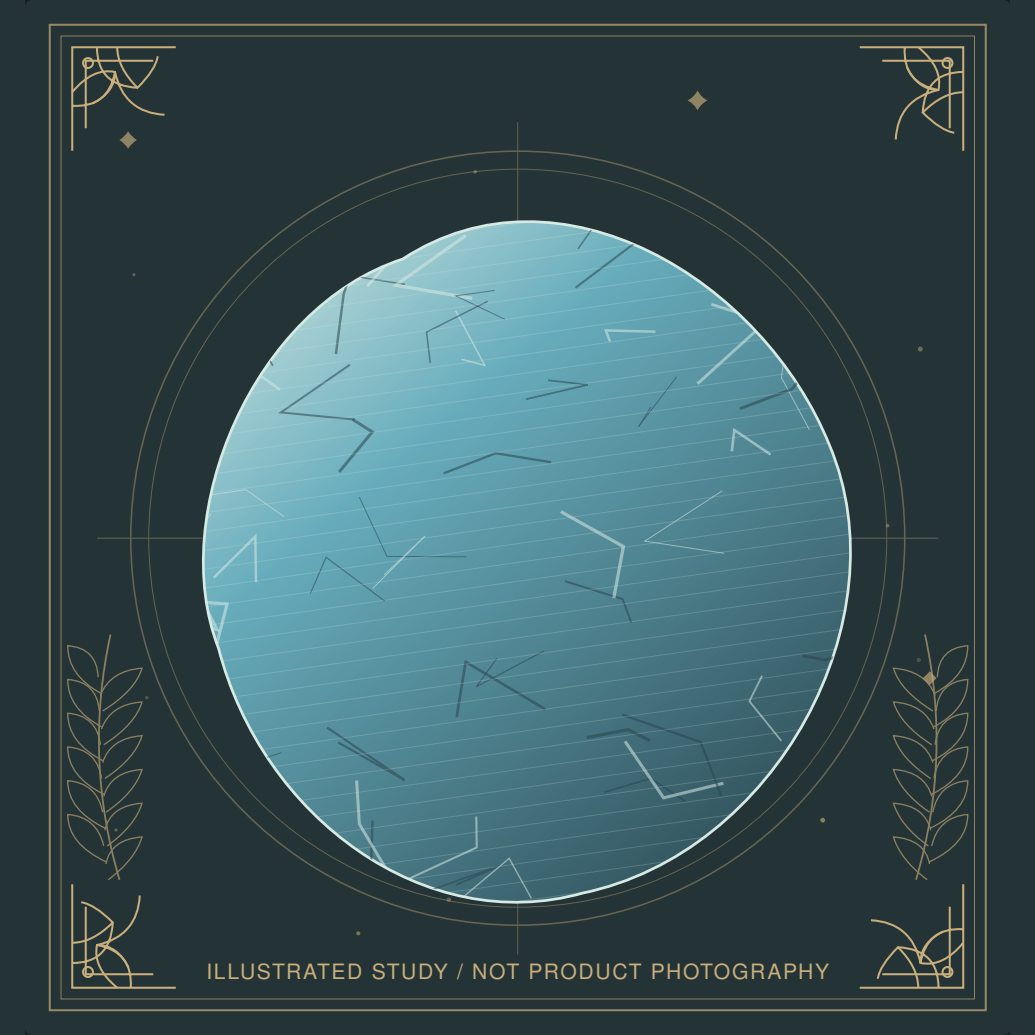
Meaning & tradition
Kynes: relationships. [3]
In this guide
Visual identity & plain-language name
Larimar is trade language for blue pectolite material from the Dominican Republic, not a separate mineral species. White, blue and sometimes green areas make a cloudlike polished pattern. The product can include associated phases, so a whole carving should not be assumed chemically pure pectolite. [2][4]
Earth story: formation, structure & color
Pectolite is NaCa2Si3O8(OH), a triclinic silicate; the Handbook gives hardness 4.5–5. Modern research on Dominican material examines mineral-bearing fluids and growth in altered basalt. The 2024 study links changing colors and mineralization conditions with a specific geological setting, keeping formation hypotheses grounded in sample evidence. [2][4]
Larimar is the blue ornamental variety associated with pectolite, a sodium calcium silicate hydroxide, NaCa2Si3O8(OH). Pectolite's triclinic structure can form radiating fine fibers, while compact material produces familiar pale-blue and white patterns in cabochons. The parent mineral has a wider color and locality range than the Larimar variety. Blue color and a sea-like design therefore need a supported pectolite determination and an independently documented variety or source account. [2][4]
The Handbook records pectolite hardness 4.5–5, density about 2.84–2.90 and pronounced cleavage in two directions. Fine fibrous texture and compact aggregate structure affect behavior in addition to hardness. A smooth polished dome may conceal those mineral boundaries. The properties are distinct from dyed quartz or a ceramic substitute even when a comparison image looks persuasive. [2][4]
The 2024 geological study investigates Larimar formation in altered basalt of the Dominican Republic, with mineralizing waters involving a mixture of magmatic and meteoric contributions and comparatively low temperatures in the studied setting. This is a specific deposit model, not a recipe for all pectolite. Blue, green and white zones reflect complex formation and material differences, and exact color explanation should remain tied to analyses rather than an unsupported universal blue-equals-copper slogan. [2][4]
Varieties & look-alikes
Compare blue-white larimar, greener areas, more host-rich material and ordinary white-gray pectolite from other settings. Blue chalcedony, dyed crackled silica and ceramic imitations can resemble its pattern. GIA has documented a ceramic substitute; color and a familiar web pattern are insufficient authenticity criteria. [2][4]
- Blue larimar
- Blue ornamental pectolite has a variety identity requiring more than a color match. A rich blue field can be visually desirable without establishing origin or untreated status. The pectolite structure and suitable material properties support identification. Retain the documented source of a variety designation separately from the observed hue and pattern. [2][4]
- White-and-blue larimar
- White zones and paler patterns can contribute to the familiar decorative contrast. They do not automatically identify a different mineral or a universal growth sequence. Describe texture and color distribution before interpreting them. A polished piece may contain fractures or interventions, so pattern beauty and treatment assessment remain independent parts of its record. [2][4]
- Pectolite comparison
- Pectolite is the parent mineral and occurs in settings beyond the blue Dominican ornamental variety. Colorless, whitish, grayish and yellowish appearances are recorded in the Handbook. A pale fibrous specimen is not therefore a failed Larimar gem; it has its own mineral identity. Preserve species, appearance and locality without merging them into one prestige trade label. [2][4]
Human story: objects, names & cultural context
The modern trade history connects a named Dominican material with lapidary commerce. Published gemological studies made its properties and deposit accessible to collectors. An Atlantis narrative belongs to individually attributed modern lore, not the geological explanation of pectolite formation. [2][4]
The blue material's scientific and lapidary histories connect a regional occurrence with later mineralogical and gemological investigation. The pectolite name has its own older Greek-root account in the Handbook, referring to compactness, while Larimar serves a distinct commercial variety identity. A place-based variety reputation does not mean a blue-white imitation shares that history. Preserve a documented source, maker and material report for the individual cabochon rather than inventing an ancient island tradition from the visual resemblance to sea and clouds. [2][4]
Meaning & practice: attributed traditions
Sandra Kynes associates larimar with relationships in her 2018 framework. This is a contemporary correspondence. [3]
An editorial relationship practice can note one shared priority and one point of misunderstanding. The blue-white pattern can cue attention to both, without assigning communication or emotional effects to pectolite chemistry.
Material truth: trade names & treatments
Keep mineral identity, trade name and documented origin separate. GIA’s imitation work demonstrates the usefulness of microscopy and other gemological tests. A scratch or heat experiment on a finished piece is unnecessary damage. Ask about dye, resin and repairs and retain their disclosure with the object. [2][1]
GIA's imitation study identifies a ceramic product sold in comparison with Larimar, demonstrating that the sea-blue pattern does not authenticate pectolite. Other trade lookalikes can include colored silica material. Quench-crackled and dyed products need their actual substrate and treatment identified; a network of pale veins is not sufficient proof of natural fibrous pectolite. A report's conclusion should be preserved exactly, with source and treatment uncertainties kept separate from a secure species finding. [2][1]
Observe whether pale patterns sit within the material, cross the surface or correspond to grain boundaries and fractures. Keep the exact cause unresolved if it has not been examined. Blue intensity, translucency, cutting orientation and illumination all influence the photograph. Avoid scratch, heat or solvent experiments on finished jewelry; suitable gemological examination can answer more while preserving the piece. A concise honest label can state confirmed blue pectolite with documented Dominican provenance and retain any assessed treatment or repair alongside it.
Sources & related specimens
The Handbook explains pectolite; the 2024 research grounds local formation, and GIA documents an imitation example. Kynes supplies the modern meaning. Compare chalcedony and turquoise for similar colors with different identities.
- Imitation Larimar
Gemological Institute of America · Mineralogy, geology, naming and documented material history · Accessed October 9, 2026
- Handbook of Mineralogy: Pectolite
Mineralogical Society of America · Mineralogy, geology, naming and documented material history · Accessed October 9, 2026
- Sandra Kynes: 365 Days of Crystal Feng Shui for Your Home (2018)
Llewellyn Worldwide · Sandra Kynes’s contemporary crystal-placement and intention framework · Accessed October 9, 2026
- Origin of bluish pectolite aka larimar from the Dominican Republic: Constraints from mineralogy and geochemistry
Journal of South American Earth Sciences · Mineralogy, geology, naming and documented material history · Accessed October 9, 2026