
A waxen blue
Chalcedony
Microcrystalline/fibrous silica aggregate; includes many named gem varieties.
Patterned or colored microcrystalline silica aggregate
Chalcedony is a fine-grained silica aggregate, not one large visible quartz crystal. In narrower gem usage the name often denotes relatively even blue, white or gray material, while the wider family includes many patterned varieties such as agate and carnelian.
Geology · Human history · Attributed traditions
Explore the specimen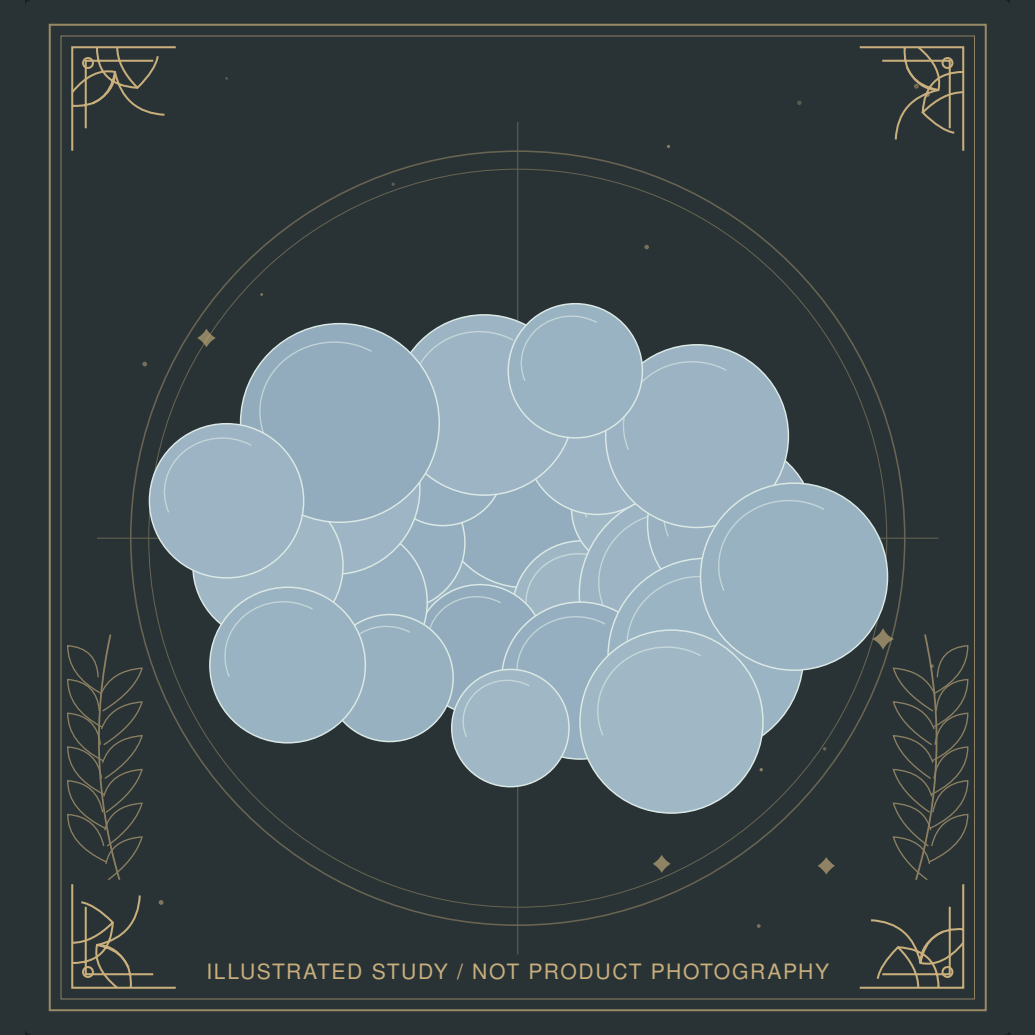
Material
Microcrystalline/fibrous silica aggregate; includes many named gem varieties. [1]
Family
Chalcedony and related silica [1]
Appearance
Soft internal clouding [1]
Traditions
The Crystal Council associates blue chalcedony with communication and gentle expression. [6]
In this guide
Visual identity
Chalcedony is a fine-grained silica aggregate, not one large visible quartz crystal. In narrower gem usage the name often denotes relatively even blue, white or gray material, while the wider family includes many patterned varieties such as agate and carnelian. [1]
Chalcedony is the broad host category beneath many familiar shop names. In more restricted gem usage, an unqualified chalcedony listing often refers to a comparatively even, translucent material rather than a strongly patterned agate or opaque jasper. Both usages are intelligible if the description supplies color, translucency and pattern. A softly lit blue cabochon and a red carnelian carving can belong to the same fine-grained silica family while remaining distinct varieties in the catalogue. [1][2]
Earth story: geology and formation
Its small crystallites and fibrous structures create a waxy appearance and variable translucency. The family contains many colors and inclusion textures. A botryoidal mass can resemble grapes without being a banded agate; a morphology name and a mineral identification are different descriptions. The name can be used broadly for a fine-grained silica family and more narrowly for relatively even-colored gem material. Making that usage explicit helps explain why agate and carnelian can be called chalcedony without erasing their visible distinctions. Some objects retain an inclusion or band pattern, while others emphasize soft uniform translucency. A family relationship is therefore a useful scientific connection, not a reason to treat all the commercial names as redundant. [1]
Fine-grained silica differs visually from a single clear quartz crystal: its tiny crystallites and inclusions scatter light and produce a waxy or softly glassy surface. The Australian Museum gives microcrystalline quartz a hardness around 6.5, refractive indices of approximately 1.530–1.539, and specific gravity around 2.57–2.64. These are reference ranges, not a certificate for every rock sold under a related trade name. Many fine-grained silica materials accept artificial color because their microstructure can admit a staining solution. The visible pattern, the aggregate structure and any treatment must therefore be considered together. A highly polished surface reveals contrast in a cut section; it does not show the complete shape in which the material originally formed. [1]
The small scale of the crystalline material helps explain the contrast with rock crystal. Large quartz can show individual prism faces and terminations, whereas chalcedony usually presents a continuous fine-grained field, rounded filling or layered surface. A crystalline quartz lining may occur beside chalcedony in the same object. Their coexistence records different textures of silica and should not lead to a claim that the entire piece is one crystal. A thin polished edge can reveal translucency concealed by a thicker body. [3][1]
Varieties and lookalikes
These names describe different levels of information: a mineral species, a visual variety, a crystal habit or a retail label. The distinctions below keep the recognizable shop vocabulary alongside its material explanation.
The variety vocabulary mixes composition-related color names, pattern names and optical names. Chrysoprase is a nickel-colored green category, carnelian is orange to red, onyx is associated with straight banding and jasper is generally opaque. Fire and iris agate concern different light effects. These categories organize what people see and trade; they are not all equivalent levels of classification. An encyclopedia can preserve the familiar terms while explaining why one stone may receive both a host name and a more specific descriptive variety name. [1][2][4]
- Blue chalcedony
- Even blue material can differ visually from the pale-and-white bands defining blue lace agate. Their family relationship does not erase this appearance distinction. [1]
- White and pink chalcedony
- Color descriptions retain the broad silica identity but need their own treatment information. A color alone cannot establish the source. [1]
- Grape agate comparison
- Grape agate or Manakarra is a trade name for grape-like quartz clusters from Sulawesi. Laurs and Rossman’s 2018 study identified quartz by Raman analysis and found radiating microcrystals coarser than ordinary cryptocrystalline chalcedony or agate. Purple material matched amethyst optically, while green material contained numerous inclusions. The familiar agate name therefore describes the market appearance rather than demonstrating banded chalcedony. The clusters belong in this comparison while their more precise quartz texture remains explicit. [8]
Human story: history and naming
The British Museum’s Iranian armband includes chalcedony beside carnelian in engraved amulets. The verses, workmanship and documented context convey the object’s meaning. The example shows why material chemistry alone cannot supply an object’s entire cultural identity. [5]
Idar-Oberstein provides a documented example of a craft tradition sustained by changing supply. GIA describes early use of local agate and later importation from Brazil as the German deposits became depleted. The continuity lies in the lapidary skill and workshop culture, not in every object being cut from the same regional stone. Modern carvers also work jasper and other fine-grained silica. This material history is more precise than assigning one spiritual meaning to all chalcedony across centuries. [4]
Meaning and practice: attributed traditions
The Crystal Council associates blue chalcedony with communication and gentle expression. This is a variety-specific contemporary account, not a universal property of every chalcedony color. The intention to listen and express oneself remains a human practice. [6]
An optional communication practice is to notice how much can be expressed by a small, quiet object and then choose one concise thought to share.
Material identity and trade terminology
Grape agate is a trade and morphology name also used for botryoidal quartz material. It does not prove agate-style bands. Artificial color and different fine-grained silica mixtures should be disclosed when known; the familiar family name is not a treatment certificate. [1]
The name alone does not communicate enhancement, geographic source or the exact reason for color. Useful descriptions combine the host identity with a recognized variety and any declared treatment. Artificially colored chalcedony differs from a glass imitation because the former retains its fine-grained silica host. Neither should be confused with a laboratory-grown single quartz crystal simply because all may be marketed through familiar quartz-family language. Reliable identification addresses the actual material structure as well as the visible color. [7][1]
Sources and related specimens
The references below distinguish mineral identification and physical properties from historical interpretation and practitioner symbolism. A cited material category describes a kind of stone; it does not certify the identity, treatment or provenance of an untested individual retail specimen.
- Quartz
Australian Museum · Geological, gemological or documented material-history evidence · Accessed October 9, 2026
- Natural Gemstones: Mineral Gemstones
US Geological Survey · Geological, gemological or documented material-history evidence · Accessed October 9, 2026
- Handbook of Mineralogy: Quartz
Mineralogical Society of America · Mineral composition, structure, physical properties and occurrence · Accessed October 9, 2026
- Gem Cutters Reveal the Beauty of Chalcedony
Gemological Institute of America · Geological, gemological or documented material-history evidence · Accessed October 9, 2026
- British Museum: Iranian wrestler’s armband
British Museum · Documented museum object, material and historical context · Accessed October 9, 2026
- The Crystal Council: Blue Chalcedony
The Crystal Council · Contemporary practitioner symbolism and retailer terminology; distinct from mineralogical evidence · Accessed October 9, 2026
- GIA: An Introduction to Gem Treatments
Gemological Institute of America · Geological, gemological or documented material-history evidence · Accessed October 9, 2026
- Grape-like Manakarra quartz from Sulawesi, Indonesia (2018)
The Gemmological Association of Great Britain · Geological, gemological or documented material-history evidence · Accessed October 9, 2026