
The apple green field
Chrysoprase
Nickel-colored green chalcedony.
Patterned or colored microcrystalline silica aggregate
Chrysoprase is green chalcedony, valued for apple-green color and gentle translucency. It lacks aventurine’s conspicuous scattered glitter and is not jade simply because it is green. An even surface and a mottled interior can share the same broad material identity.
Geology · Human history · Attributed traditions
Explore the specimen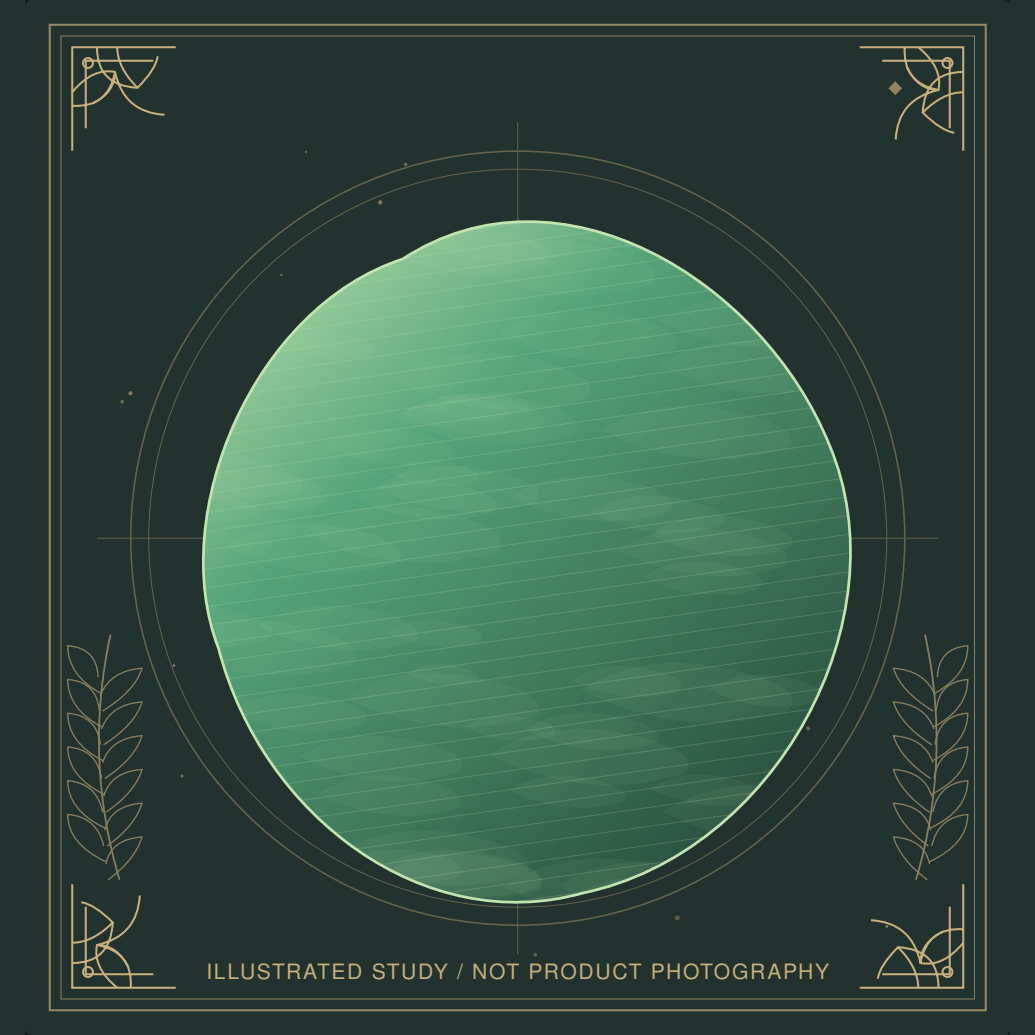
Traditions
Sandra Kynes’s 2018 correspondences include chrysoprase in abundance-oriented practice. [7]
In this guide
Visual identity
Chrysoprase is green chalcedony, valued for apple-green color and gentle translucency. It lacks aventurine’s conspicuous scattered glitter and is not jade simply because it is green. An even surface and a mottled interior can share the same broad material identity. [1][2]
A chrysoprase specimen can range from comparatively translucent to clouded, and pale to more saturated green. White or brown areas may retain a useful record of how the decorative portion sits with less vividly colored material. A uniform apple-green cabochon is a selected and polished portion of rough, rather than a model of an entire deposit. Its waxy-looking surface belongs to the familiar chalcedony appearance; it should not be mistaken for the cleavage faces of a transparent green single crystal. [1][2]
Earth story: geology and formation
GIA’s study of Marlborough Creek deposits relates chrysoprase to nickel-bearing geological environments and fine-grained silica. Analyses associated stronger green with nickel content. This is a specific research account, not permission to identify every green inclusion visually or to classify a different green rock as chrysoprase. The GIA Marlborough Creek study examined silica veins in an altered nickel-bearing geological environment. Its sample observations and chemical results concern that studied material. They do not establish that every chrysoprase deposit has an identical vein geometry or that every green stone from Australia is chrysoprase. The connection between host silica and nickel-bearing components explains the category while preserving the need for analysis of an individual inclusion or unusual retail comparison. [1][2]
Fine-grained silica differs visually from a single clear quartz crystal: its tiny crystallites and inclusions scatter light and produce a waxy or softly glassy surface. The Australian Museum gives microcrystalline quartz a hardness around 6.5, refractive indices of approximately 1.530–1.539, and specific gravity around 2.57–2.64. These are reference ranges, not a certificate for every rock sold under a related trade name. Many fine-grained silica materials accept artificial color because their microstructure can admit a staining solution. The visible pattern, the aggregate structure and any treatment must therefore be considered together. A highly polished surface reveals contrast in a cut section; it does not show the complete shape in which the material originally formed. [1]
GIA’s 1965 study of Australian material connects chrysoprase with weathering in a nickel-bearing geological setting. The green silica and its associated host alteration belong to a linked process, rather than green quartz appearing without surrounding geology. The study also compared color with nickel content in analyzed samples. That relationship supports nickel as a meaningful part of the coloration account, but it does not mean a collector can read an exact nickel concentration from a photograph or apply one sample’s measurements to every deposit. [2]
Varieties and lookalikes
These names describe different levels of information: a mineral species, a visual variety, a crystal habit or a retail label. The distinctions below keep the recognizable shop vocabulary alongside its material explanation.
Green jade, serpentine and chrysoprase can all appear in similar carved objects while representing different materials. Jadeite is a pyroxene and nephrite is an amphibole aggregate; serpentine names refer to a separate mineral group and its related rocks. Chrysoprase belongs to fine-grained silica. Color is therefore the beginning of a comparison, not its conclusion. A seller’s green-stone label becomes more useful when it names the actual material and does not treat the word jade as a universal term for attractive green carving stone. [1][3][4][5]
Human story: history and naming
Vapriikki recounts a chrysoprase amulet story attributed to the thirteenth-century scholar Albertus Magnus concerning Alexander the Great. The attribution makes it medieval reported lore, not independently verified ownership by Alexander. Historical naming and a later legend should retain their different evidential weight. [6]
The medieval amulet account reported by Vapriikki links a celebrated ruler to a valued green stone, but the distance between the attributed writer and Alexander matters. It documents the circulation of a story, not an excavated object with a secure ownership record. The mineral’s more readily supported history includes naming, collecting and the study of Australian deposits. These are substantial human relationships with the material even where a modern shop’s claims of universal ancient abundance symbolism have no equally specific record. [6][2]
Meaning and practice: attributed traditions
Sandra Kynes’s 2018 correspondences include chrysoprase in abundance-oriented practice. Her home-focused article is a contemporary spiritual source, not a chemical account of nickel. An intention to appreciate resources can be meaningful without predicting wealth. [7]
An optional abundance reflection is to describe something already available before naming something desired. The stone can supply a visual reminder of that distinction.
Kynes writes about using correspondences within the home, so abundance is presented as an intended meaning in a chosen practice. The association is not a statement about a deposit yielding profit or a guarantee about the owner’s finances. A contemporary reflective use might center attention on generosity or the thoughtful use of resources. Naming the practitioner and the setting of her article keeps that interpretation precise, while allowing the green material’s coloration, texture and geological identity to remain independently described. [7]
Material identity and trade terminology
Lemon chrysoprase is often applied in commerce to a different nickel-bearing material, so the name must not silently inherit chalcedony identity. Dyed green silica and other green carving stones need separate disclosure. Color, confirmed host and any known treatment belong in an accurate caption. [1][2]
Sources and related specimens
The references below distinguish mineral identification and physical properties from historical interpretation and practitioner symbolism. A cited material category describes a kind of stone; it does not certify the identity, treatment or provenance of an untested individual retail specimen.
- Quartz
Australian Museum · Geological, gemological or documented material-history evidence · Accessed October 9, 2026
- Marlborough Creek Chrysoprase Deposits, Fall 1965
Gemological Institute of America · Geological, gemological or documented material-history evidence · Accessed October 9, 2026
- Handbook of Mineralogy: Jadeite
Mineralogical Society of America · Mineral composition, structure, physical properties and occurrence · Accessed October 9, 2026
- Handbook of Mineralogy: Tremolite
Mineralogical Society of America · Mineral composition, structure, physical properties and occurrence · Accessed October 9, 2026
- Handbook of Mineralogy: Lizardite
Mineralogical Society of America · Mineral composition, structure, physical properties and occurrence · Accessed October 9, 2026
- Chalcedonies
Vapriikki Mineral Museum · Geological, gemological or documented material-history evidence · Accessed October 9, 2026
- Sandra Kynes: 365 Days of Crystal Feng Shui for Your Home (2018)
Llewellyn Worldwide · Contemporary practitioner symbolism and retailer terminology; distinct from mineralogical evidence · Accessed October 9, 2026