
A glint in green
Aventurine
Aventurescent quartz-rich material with reflective inclusions.
Aventurescent quartz-rich aggregate
Aventurine is a quartz-rich material with reflective inclusions producing scattered glitter. Green is familiar, but red, orange, blue and yellow retail materials also occur. Its small glints differ from the broad colored flash of some feldspars and the single moving band of tiger’s eye.
Geology · Human history · Attributed traditions
Explore the specimen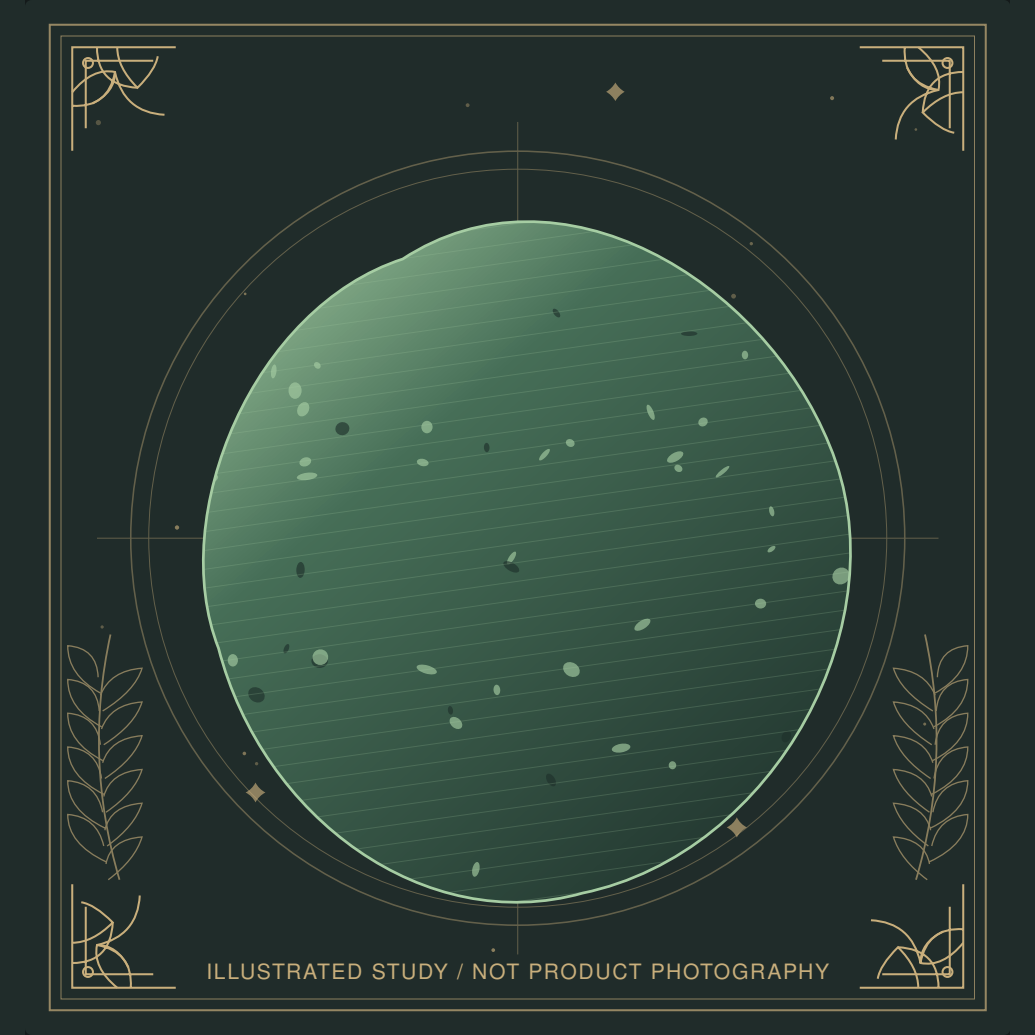
Traditions
Margaret Ann Lembo’s 2013 chart includes green aventurine among heart-related stones associated with compassion, acceptance, abundance and prosperity. [6]
In this guide
Visual identity
Aventurine is a quartz-rich material with reflective inclusions producing scattered glitter. Green is familiar, but red, orange, blue and yellow retail materials also occur. Its small glints differ from the broad colored flash of some feldspars and the single moving band of tiger’s eye. [1][2]
The individual glints can appear and disappear as light meets reflective particles at different orientations. A smooth green field seen in one photograph may sparkle conspicuously in another view. This does not necessarily mean its color was changed between images; illumination can make the inclusions more apparent. The useful description separates the body color from the reflective event and records whether the object is rough, cut or polished. A glassy surface produced by polishing should not be mistaken for proof that the underlying material itself is glass. [2]
Earth story: geology and formation
The Australian Museum describes mica-colored green quartz, while GIA explains reflective inclusions and aventurescence. The host and reflective phase both contribute to appearance. A polished surface reveals the glitter; the fine-grained aggregate does not possess the large exposed faces of rock crystal. [1][2]
Aventurine is a quartz-rich aggregate rather than one transparent rock-crystal prism. The host mineral quartz has SiO₂ composition and hardness 7, but mica and other components can affect the properties of an actual aggregate. GIA treats aventurescence as reflection from included particles, not proof that every sparkling stone shares the same host. A natural quartz-rich specimen, inclusion-bearing feldspar sunstone and manufactured goldstone consequently need separate identities. The polished surface reveals glints and color while often concealing the original rock texture. Reference quartz values describe the host mineral; they should not be presented as a laboratory measurement of an unidentified retail tumble. [3][2][4]
GIA’s optical review treats aventurescence as one of several inclusion-related phenomena. A scattered population of reflective particles differs from the aligned fibrous arrangement behind a moving tiger’s-eye band. It also differs from feldspar layers that produce broad iridescence. These distinctions are structural even where all three effects become vivid under a directed light. A comparison can therefore begin by asking whether the observed event is scattered glitter, a silky moving band or a broad flash, before selecting a mineralogical explanation. [2]
Varieties and lookalikes
These names describe different levels of information: a mineral species, a visual variety, a crystal habit or a retail label. The distinctions below keep the recognizable shop vocabulary alongside its material explanation.
The green color and glitter should not be treated as one inseparable property. A quartz-rich aggregate can contain components that color it, components that reflect light, or components doing both. Identifying the reflective phase requires appropriate evidence. A red, blue or yellow commercial label similarly records appearance rather than all the components in the aggregate. This is why a variety gallery can preserve familiar colors without supplying a made-up formula for every retail name. [1][2]
- Green aventurine
- Commonly associated with reflective mica. Its glints and opacity differ from transparent prasiolite and finely interlocked jade. [1][2]
- Red/orange aventurine
- These are color descriptions for inclusion-bearing material. The reflective phase should be identified when evidence permits, rather than inferred from a red surface. [1][2]
Human story: history and naming
Vapriikki’s mineral museum records aventurine deposits in Finnish Lapland in its account of fine-grained silica materials. That occurrence offers a real geographic context, not a universal provenance. The place where a material grew, the place it was cut and the place it was sold can all differ. [5]
Meaning and practice: attributed traditions
Margaret Ann Lembo’s 2013 chart includes green aventurine among heart-related stones associated with compassion, acceptance, abundance and prosperity. This is her contemporary color-based framework. It applies to the green material named in the chart, rather than establishing identical meanings for every red or blue trade variety. [6]
An optional abundance reflection is to notice a resource already present, such as a skill or friendship. The scattered glints can be a chosen reminder rather than a prediction of wealth.
Lembo’s green-stone grouping places several different materials in one heart-related symbolic lane. Their shared role in the chart is chosen by a practitioner; it does not make jade, green calcite and green aventurine one mineral family. That distinction allows a reader to compare the spiritual system alongside the materials. The person may choose one particular green specimen as a reminder of kindness or appreciation while keeping its identity, inclusions and treatment history accurately described. [6]
Material identity and trade terminology
Aventurine quartz and goldstone are different: goldstone is manufactured glittering glass. Prasiolite is also green quartz but differs in appearance and color history. The inclusion identity and any coloring treatment belong to the actual specimen, not to a generalized cheerful-green image. Aventurescence describes a reflective effect rather than a single chemical formula. Sunstone can show reflective inclusions in feldspar and goldstone can show glittering particles in manufactured glass; these materials do not become aventurine quartz because their surfaces sparkle. A description that records the host first and then the reflective feature is clearer than using one visual word for all three. The individual inclusion chemistry can remain unspecified where it has not been tested. [1][2]
GIA’s sunstone-imitation discussion distinguishes manufactured goldstone from naturally occurring reflective feldspar. The same comparison is useful beside aventurine quartz: a visual resemblance is not an identity. A product may be attractive precisely because it is a carefully made glass, but that should be stated rather than borrowed from the natural-material catalogue. The host identity also prevents an erroneous transfer of hardness, density or geology from quartz-rich aventurine to every glittering object sold next to it. [4][3]
Sources and related specimens
The references below distinguish mineral identification and physical properties from historical interpretation and practitioner symbolism. A cited material category describes a kind of stone; it does not certify the identity, treatment or provenance of an untested individual retail specimen.
- Quartz
Australian Museum · Geological, gemological or documented material-history evidence · Accessed October 9, 2026
- GIA: Optical Effects in Phenomenal Gemstones
Gemological Institute of America · Geological, gemological or documented material-history evidence · Accessed October 9, 2026
- Handbook of Mineralogy: Quartz
Mineralogical Society of America · Mineral composition, structure, physical properties and occurrence · Accessed October 9, 2026
- GIA: Are there sunstone imitations?
Gemological Institute of America · Geological, gemological or documented material-history evidence · Accessed October 9, 2026
- Chalcedonies
Vapriikki Mineral Museum · Geological, gemological or documented material-history evidence · Accessed October 9, 2026
- Margaret Ann Lembo: Colors, Enlivening the Rainbow Body (2013)
Llewellyn Worldwide · Contemporary practitioner symbolism and retailer terminology; distinct from mineralogical evidence · Accessed October 9, 2026