
A landscape enclosed
Included Quartz
Quartz containing other minerals or visible growth features.
Quartz with mineral or fluid inclusions and growth textures
Included quartz is a comparison category for quartz containing visible minerals, fluids or growth features. Gold needles, black rods and green gardens are not one inclusion species. The host provides a window, but naming what appears inside requires more than recognizing an evocative pattern.
Geology · Human history · Attributed traditions
Explore the specimen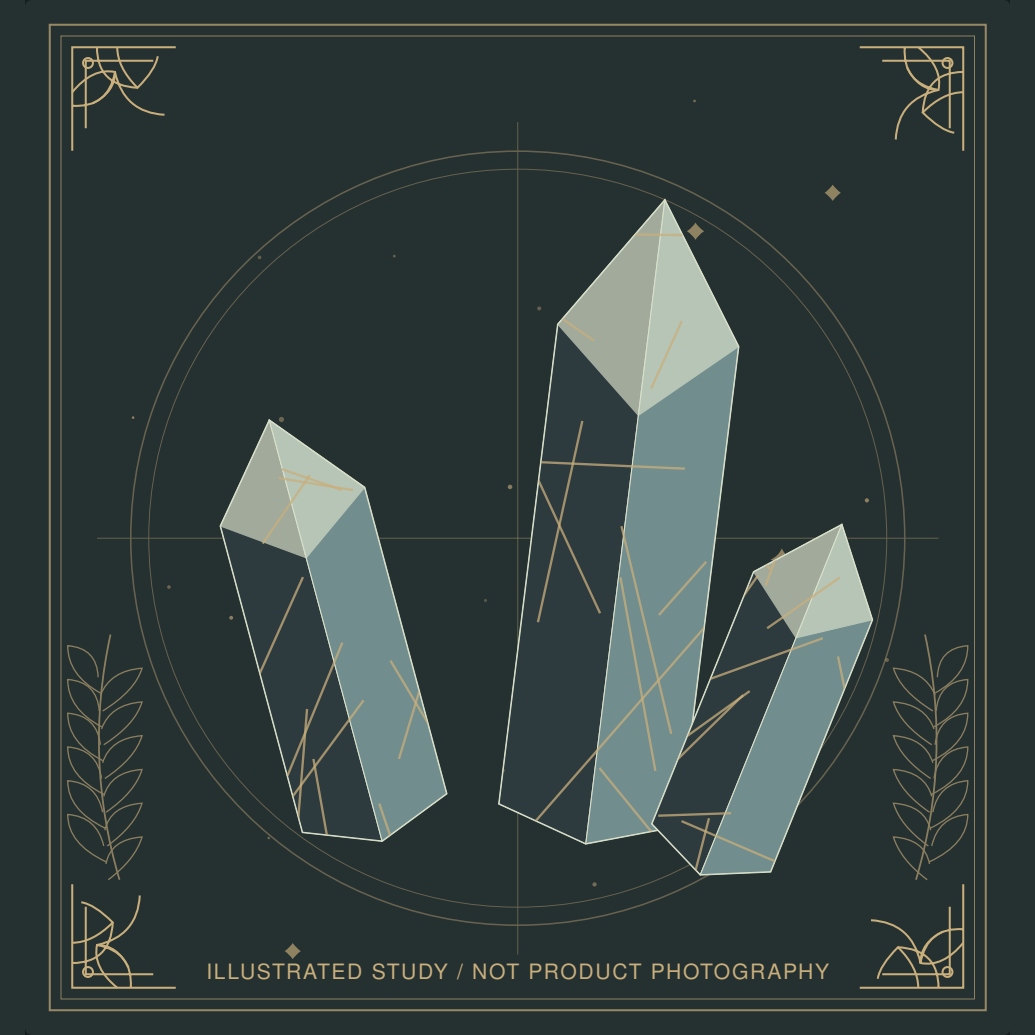
Traditions
The Crystal Council attributes grounding and expanded-awareness symbolism to tourmalinated quartz specifically. [4]
In this guide
Visual identity
Included quartz is a comparison category for quartz containing visible minerals, fluids or growth features. Gold needles, black rods and green gardens are not one inclusion species. The host provides a window, but naming what appears inside requires more than recognizing an evocative pattern. [1][2][3]
Included quartz is best described at two scales. At the larger scale, the host can be a prism, cluster, polished window or curved carving. At the smaller scale, an inclusion can be a needle, flake, cloud, cavity or outline of an earlier growth. The host’s form and the inclusion’s form do not identify the same thing. This distinction prevents a caption from naming every golden streak rutile or every dark rod tourmaline merely because those are familiar commercial categories. [1][3]
Earth story: geology and formation
GIA explains that inclusions can predate, accompany or follow the growth of a host crystal. Mineral crystals, trapped fluids and partly healed fractures preserve different kinds of information. Rutile is titanium dioxide and tourmaline is a borosilicate family. A needle is an observed shape; its mineral identity needs appropriate testing. The relative position of an inclusion and its host matters. A complete earlier crystal can be enclosed as quartz grows around it; a growth interruption may create a phantom outline; a fracture can later heal partly and preserve a fluid-bearing trail. GIA’s inclusion research uses such relationships to interpret sequence and origin. An attractive needle pattern can therefore be both an aesthetic subject and geological evidence, but the exact sequence is not established merely by an expressive retail name. [1][2][3]
Quartz has the composition SiO₂, a glassy luster on crystal faces, and Mohs hardness 7. Its density is about 2.65 grams per cubic centimetre. It generally breaks along curved, shell-like surfaces rather than opening into the regular cleavage plates characteristic of feldspar. The familiar six-sided prism expresses its crystal symmetry; some growths are distorted, intergrown or entirely massive. Hardness describes resistance to scratching, so even a hard quartz crystal can chip at a sharp tip or split along an existing fracture. Quartz occurs in granite and pegmatite, mineral veins, sandstone and quartzite, and survives as a widespread component of soils and sediments. The same mineral identity can therefore accompany very different shapes, colors and geological histories. [1]
GIA’s inclusion research distinguishes information about formation from information about subsequent alteration. A host crystal can enclose material that was already present, and later processes can create or modify fractures and inclusions. Microscopy can establish spatial relationships that are invisible in a promotional photograph. A transparent polished face may supply a useful viewing window, yet the observer still needs appropriate analytical evidence for exact species names. The study of inclusions therefore joins observation, geometry and testing rather than relying on a poetic retail description. [3]
Varieties and lookalikes
These names describe different levels of information: a mineral species, a visual variety, a crystal habit or a retail label. The distinctions below keep the recognizable shop vocabulary alongside its material explanation.
Rutile is TiO₂ and should not be confused with every red or gold included phase. The Handbook records its own crystal structure and physical properties, independent of the quartz that may enclose it. In a named rutilated quartz, the caption describes a composite specimen: one mineral acts as the host and another is included. That host–inclusion relationship does not make a third mineral species. The same principle applies to quartz containing a separately confirmed tourmaline crystal. [2][1]
- Rutilated and tourmalinated quartz
- Rutile needles and tourmaline crystals are distinct inclusions. Gold or black color is suggestive, but a photograph alone cannot reliably determine species. [1][2][3]
- Chlorite/garden quartz and lodolite
- A landscape-like interior is a visual description. Identifying its green minerals is a separate analytical question. [1][2][3]
- Hematite, golden healer and tangerine quartz
- Hematite quartz makes a mineral-component claim that needs identification of the iron oxide. Tangerine and golden healer are descriptive commercial labels that may emphasize warm coloration or an iron-rich coating. A warm color alone does not establish which oxide or hydroxide is present, nor whether it lies inside the host or on a surface. The quartz identity and any analyzed color-bearing material can be stated separately without creating new mineral species from the retailer’s chosen phrase. [1][3]
- Strawberry quartz
- Natural included quartz and imitation glass can use similar retail names. The name does not itself establish growth origin or an inclusion species. [1][2][3]
- Phantom, enhydro and Super Seven
- A phantom is a visible internal outline of an earlier growth stage, whereas enhydro quartz is a trade description for fluid-bearing cavities, sometimes with a moving gas bubble. GIA’s 2025 amethyst report distinguishes that usage from water-bearing chalcedony nodules. Super Seven instead presents a commercial combination claim: its named inclusions should be individually established rather than assumed from the label. Growth-stage outlines, enclosed fluids and an asserted multi-mineral inventory are different kinds of information. [3][5]
Human story: history and naming
GIA highlights Henry Clifton Sorby’s 1858 work on microscopic crystal structure in the development of petrography. This history of looking inside stones provides a substantial human story. An aesthetic landscape and a scientific record can occupy the same interior without turning every included quartz into an ancient sacred object. [3]
Meaning and practice: attributed traditions
The Crystal Council attributes grounding and expanded-awareness symbolism to tourmalinated quartz specifically. The meaning belongs to that named combination in contemporary practice. Rutile, chlorite-like gardens, hematite and fluid-bearing varieties do not automatically inherit the same correspondence because they share a quartz host. [4]
Drawing one inclusion and recording its visible shape can be an attention practice. Leaving an unidentified component unnamed is more informative than adopting an unsupported mineral label.
The Crystal Council’s tourmalinated-quartz interpretation joins themes it associates with quartz and tourmaline. That combination is a practitioner’s symbolic system, rather than an experiment demonstrating that two mineral components produce a new spiritual force. A person can still use the dark-on-clear contrast as a personal image of attention or boundaries. The attribution matters because it leaves other included quartz varieties open to different interpretations and keeps the scientific composite identity separate from a chosen reflective meaning. [4]
Material identity and trade terminology
Strawberry quartz, golden healer, lodolite and Super Seven are trade descriptions whose scope varies. A Super Seven label does not prove seven minerals are present. Surface coatings, trapped fluids, mineral inclusions and particles in imitation glass are different constructions. They should be described separately without destructive attempts to expose a fluid cavity. [1][2][3]
An imitation can reproduce an inclusion-like visual effect without reproducing the same geological structure. Glass may carry bubbles or particles, while natural quartz can also contain genuine fluid-bearing features. The presence of something rounded inside a transparent object is therefore not a complete origin test. Professional identification uses multiple observations together. A photo can record color, pattern and apparent position, but the description should avoid upgrading those observations into an unsupported guarantee of natural growth or a specific included mineral. [3]
Sources and related specimens
The references below distinguish mineral identification and physical properties from historical interpretation and practitioner symbolism. A cited material category describes a kind of stone; it does not certify the identity, treatment or provenance of an untested individual retail specimen.
- Handbook of Mineralogy: Quartz
Mineralogical Society of America · Mineral composition, structure, physical properties and occurrence · Accessed October 9, 2026
- Handbook of Mineralogy: Rutile
Mineralogical Society of America · Mineral composition, structure, physical properties and occurrence · Accessed October 9, 2026
- Inclusions in Gemstones
Gemological Institute of America · Geological, gemological or documented material-history evidence · Accessed October 9, 2026
- The Crystal Council: Tourmalinated Quartz
The Crystal Council · Contemporary practitioner symbolism and retailer terminology; distinct from mineralogical evidence · Accessed October 9, 2026
- Enhydro Amethyst from Morocco (2025)
Gemological Institute of America · Geological, gemological or documented material-history evidence · Accessed October 9, 2026