
The six sided prism
Clear Quartz
Quartz, crystalline silica (SiO2).
Colorless or milky crystalline quartz variety
Rock crystal is colorless, visibly crystalline quartz. A clear point may contain white clouds, internal cracks or mineral inclusions and still be quartz. Its transparent interior and outer growth faces tell different parts of its history. A smooth polished tower exposes the interior while replacing the natural surface with a manufactured shape.
Geology · Human history · Attributed traditions
Explore the specimen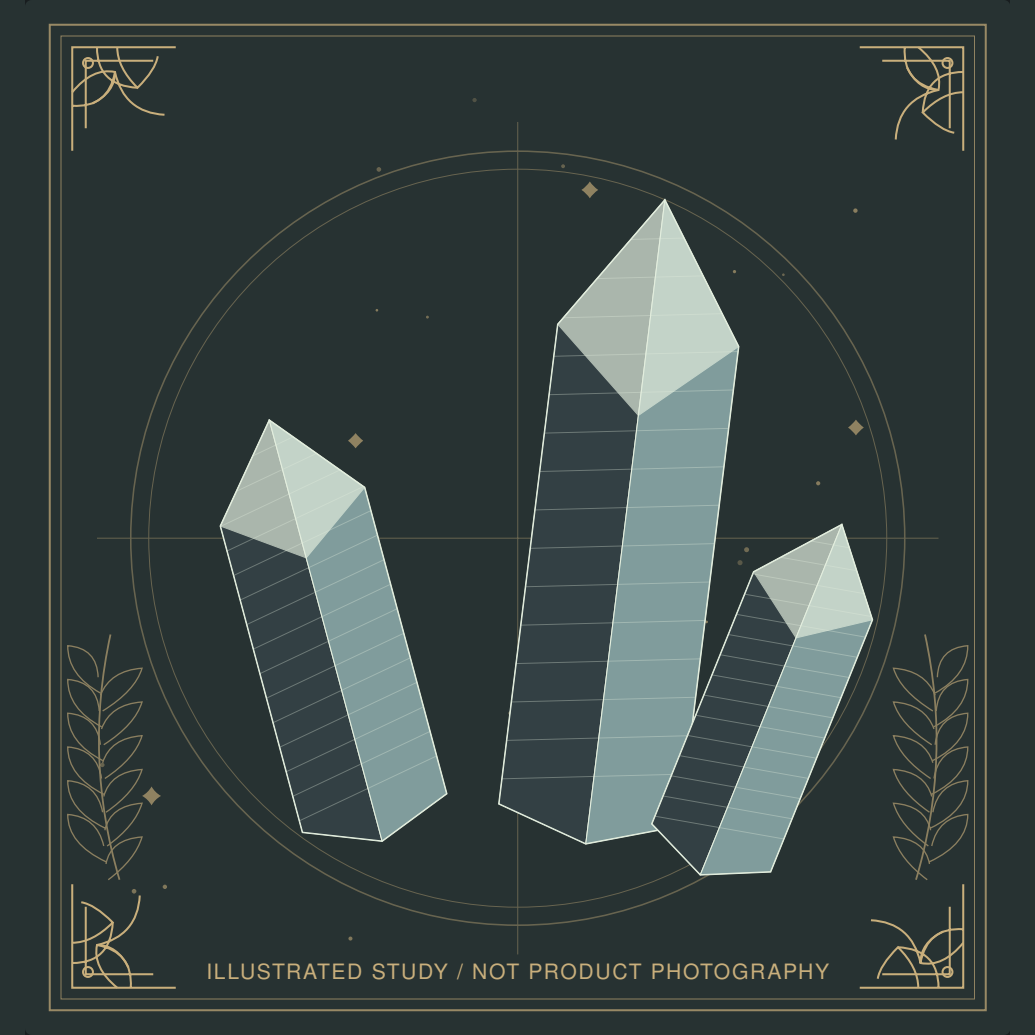
Material
Quartz, crystalline silica (SiO2). [1]
Family
Quartz family [1]
Appearance
Angular faces and fractures [1]
Traditions
In her 2024 Crystal Shopping List, Tudorbeth treats quartz as a versatile ritual material. [3]
In this guide
Visual identity
Rock crystal is colorless, visibly crystalline quartz. A clear point may contain white clouds, internal cracks or mineral inclusions and still be quartz. Its transparent interior and outer growth faces tell different parts of its history. A smooth polished tower exposes the interior while replacing the natural surface with a manufactured shape. [1]
Earth story: geology and formation
Open cavities permit crystals to develop faces, whereas a tightly filled vein can become an interlocking quartz mass. Six sides therefore describe a well-developed prism rather than every fragment. Growth boundaries, fractures and attached crystals are worth observing separately before a specimen is assigned a locality or trade variety. The Handbook records fine quartz from the European Alps, Brazil and the Ouachita Mountains of Arkansas among many other localities. Associated minerals include feldspar, mica, calcite and fluorite. These examples show the variety of host settings rather than a way to guess provenance from a clear crystal. An attached matrix may retain useful geological relationships, while a detached polished object can lose them. A cluster’s arrangement also records the available growth space, which is different from the arrangement chosen for a decorative display. [1]
Quartz has the composition SiO₂, a glassy luster on crystal faces, and Mohs hardness 7. Its density is about 2.65 grams per cubic centimetre. It generally breaks along curved, shell-like surfaces rather than opening into the regular cleavage plates characteristic of feldspar. The familiar six-sided prism expresses its crystal symmetry; some growths are distorted, intergrown or entirely massive. Hardness describes resistance to scratching, so even a hard quartz crystal can chip at a sharp tip or split along an existing fracture. Quartz occurs in granite and pegmatite, mineral veins, sandstone and quartzite, and survives as a widespread component of soils and sediments. The same mineral identity can therefore accompany very different shapes, colors and geological histories. [1]
The Handbook records piezoelectric and pyroelectric behavior in quartz. Piezoelectric means that mechanical stress and an electrical response are related in the crystal; pyroelectric refers to a response associated with temperature change. These are physical properties of a structured material, and explaining them does not require an aura or a universal ritual effect. A household crystal point also is not the same object as a carefully oriented and engineered quartz component. Material identity can link the two scientifically while their shape, preparation and use differ. [1]
Varieties and lookalikes
These names describe different levels of information: a mineral species, a visual variety, a crystal habit or a retail label. The distinctions below keep the recognizable shop vocabulary alongside its material explanation.
Quartz can be an individual crystal, a cluster or a massive aggregate. A large central point with smaller crystals attached and a flat surface covered in tiny crystals are different arrangements, even though both may be called crystal clusters in casual conversation. Natural faces can carry growth lines; a polished face instead records a cutter’s work. A comparison gallery should label that difference, because symmetry produced by a lapidary is not evidence that the original quartz grew into the finished object’s shape. [1]
- Rock crystal and milky quartz
- Rock crystal describes colorless transparent material; milky quartz has light-scattering features. Transparency distinguishes their appearance rather than establishing two species. [1]
- Points and double terminations
- A natural point preserves terminal growth faces. Two terminations describe growth at both ends; a lapidary-cut point is a different origin of shape. [1]
- Druzy and spirit/cactus quartz
- Druzy describes small crystals covering a surface. Spirit/cactus is retail habit language for smaller crystals around a central growth; neither label independently establishes composition or locality. [1]
- Herkimer and Lemurian names
- One is locality-associated and the other commonly carries a modern spiritual narrative. Both require more than an attractive photograph for claims beyond basic quartz identity. [1]
Human story: history and naming
The British Museum lists crystal ball SLCups.232 as associated with John Dee, but qualifies its material and possible seventeenth-century date and says that the association was made later. The record supports a history of collecting and interpretation, not proven ownership by Dee. A scrying object acquires its role through human use; transparency itself does not establish that role. [2]
The British Museum’s record includes the ball in Sir Hans Sloane’s collection, bequeathed in 1753. It preserves a catalogue description of a large crystal ball and separately records the later Dee association. Those separate strands make the object an instructive example of provenance: being in an old collection, being described as crystal and being attributed to a famous person are not one claim. A responsible retelling can preserve the object’s evocative history while retaining the museum’s uncertainty about material and date. [2]
Meaning and practice: attributed traditions
In her 2024 Crystal Shopping List, Tudorbeth treats quartz as a versatile ritual material. This is contemporary practitioner framing. Clarity and a chosen intention can function as personal symbolism, while the article’s wider healing assertions do not establish measured effects. A sphere, point and tumble can occupy different visual roles without becoming different mineral species. [3]
For an optional reflection, describe one inclusion before assigning a meaning to it. Observing first allows personal symbolism to remain distinct from identification.
A practitioner’s all-purpose description concerns how the material is selected within a ritual system. It does not make every quartz variety spiritually interchangeable: the same author or another practitioner may assign a different role to smoky, purple or pink material. Keeping the specific attribution allows a reader to explore that system without mistaking it for a consensus of all cultures. A personal quartz intention can be simple and explicit, such as remembering a chosen task, rather than requiring an unverified story about the crystal’s distant origin. [3]
Material identity and trade terminology
Herkimer diamond is quartz, not diamond, and two terminations do not prove Herkimer provenance. Lemurian is a trade and spiritual-story label, not evidence of an ancient civilization. A smooth symmetrical tower may have been carved from massive quartz. The meaningful description distinguishes mineral identity, natural growth form, worked shape and documented origin. [1]
Aura-coated quartz retains quartz as its host while an applied thin film produces a new surface appearance. GIA’s 1996 report documented aqua-aura’s gold coating and other coatings that imitated colors of familiar quartz varieties. Those examples demonstrate why a natural crystal outline or quartz refractive index does not establish natural color. Dyed or crackle quartz adds a different process: induced fractures can admit dye into the material. GIA’s 2025 treatment note explicitly records the wider use of quench-crackle and dye on quartz. These are treated comparisons, not newly discovered quartz species. [4][5]
Sources and related specimens
The references below distinguish mineral identification and physical properties from historical interpretation and practitioner symbolism. A cited material category describes a kind of stone; it does not certify the identity, treatment or provenance of an untested individual retail specimen.
- Handbook of Mineralogy: Quartz
Mineralogical Society of America · Mineral composition, structure, physical properties and occurrence · Accessed October 9, 2026
- British Museum: Crystal ball SLCups.232
British Museum · Documented museum object, material and historical context · Accessed October 9, 2026
- Tudorbeth: A Crystal Shopping List (2024)
Llewellyn Worldwide · Contemporary practitioner symbolism and retailer terminology; distinct from mineralogical evidence · Accessed October 9, 2026
- Gems & Gemology Fall 1996: Coated Quartz
Gemological Institute of America · Geological, gemological or documented material-history evidence · Accessed October 9, 2026
- Quench-Crackled and Dyed Laboratory-Grown Sapphire (2025)
Gemological Institute of America · Geological, gemological or documented material-history evidence · Accessed October 9, 2026