
The smoke within
Smoky Quartz
Brown to near-black quartz.
Quartz color variety
Smoky quartz ranges from a gray-brown veil to almost black. A thin edge may transmit light even when the centre looks opaque. Morion is an established name for very dark material. The smoky color is within the quartz, distinct from an iron-colored surface coating.
Geology · Human history · Attributed traditions
Explore the specimen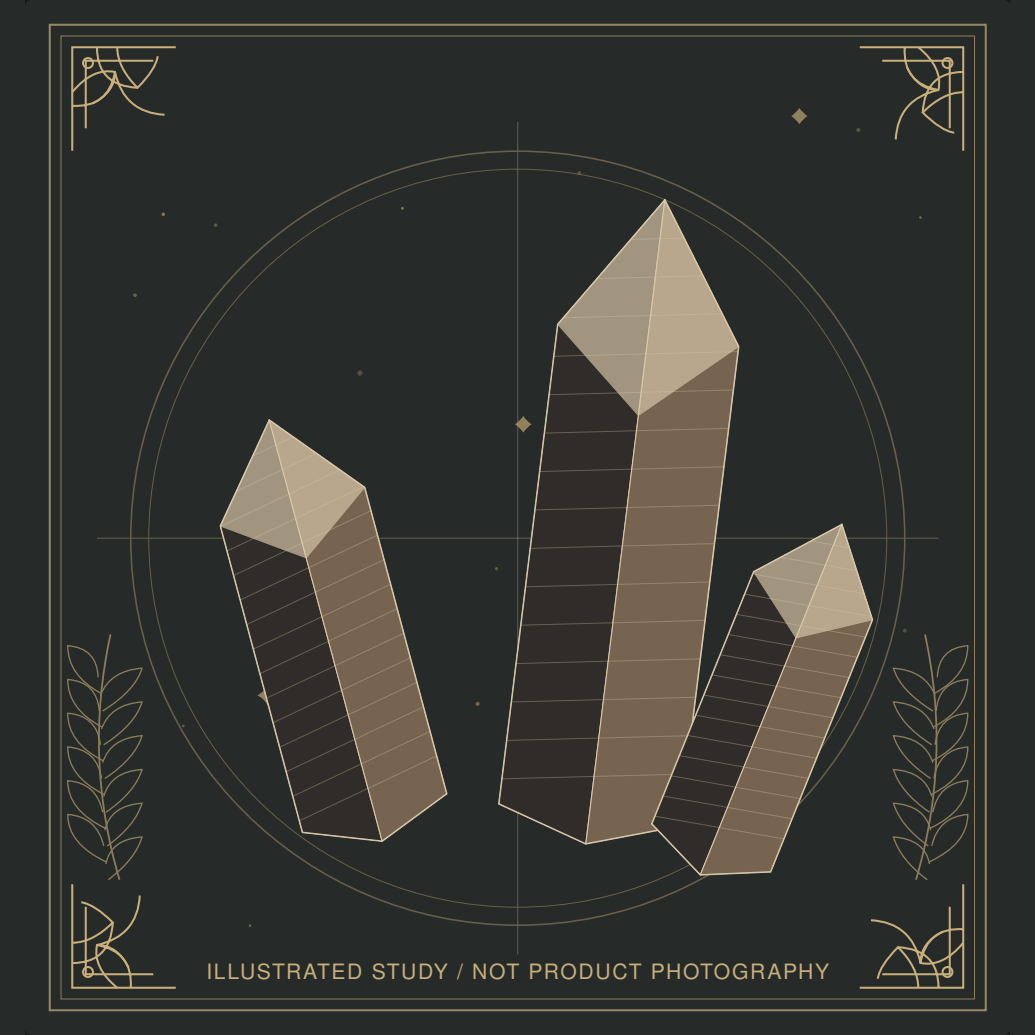
Traditions
The Crystal Council presents smoky quartz through grounding, determination and focus. [5]
In this guide
Visual identity
Smoky quartz ranges from a gray-brown veil to almost black. A thin edge may transmit light even when the centre looks opaque. Morion is an established name for very dark material. The smoky color is within the quartz, distinct from an iron-colored surface coating. [1][2]
A smoky point may show a nearly colorless tip, darker base or uneven internal shade. Thickness and zoning can both influence the view. A broken fragment displays curved fracture surfaces where a naturally grown crystal displays faces. These are separate observations: describing a piece as morion records its very dark appearance, while describing it as a natural point concerns preserved growth. Neither term supplies a laboratory conclusion about irradiation history. [1][3]
Earth story: geology and formation
GIA explains smoky color through irradiation acting on aluminium-related defects in quartz. Natural radiation over geological time and laboratory irradiation can both create it. Aluminium alone is not sufficient. Darkness therefore cannot prove that color formed naturally, and a pale piece is not necessarily less authentic. The difference between natural and laboratory irradiation concerns when and where the color centres developed, rather than a second chemical species. A darker centre and lighter edge can also reflect how far light travels through a specimen. Viewing a thin edge is useful for describing transparency, but it cannot settle the radiation history. A smoky crystal with a natural termination and a polished dark sphere preserve different evidence about original habit, even if their apparent colors are similar. [1][2]
Quartz has the composition SiO₂, a glassy luster on crystal faces, and Mohs hardness 7. Its density is about 2.65 grams per cubic centimetre. It generally breaks along curved, shell-like surfaces rather than opening into the regular cleavage plates characteristic of feldspar. The familiar six-sided prism expresses its crystal symmetry; some growths are distorted, intergrown or entirely massive. Hardness describes resistance to scratching, so even a hard quartz crystal can chip at a sharp tip or split along an existing fracture. Quartz occurs in granite and pegmatite, mineral veins, sandstone and quartzite, and survives as a widespread component of soils and sediments. The same mineral identity can therefore accompany very different shapes, colors and geological histories. [1]
GIA’s irradiation discussion explains that trace aluminium occupying part of the quartz structure is involved in the creation of smoky color. The color depends on structural defects affected by radiation, not simply on loose dark particles mixed into the crystal. Heating can affect such color centres, but a compendium description is not a treatment recipe. The scientific account helps distinguish internally smoky quartz from coated quartz and from a glass object chosen to imitate its brown transparency. [2]
The visible darkness and the shape of a crystal answer different geological questions. Irradiation-related color concerns defects and trace constituents in the quartz structure, whereas natural faces reflect the space and conditions available during growth. A smoky massive fragment can have the same color mechanism as a pointed specimen without ever showing a complete free-growing prism. Subsequent heating or other changes can alter a color-center record, which is why mineral identity alone does not determine whether the present shade is entirely natural. [2][1][4]
Varieties and lookalikes
These names describe different levels of information: a mineral species, a visual variety, a crystal habit or a retail label. The distinctions below keep the recognizable shop vocabulary alongside its material explanation.
The USGS uses cairngorm beside smoky quartz in its variety vocabulary. Such historic or regional naming can be useful when reading an old collection label, but it is not proof that a modern piece came from the associated place. A current specimen can be described by the material and visible shade while its source remains unknown. This is more precise than assigning the best-known locality to every brown transparent quartz. [3]
Human story: history and naming
The US Geological Survey lists smoky quartz or cairngorm and black morion among coarsely crystalline silica varieties. These names record appearance and sometimes place-associated language. They do not establish one universal historical ritual. A dated collection label offers a more specific human story than a claim of unnamed ancient use. [3]
Meaning and practice: attributed traditions
The Crystal Council presents smoky quartz through grounding, determination and focus. This is contemporary practitioner interpretation. Grounding here describes a symbolic intention to attend to the present, not a measured release of harmful energy. Its brown color has a physical explanation independent of the meaning a practitioner assigns. [5]
A personal focus exercise can use the transition from dark centre to clear edge as a cue to separate what is known from what still needs attention.
In The Crystal Council’s interpretation, the material’s symbolism centres on steadiness and directed attention. That is the publisher’s current practice rather than a property inferred from aluminium defects. The dark-to-clear visual transition can make the intention tangible to an individual, yet another practitioner may use different correspondence language. Keeping the attribution allows those interpretations to be compared without requiring that geology validate one of them. [5]
Material identity and trade terminology
Natural and laboratory irradiation can produce smoky color. Darkness, a quartz point or a locality-like sales name cannot establish natural color or provenance. Glass can imitate the appearance of polished smoky quartz. A useful description names material, worked shape, known treatment and documented origin separately. [1][2]
Sources and related specimens
The references below distinguish mineral identification and physical properties from historical interpretation and practitioner symbolism. A cited material category describes a kind of stone; it does not certify the identity, treatment or provenance of an untested individual retail specimen.
- Handbook of Mineralogy: Quartz
Mineralogical Society of America · Mineral composition, structure, physical properties and occurrence · Accessed October 9, 2026
- Color in Gems, Summer 1981
Gemological Institute of America · Geological, gemological or documented material-history evidence · Accessed October 9, 2026
- Natural Gemstones: Mineral Gemstones
US Geological Survey · Geological, gemological or documented material-history evidence · Accessed October 9, 2026
- GIA: An Introduction to Gem Treatments
Gemological Institute of America · Geological, gemological or documented material-history evidence · Accessed October 9, 2026
- The Crystal Council: Smoky Quartz
The Crystal Council · Contemporary practitioner symbolism and retailer terminology; distinct from mineralogical evidence · Accessed October 9, 2026