
The golden prism
Citrine
Yellow to orange quartz.
Quartz color variety
Citrine is yellow-to-orange quartz. A honey crystal and an orange cluster can share quartz identity while having different color histories. The defining material questions are what mineral is present and whether the current color arose geologically or through treatment.
Geology · Human history · Attributed traditions
Explore the specimen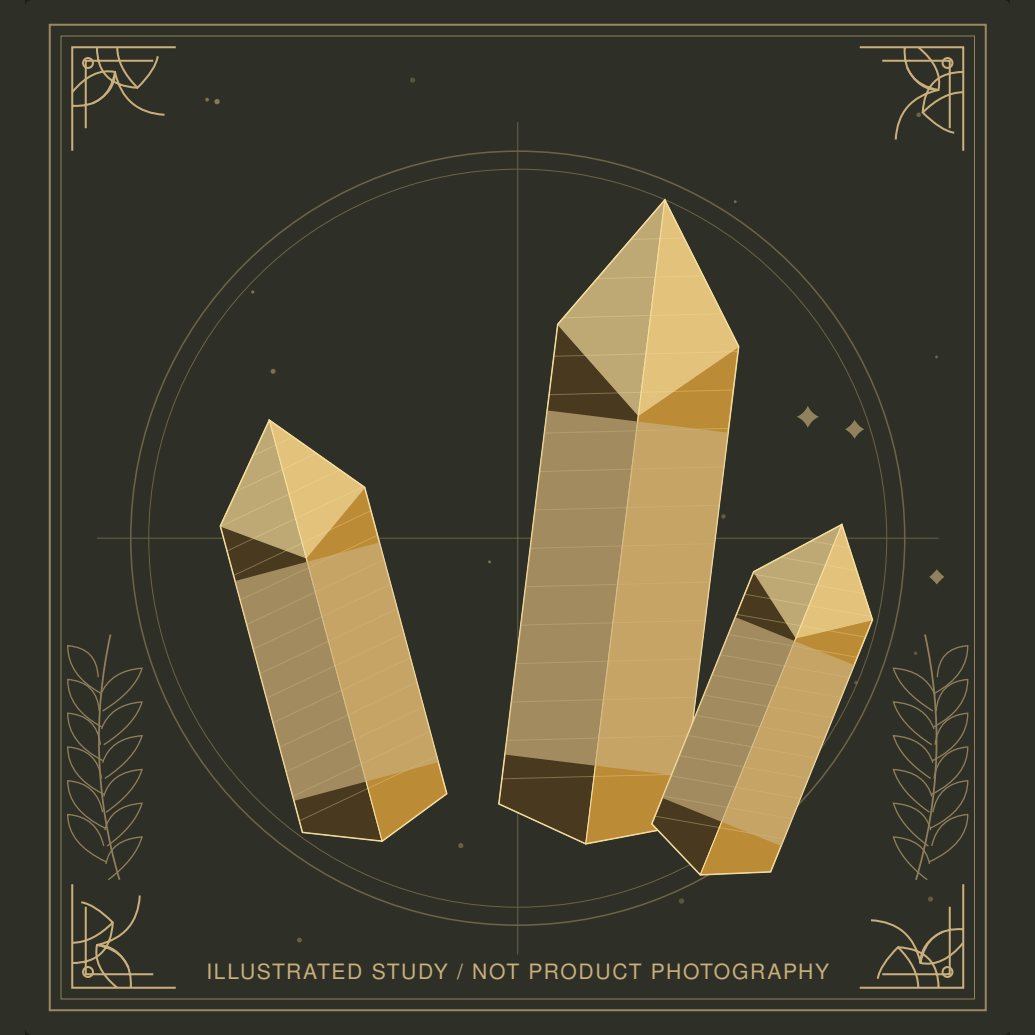
Traditions
Tudorbeth’s 2024 practitioner account uses creativity, confidence and prosperity-oriented meanings for citrine. [5]
In this guide
Visual identity
Citrine is yellow-to-orange quartz. A honey crystal and an orange cluster can share quartz identity while having different color histories. The defining material questions are what mineral is present and whether the current color arose geologically or through treatment. [1][2][3]
GIA defines citrine across pale yellow, brownish orange and reddish-orange appearances. Transparency matters to the gem description, while cloudy or intergrown quartz can still be an attractive decorative material. The popular dark orange shade is not the entire natural variety. A photographed cluster and a faceted gem also expose different structures: one retains many growth surfaces and the other has been oriented and cut for a finished design. [1]
Earth story: geology and formation
Natural-color citrine exists, but GIA explains that much commercial material starts as amethyst and becomes yellow or orange through heating. The treatment alters color without turning quartz into topaz. Rough habit, zoning and transparency help describe a piece, but generally do not let a photograph settle its treatment history. [1][2][3]
Quartz has the composition SiO₂, a glassy luster on crystal faces, and Mohs hardness 7. Its density is about 2.65 grams per cubic centimetre. It generally breaks along curved, shell-like surfaces rather than opening into the regular cleavage plates characteristic of feldspar. The familiar six-sided prism expresses its crystal symmetry; some growths are distorted, intergrown or entirely massive. Hardness describes resistance to scratching, so even a hard quartz crystal can chip at a sharp tip or split along an existing fracture. Quartz occurs in granite and pegmatite, mineral veins, sandstone and quartzite, and survives as a widespread component of soils and sediments. The same mineral identity can therefore accompany very different shapes, colors and geological histories. [2]
GIA lists quartz refractive indices around 1.544–1.553 and a specific gravity close to 2.66 for citrine. These reference properties differ from topaz despite their sometimes similar color. Refractive index describes how strongly light is bent in a material; it is not a measurement of spiritual clarity. Together with microscopy and other examination, physical reference properties help answer an identification question that a yellow color photograph cannot settle on its own. [1]
Varieties and lookalikes
These names describe different levels of information: a mineral species, a visual variety, a crystal habit or a retail label. The distinctions below keep the recognizable shop vocabulary alongside its material explanation.
- Natural-color citrine
- A natural mineral and an untreated color are separate claims. The identity quartz does not independently verify how its present yellow color arose. [1][2][3]
- Heat-treated amethyst comparison
- The resulting material remains quartz, but heating supplies part of its visible history. Its natural crystal origin does not make the color untreated. [1][2][3]
- Lemon quartz and yellow lookalikes
- Lemon quartz is a separate trade description whose color history needs disclosure. The Geominero Museum’s information sheet describes a quartz specimen colored through gamma irradiation followed by mild heating. Its host remains quartz, while its lemon appearance is engineered. Yellow topaz and glass provide additional lookalikes with different material identities. A citrus shade alone cannot demonstrate natural-color citrine, and a seller’s natural quartz claim should not be read as an untreated-color declaration. [6][1][7][3]
Human story: history and naming
GIA illustrates Victorian citrine jewelry, including a gold pendant and a brooch thought to date from the 1860s. These are concrete anchors for historical use. The much broader history of quartz jewelry should not be converted into an undated ancient prosperity tradition specifically for yellow citrine. [4]
The illustrated Victorian pieces show yellow quartz used with gold and other colored gems. An object’s surviving design can be studied without assuming that its present color was entirely unmodified. Older gemstone vocabulary also confused citrine with topaz, so a historic word does not always identify the modern species. A precise historical account begins with the catalogued object and its attributed date, then keeps material identification and any inferred symbolism explicit. [4]
Meaning and practice: attributed traditions
Tudorbeth’s 2024 practitioner account uses creativity, confidence and prosperity-oriented meanings for citrine. These describe intentions within contemporary practice, not predictions of income or business success. A treated piece can still carry personal meaning, while honest color-history disclosure remains necessary for material comparison. [5]
An optional prosperity reflection is to name one practical step toward a creative or financial goal. The gem supplies a visual cue; planning and action supply the step.
Prosperity symbolism is especially common in contemporary citrine descriptions, but a symbolic use and a commercial price or outcome are unrelated kinds of claim. Tudorbeth’s account offers a modern practitioner example. A person can use the golden color as a reminder of a creative plan without presenting the stone as a cause of wealth. Whether a particular piece has been heated remains an identity-and-treatment disclosure rather than a test of whether the owner may find personal meaning in it. [5]
Material identity and trade terminology
Natural-color citrine and heat-treated amethyst sold as citrine answer different treatment questions. Golden topaz is another mineral. Lemon quartz is a sales description requiring its own origin and treatment explanation. Neither a very orange cluster nor a pale yellow gem is a conclusive authentication test. A seller can usefully provide a photograph of the actual piece, state whether the color history is known, and distinguish an identification report from a locality claim. Treating a naturally grown quartz crystal does not make it laboratory-grown quartz; the growth and treatment categories are independent. Similarly, a natural-color assertion does not identify the place where the crystal formed. This vocabulary allows a treated comparison to remain understandable while the natural catalogue retains a precise purpose. [1][2][3]
Sources and related specimens
The references below distinguish mineral identification and physical properties from historical interpretation and practitioner symbolism. A cited material category describes a kind of stone; it does not certify the identity, treatment or provenance of an untested individual retail specimen.
- GIA: Citrine
Gemological Institute of America · Geological, gemological or documented material-history evidence · Accessed October 9, 2026
- Handbook of Mineralogy: Quartz
Mineralogical Society of America · Mineral composition, structure, physical properties and occurrence · Accessed October 9, 2026
- GIA: An Introduction to Gem Treatments
Gemological Institute of America · Geological, gemological or documented material-history evidence · Accessed October 9, 2026
- Citrine History and Lore
Gemological Institute of America · Historical naming, material use and explicitly attributed lore · Accessed October 9, 2026
- Tudorbeth: A Crystal Shopping List (2024)
Llewellyn Worldwide · Contemporary practitioner symbolism and retailer terminology; distinct from mineralogical evidence · Accessed October 9, 2026
- Geominero Museum: Gems information sheet
Instituto Geológico y Minero de España · Geological, gemological or documented material-history evidence · Accessed October 9, 2026
- Handbook of Mineralogy: Topaz
Mineralogical Society of America · Mineral composition, structure, physical properties and occurrence · Accessed October 9, 2026