
A meeting of colors
Ametrine
Quartz combining amethyst-purple and citrine-yellow/orange zones.
Quartz color variety
Ametrine combines purple and yellow-orange zones within one quartz crystal. It is not two unrelated minerals physically joined together. A cutting orientation can create a clean division in a finished gem, while rough reveals a more complex arrangement.
Geology · Human history · Attributed traditions
Explore the specimen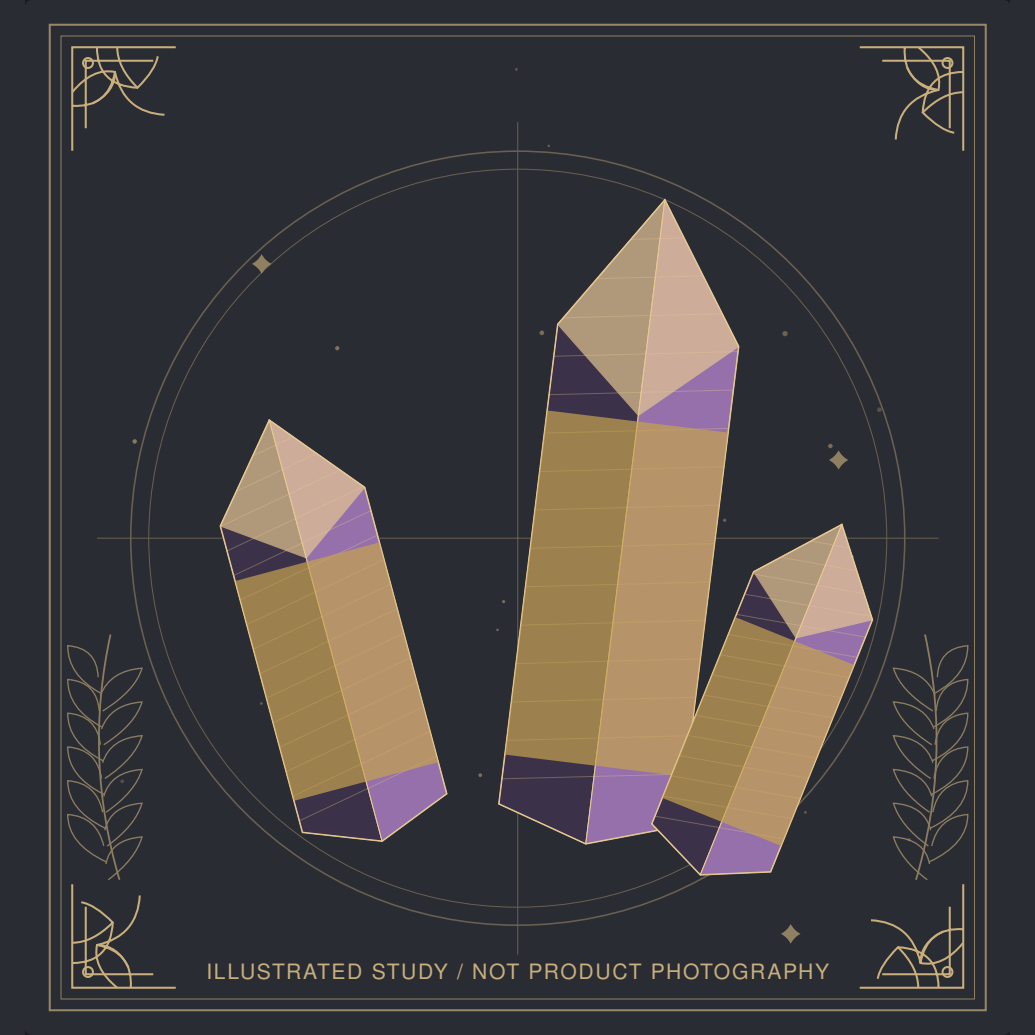
Traditions
Michelle Welch’s January 2021 article interprets ametrine through courage and self-worth, using crown and solar-plexus chakra imagery. [4]
In this guide
Visual identity
Ametrine combines purple and yellow-orange zones within one quartz crystal. It is not two unrelated minerals physically joined together. A cutting orientation can create a clean division in a finished gem, while rough reveals a more complex arrangement. [1][2]
The contrasting zones can be deliberately positioned by the cutter. A rectangular gem often makes the purple-yellow division easy to see, while a different outline can mix the colors optically. An observer should distinguish the actual spatial zones from colors produced by reflection through a finished cut. The individuality of the visible arrangement is a design feature, not a certificate that the material is natural or from the most familiar commercial source. [1]
Earth story: geology and formation
GIA identifies natural bicolored quartz associated with the Anahí mine in Bolivia. Orientation and transparency influence how clearly both zones appear. Natural zoning, laboratory growth and altered color need different explanations: seeing two colors is an observation, whereas their origin is an identification question. [1][2]
Quartz has the composition SiO₂, a glassy luster on crystal faces, and Mohs hardness 7. Its density is about 2.65 grams per cubic centimetre. It generally breaks along curved, shell-like surfaces rather than opening into the regular cleavage plates characteristic of feldspar. The familiar six-sided prism expresses its crystal symmetry; some growths are distorted, intergrown or entirely massive. Hardness describes resistance to scratching, so even a hard quartz crystal can chip at a sharp tip or split along an existing fracture. Quartz occurs in granite and pegmatite, mineral veins, sandstone and quartzite, and survives as a widespread component of soils and sediments. The same mineral identity can therefore accompany very different shapes, colors and geological histories. [2]
GIA gives ametrine the same quartz refractive-index range, about 1.544–1.553, and specific gravity close to 2.66 used for its related gem varieties. It is the distribution of purple and yellow-orange color that supplies the gem name, while the host structure remains quartz. A useful geological comparison therefore begins with the common mineral framework and then asks what produced the particular zoning. A two-colored stone from another material cannot be identified as ametrine by color pairing alone. [1]
Varieties and lookalikes
These names describe different levels of information: a mineral species, a visual variety, a crystal habit or a retail label. The distinctions below keep the recognizable shop vocabulary alongside its material explanation.
Human story: history and naming
GIA recounts a princess-and-conquistador account linked with the Anahí mine and explicitly labels it legend. The literary story remains separate from documented gem production. Ametrine’s name combines two quartz color-variety names, not the names of two separate species. [3]
The Anahí account illustrates how a real mine can become surrounded by a romantic legend. A mine’s documented commercial importance and a story about its transfer are not the same evidence. A modern jewelry object can refer to the legend aesthetically without proving it historically. Preserving that distinction lets the human story remain engaging while preventing it from becoming a provenance claim for a particular crystal or an asserted ancient ritual lineage. [3]
Meaning and practice: attributed traditions
Michelle Welch’s January 2021 article interprets ametrine through courage and self-worth, using crown and solar-plexus chakra imagery. This is a named contemporary spiritual system. The two colors can provide a personal metaphor for bringing priorities together, without promising bodily activation or guaranteed transformation. [4]
An optional reflection is to name two priorities and consider one step that respects both. Their paired colors become a metaphor chosen by the reader.
Welch’s account brings two chakra symbols into relation and uses them to discuss courage and a person’s sense of purpose. These concepts come from the named contemporary system; they do not explain how quartz color zones formed. The split-color appearance may help someone remember a chosen reflection about combining aims. An entirely geological appreciation of the same piece is equally possible, because a material’s beauty does not depend on accepting one practitioner’s interpretation. [4]
Material identity and trade terminology
A Bolivia label and a purple-yellow division do not independently authenticate natural ametrine. GIA distinguishes natural, synthetic and treated gem materials. Growth origin, mineral identity and color history are separate disclosures; an assembled imitation would require construction information as well. A clearly divided finished gem may reflect a cutter’s choice of orientation rather than a perfectly straight boundary throughout the rough. Good documentation separates the original growth of the quartz, any subsequent processing and the final cutting. The degree of visible contrast is a design and optical feature; it is not a stand-alone test of Bolivian provenance. One should also avoid treating the legend surrounding the Anahí mine as authentication for a commercial piece. [1][2]
A bicolor appearance can be produced or imitated through several routes, so an even purple-and-yellow picture is insufficient to determine origin. GIA separates treatment of existing material from synthesis of a counterpart and from a different host used as an imitation. The Geominero Museum’s Bolivian ametrine record provides an identified natural specimen and its mining context. A synthetic or altered comparison should be described with its actual origin or process rather than borrow that natural source record. The same visual category does not give every offered stone the same growth history. [5][6][1]
Sources and related specimens
The references below distinguish mineral identification and physical properties from historical interpretation and practitioner symbolism. A cited material category describes a kind of stone; it does not certify the identity, treatment or provenance of an untested individual retail specimen.
- GIA: Ametrine
Gemological Institute of America · Geological, gemological or documented material-history evidence · Accessed October 9, 2026
- Handbook of Mineralogy: Quartz
Mineralogical Society of America · Mineral composition, structure, physical properties and occurrence · Accessed October 9, 2026
- GIA: Ametrine History and Lore
Gemological Institute of America · Historical naming, material use and explicitly attributed lore · Accessed October 9, 2026
- Michelle Welch: 14 Crystals for Clearing, Protecting, and Transmuting (2021)
Llewellyn Worldwide · Contemporary practitioner symbolism and retailer terminology; distinct from mineralogical evidence · Accessed October 9, 2026
- GIA: An Introduction to Gem Treatments
Gemological Institute of America · Geological, gemological or documented material-history evidence · Accessed October 9, 2026
- Geominero Museum: Gems information sheet
Instituto Geológico y Minero de España · Geological, gemological or documented material-history evidence · Accessed October 9, 2026