
The violet chamber
Amethyst
Purple quartz.
Quartz color variety
Amethyst is purple quartz, from pale lavender to deep violet. Pale or colorless zones can share a crystal with dark violet areas. A geode contains a cavity lined by many crystals rather than one enormous amethyst crystal. Rough clusters and polished banded pieces reveal different parts of that architecture.
Geology · Human history · Attributed traditions
Explore the specimen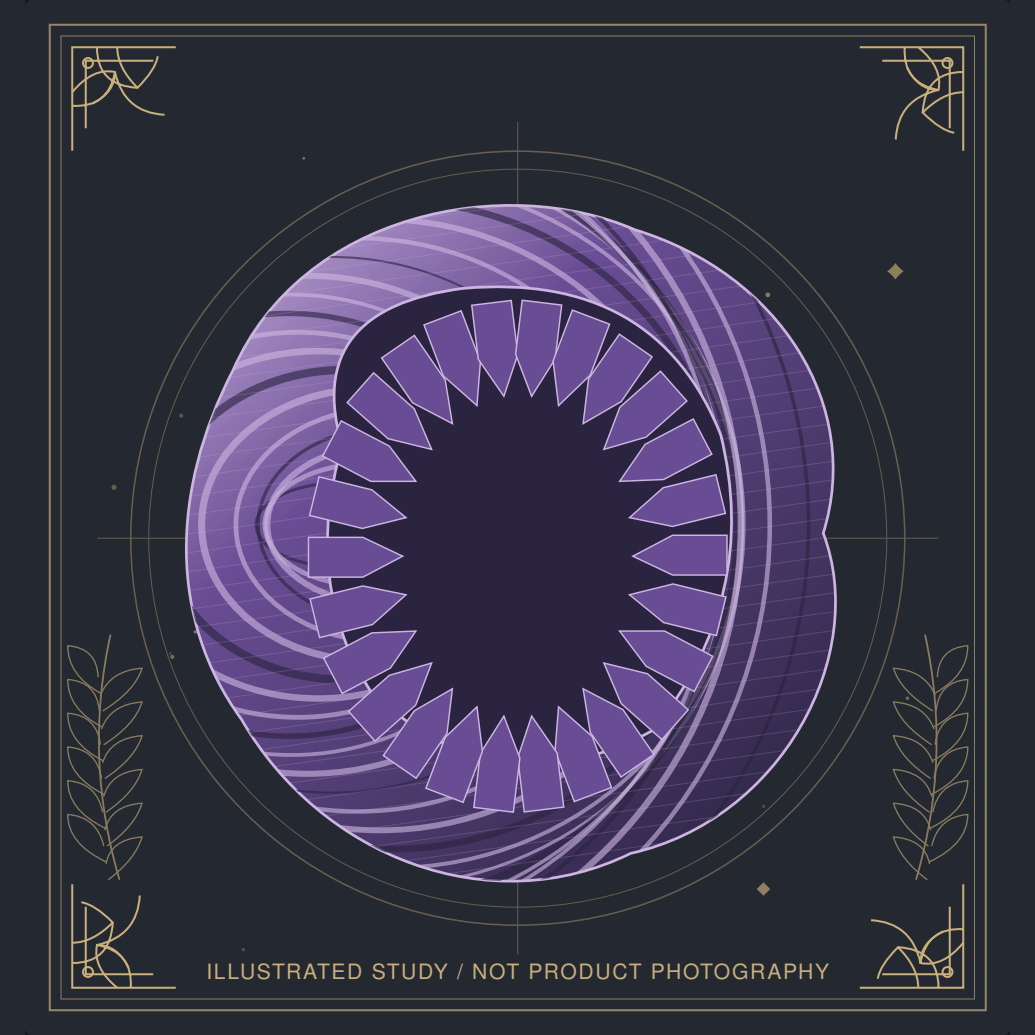
Traditions
Tudorbeth’s 2024 writing associates amethyst with peace and calm. [5]
In this guide
Visual identity
Amethyst is purple quartz, from pale lavender to deep violet. Pale or colorless zones can share a crystal with dark violet areas. A geode contains a cavity lined by many crystals rather than one enormous amethyst crystal. Rough clusters and polished banded pieces reveal different parts of that architecture. [1][2][3]
A crystal cluster presents many terminal faces at once. Different tips can appear darker or lighter because of actual zoning, transparency and the length of the light path. A cut chevron piece organizes those internal changes into a graphic pattern, while a geode retains the curved surface of the original cavity. These forms show why a gallery of several specimens is more informative than treating one purple pointed silhouette as the appearance of the whole variety. [1][2]
Earth story: geology and formation
Purple color involves iron-related structural defects and irradiation. In a cavity, crystal tips develop into the available open space. Color zoning and angular chevron patterns record variations within quartz, not necessarily additional unrelated minerals. A polished slice emphasizes the internal bands, while a cluster preserves the surface of growth. GIA documents natural and synthetic quartz as well as altered colors. Growth into open space and later cutting are consequently useful separate observations. A slice through a cluster can show pale quartz around or beneath purple crystals; that relationship belongs to the specimen’s growth, not a universal layer order. An amethyst geode often retains its outer host and inner cavity, while a detached point has lost much of that context. The mineral name alone cannot supply the full age or formation history of the original host. [1][2][3]
Quartz has the composition SiO₂, a glassy luster on crystal faces, and Mohs hardness 7. Its density is about 2.65 grams per cubic centimetre. It generally breaks along curved, shell-like surfaces rather than opening into the regular cleavage plates characteristic of feldspar. The familiar six-sided prism expresses its crystal symmetry; some growths are distorted, intergrown or entirely massive. Hardness describes resistance to scratching, so even a hard quartz crystal can chip at a sharp tip or split along an existing fracture. Quartz occurs in granite and pegmatite, mineral veins, sandstone and quartzite, and survives as a widespread component of soils and sediments. The same mineral identity can therefore accompany very different shapes, colors and geological histories. [2]
The quartz host supplies the same silicon-dioxide framework found in rock crystal. Iron-related defects and irradiation supply a different color history. Treatment can change that appearance without producing a new chemical species; GIA’s gem-treatment account includes quartz among heat-affected materials. A label can therefore be accurate about quartz identity and still incomplete about color origin. The distinction also explains why a natural crystal, a natural-color statement and an untreated statement should not be treated as synonyms. [1][3]
Varieties and lookalikes
These names describe different levels of information: a mineral species, a visual variety, a crystal habit or a retail label. The distinctions below keep the recognizable shop vocabulary alongside its material explanation.
- Chevron/dream and banded amethyst
- Angular purple and pale bands are quartz patterns. Dream is a retail descriptor rather than an additional mineral species. [1][2][3]
- Amethyst geodes
- A geode displays an interior lining of crystals within a host rock. Cutting exposes that lining, while polishing changes the surface presented to the eye. [1][2][3]
Human story: history and naming
GIA connects amethyst’s name with the Greek idea of avoiding intoxication and recounts Greek and Roman sobriety beliefs. Later religious and royal jewelry provides another context for its esteem. Those beliefs are cultural history, not evidence that a mineral prevents intoxication, and they do not prove ancient continuity for every modern ritual. [4]
GIA describes the purple gem’s association with rulers and religious jewelry alongside the much older sobriety belief. Royal use concerns status and access to a valued material; the sobriety account concerns a belief about its effect. Those histories have different evidence and should not be collapsed into a single protection narrative. The durable purple color and suitability for jewelry help explain the objects’ visual appeal, while the meaning assigned by a wearer depends on the particular social setting. [4]
Meaning and practice: attributed traditions
Tudorbeth’s 2024 writing associates amethyst with peace and calm. It can serve within that contemporary practice as a focus for quiet attention. The source’s illness and addiction assertions are a separate category from the symbolic meanings presented here. Violet color is a mineral feature; a wish to cultivate calm is a human interpretation. [5]
An optional attention practice is to observe a pale-to-dark boundary for a quiet moment. The pause is an activity chosen by the reader, not a promised effect of the stone.
The calm-oriented profile in Tudorbeth’s contemporary writing can be read as a practice of intention. The reader might choose amethyst for a quiet place or a reminder to pause, while the geological explanation remains iron-related quartz color. This does not make every author’s purple-stone correspondence the same. Preserving the author and date helps distinguish a modern recommendation from an archaeological object or a historical belief whose actual context is independently documented. [5]
Material identity and trade terminology
Green quartz is prasiolite; green amethyst is misleading retail terminology. GIA documents color-changing heat treatments of quartz. A geode or pink-amethyst label still needs the identity and treatment status of the specimen. The shape, intensity of violet or a dramatic provenance story alone cannot establish untreated color. [1][2][3]
Sources and related specimens
The references below distinguish mineral identification and physical properties from historical interpretation and practitioner symbolism. A cited material category describes a kind of stone; it does not certify the identity, treatment or provenance of an untested individual retail specimen.
- GIA: Amethyst
Gemological Institute of America · Geological, gemological or documented material-history evidence · Accessed October 9, 2026
- Handbook of Mineralogy: Quartz
Mineralogical Society of America · Mineral composition, structure, physical properties and occurrence · Accessed October 9, 2026
- GIA: An Introduction to Gem Treatments
Gemological Institute of America · Geological, gemological or documented material-history evidence · Accessed October 9, 2026
- GIA: Amethyst History and Lore
Gemological Institute of America · Historical naming, material use and explicitly attributed lore · Accessed October 9, 2026
- Tudorbeth: A Crystal Shopping List (2024)
Llewellyn Worldwide · Contemporary practitioner symbolism and retailer terminology; distinct from mineralogical evidence · Accessed October 9, 2026