
The cubic garden
Fluorite
Calcium fluoride (CaF2).
Calcium fluoride mineral species and color varieties
Fluorite is calcium fluoride, often seen as cubes or color-zoned masses. Purple, green, yellow and blue can share one piece. A broken octahedron and a naturally grown cube have different origins of shape.
Geology · Human history · Attributed traditions
Explore the specimen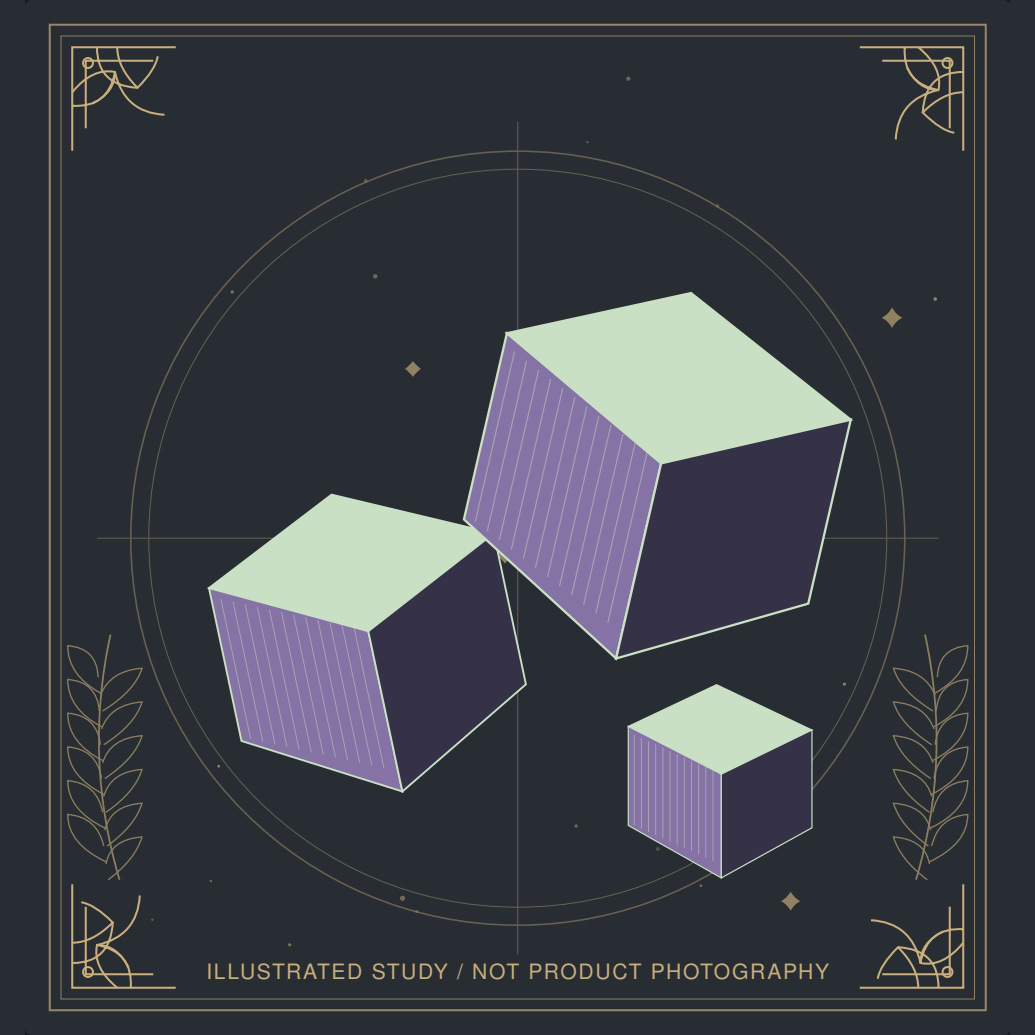
Material
Calcium fluoride (CaF2). [1]
Family
Calcium fluoride [1]
Appearance
Contrasting color zones [1]
Traditions
The Crystal Council associates fluorite with clarity and decision-making, assigning additional meanings to different colors. [6]
In this guide
Visual identity
Fluorite is calcium fluoride, often seen as cubes or color-zoned masses. Purple, green, yellow and blue can share one piece. A broken octahedron and a naturally grown cube have different origins of shape. [1]
Cubic crystals are particularly familiar, but an octahedral-looking fragment can also be produced by fluorite’s perfect cleavage in four directions. A display object’s shape may thus reflect growth, breakage or deliberate working. Purple, green, blue, yellow and colorless regions can be zoned within a crystal or mixed across a cluster. A polished rainbow-fluorite object exposes that color variation without making Rainbow a separate species. The visible layers may remain attractive even where the original natural crystal faces have been removed. [1]
Earth story: geology and formation
The Handbook of Mineralogy records cubic symmetry, four perfect cleavage directions and hardness 4. Fluorescence varies among specimens. Internal layers can record changing color conditions, while a fluorescent response concerns light absorption and emission rather than the ordinary body color alone. Recorded mineral associations include quartz, calcite, barite and several ore minerals. The Handbook lists English, Mexican, Chinese and North American examples among widespread occurrences. Natural crystal cubes and broken octahedra can be displayed beside each other as a lesson in habit and cleavage. Neither shape independently reconstructs the deposit or establishes whether an unusually saturated color has been altered after growth. [1]
Fluorite is CaF₂ with cubic symmetry and a measured density commonly around 3.18 grams per cubic centimetre. Its four perfect cleavage directions can produce regular octahedral fragments, distinct from cube-shaped growth. Zoning can be seen through a transparent piece or in a polished cut; fluorescence is observed under a suitable ultraviolet source and is not identical in all specimens. A color name, a naturally grown habit and a broken cleavage form should be recorded separately. The physical account gives several ways to understand appearance without assigning the optical response a spiritual mechanism. [1]
Fluorite is calcium fluoride, CaF₂, with cubic symmetry. The Handbook records it in mineral veins, stratabound deposits and settings related to alkaline igneous rocks. Its associations can include calcite, quartz, barite and metallic ore minerals, although not every specimen contains all of them. A collector cluster therefore may preserve a specific combination that matters to its deposit history. Its chemistry differs fundamentally from violet quartz or green calcite, even where a casual shopper initially compares them by color. [1][2][3]
Varieties and lookalikes
These names describe different levels of information: a mineral species, a visual variety, a crystal habit or a retail label. The distinctions below keep the recognizable shop vocabulary alongside its material explanation.
Green fluorite, purple fluorite and blue fluorite are color descriptions within the same species where confirmed. Rainbow fluorite refers to a multicolored appearance, while optical or specimen quality describes intended use or clarity. These are different descriptive axes. A green translucent fluorite and a green prehnite tumble can resemble one another in limited views, but their structures and physical properties differ. A cube shape is suggestive for fluorite, yet a carved cube or glass imitation should not be authenticated simply because it has that outline. [1][4]
- Green, purple, blue and yellow fluorite
- Color categories are appearances within calcium fluoride, not separate species or automatically distinct formation environments. [1]
- Rainbow fluorite
- A retail name for multiple color zones. The succession of visible colors is not a treatment or locality certificate. [1]
- Blue John
- Blue John is the established name for distinctive color-zoned fluorite from Castleton, Derbyshire. Oxford’s Corsi Collection identifies specimen 543 as a hydrothermal vein material with purple-blue and colorless zones. The record links it to ornamental stone use and a gift from the Duke of Devonshire after his 1824 visit. Similar banded fluorite from another source should retain that source rather than inherit a Derbyshire attribution from its colors. [5][1]
Human story: history and naming
Its name relates to the Latin idea of flowing and its use as a flux. This material-history connection is distinct from the later naming of fluorescence. Neither name provides evidence for an ancient clarity ritual. [1]
The mineral name is linked with flowing and its use as a flux, which gives it a documented material-use history beyond ornamental collecting. The later fluorescence terminology concerns the visible response associated with some specimens. These naming connections show two different relationships between people and the mineral: its practical role and its observation in optical study. Neither naming history establishes an ancient decision-making ritual. A particular museum or collection specimen would add its own dated human history to the general species account. [1]
Oxford’s Corsi specimen supplies a particular history alongside the general flux naming. The museum records decorative extraction of Blue John from about the mid-eighteenth century and its use in Matthew Boulton’s ornamental work. That is an identified regional material and craft context. The nineteenth-century gift to Corsi also documents how a specimen entered a collection. This account is more precise than a generic story that every purple fluorite shared one ancient spiritual purpose. [5]
Meaning and practice: attributed traditions
The Crystal Council associates fluorite with clarity and decision-making, assigning additional meanings to different colors. This is one modern correspondence system. Mineral fluorescence is a measured optical response and does not validate the publisher’s spiritual claims. [6]
An optional clarity prompt is to write the actual decision in one sentence before considering possible outcomes.
The Crystal Council gives fluorite clarity and decision-oriented meanings, with additional interpretations assigned to colors. The contemporary system should be attributed rather than described as a universal ancient practice. A person might use a visibly zoned object as a reminder to consider several options or give sustained attention to a question. That is an intended activity. The mineral’s cleavage, color zones and possible ultraviolet response explain physical behavior and appearance without validating a promise that a specimen produces better decisions. [6]
Material identity and trade terminology
A cleavage octahedron is not automatically a natural growth crystal. Color and fluorescence alone cannot certify source. A hardness value lower than quartz and perfect cleavage help explain why a polished shape and rough cluster need different handling contexts without requiring destructive testing. [1]
Hardness 4 and perfect cleavage make fluorite physically different from quartz even where the same purple shade is displayed. A polished point can scratch or chip more readily than its appearance suggests. Fluorescence is another independent feature: some specimens respond strongly under an appropriate ultraviolet source and others weakly or differently. A bright color in visible light does not guarantee one fluorescent response. The response concerns an optical interaction under defined conditions, rather than a property that establishes a healing or spiritual action. [1]
Sources and related specimens
The references below distinguish mineral identification and physical properties from historical interpretation and practitioner symbolism. A cited material category describes a kind of stone; it does not certify the identity, treatment or provenance of an untested individual retail specimen.
- Handbook of Mineralogy: Fluorite
Mineralogical Society of America · Mineral composition, structure, physical properties and occurrence · Accessed October 9, 2026
- Handbook of Mineralogy: Quartz
Mineralogical Society of America · Mineral composition, structure, physical properties and occurrence · Accessed October 9, 2026
- Handbook of Mineralogy: Calcite
Mineralogical Society of America · Mineral composition, structure, physical properties and occurrence · Accessed October 9, 2026
- Handbook of Mineralogy: Prehnite
Mineralogical Society of America · Mineral composition, structure, physical properties and occurrence · Accessed October 9, 2026
- Corsi Collection: Blue John fluorite specimen 543
Oxford University Museum of Natural History · Geological, gemological or documented material-history evidence · Accessed October 9, 2026
- The Crystal Council: Fluorite
The Crystal Council · Contemporary practitioner symbolism and retailer terminology; distinct from mineralogical evidence · Accessed October 9, 2026