
Volcanic glass
Obsidian
Natural volcanic glass, not a crystalline mineral.
Natural volcanic glass
Obsidian is natural volcanic glass rather than a crystalline mineral species.
Geology · Human history · Attributed traditions
Explore the specimen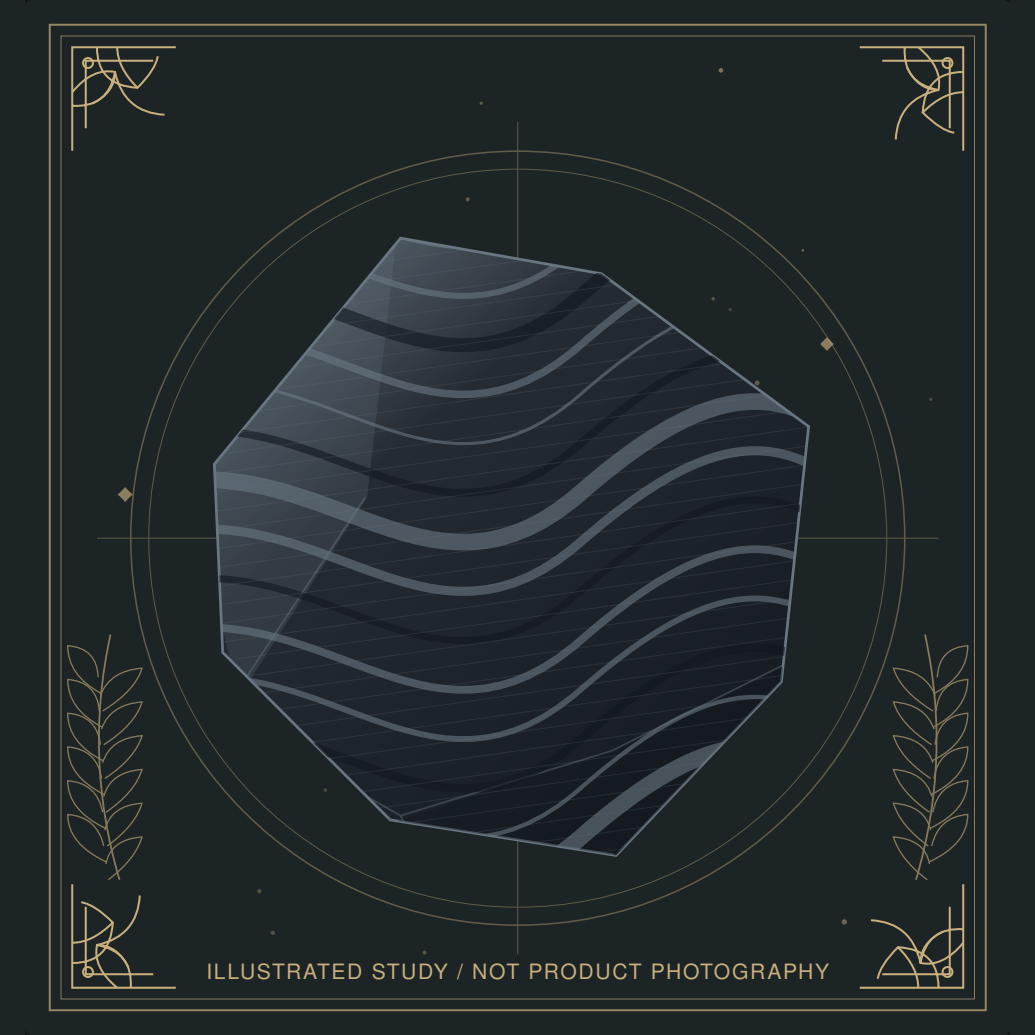
Material
Natural volcanic glass, not a crystalline mineral. [3]
Family
Volcanic glass [3]
Appearance
Natural volcanic glass with curved fracture and varied optical effects. [3]
Meaning & tradition
Documented toolmaking history; Carlin: contemporary protective symbolism. [1]
In this guide
Visual identity & plain-language name
Obsidian is natural volcanic glass rather than a crystalline mineral species. Its dark appearance is familiar, but composition, inclusions and internal textures vary. A sphere or carved blade has a manufactured outline; an irregular glass fragment shows the material before that shaping. [3]
Earth story: formation, structure & color
Silica-rich volcanic material can cool without forming a fully crystalline texture. Glass structure helps explain obsidian’s conchoidal fracture and sharp edges. The National Park Service describes the physical usefulness of that fracture for toolmaking and the chemical signatures that can distinguish sources. [3]
Obsidian is volcanic glass produced when a suitable melt cools without developing a conventional fully crystalline texture. It is commonly silica-rich, but its bulk composition is a rock or glass composition rather than one ideal mineral formula. The absence of one regular crystal lattice distinguishes it from quartz even when silica is abundant. Flow textures, bubbles, microlites and later-formed inclusions can contribute to different appearances within the glass. [3]
National Park Service geology explains how cooling, composition and eruption processes influence volcanic materials. Glass can coexist with small crystals, so a spotted obsidian specimen is not chemically uniform simply because its background is glassy. Conchoidal fracture can create sharp curved edges, an important physical property for both historical tools and modern handling. A polished sphere's smooth outline is the lapidary's work, while a fresh natural break reveals a different geometry. Neither manufactured shape nor black color proves that an unknown object is volcanic glass. [3]
Varieties & look-alikes
Black, mahogany, snowflake, sheen and rainbow are appearance or texture labels rather than separate mineral species. Crystals or reflective internal textures may modify a glass specimen’s appearance. Bright manufactured colored glass can be sold with obsidian-like names but requires a different origin description. Moldavite is also natural glass, formed in an impact context. [3]
- Black obsidian
- Black is a familiar glass appearance, but it is not unique to volcanic material. A confirmed obsidian sample can be massive, banded or contain small inclusions. Its natural glass identity and geological provenance are stronger evidence than color alone. Manufactured black glass, polished dark minerals and other black rocks need their own material determinations. [3]
- Snowflake obsidian
- Pale rounded or clustered patterns within dark glass create the familiar snowflake appearance. The pattern is an inclusion or devitrification-related texture, not a new glass mineral species. Record the host and feature determination when known rather than assuming that every white spot has been analyzed. Cut and polish influence how the pattern is exposed. [3]
- Mahogany obsidian
- Mahogany describes reddish-brown and dark areas in an obsidian product. It is appearance vocabulary, not proof of a separate species or a particular country. Describe the distribution and flow-like relationships before interpreting their origin. A color name by itself cannot authenticate natural glass or rule out a manufactured patterned substitute. [3]
- Rainbow, gold/silver sheen obsidian
- Directional colored, gold or silver sheen changes with viewing angle. Bodycolor and an optical sheen are different observations, so photographs should show illumination and orientation clearly. The occurrence of an effect does not make obsidian a crystalline quartz variety. A confirmed natural glass identity should accompany the optical appearance label. Rainbow, gold sheen and silver sheen are separate appearance descriptions, and a gallery should state which effect was actually observed rather than using them as interchangeable color grades. [3]
- Apache tears comparison
- This traditional commercial name is used for small rounded obsidian pieces. Its cultural wording should not be used to invent or homogenize an Indigenous tradition. For geological purposes, record the confirmed glass identity and provenance; for cultural claims, require a specific documented source. A rounded pebble form alone cannot authenticate the material or a narrative. [3]
Human story: objects, names & cultural context
NPS research in the Yellowstone region documents obsidian collection, toolmaking and source analysis for understanding movement and exchange. Geochemical fingerprints provide evidence beyond a visual guess. This history is tied to specific places and communities rather than a universal story of all black stones. [3]
The National Park Service's Yellowstone archaeology account connects obsidian with tool making and the investigation of material movement. Chemical characterization can help distinguish sources and trace exchange or transport, while artifact form and archaeological context address use. These are evidence-based cultural questions, rather than a universal story that every obsidian object was a protective amulet. A modern tumble may be made of the same broad material category while having no documented connection to a particular archaeological tradition. [3]
Meaning & practice: attributed traditions
Emily Carlin includes obsidian in her May 2026 protective-charm practice. This is contemporary spiritual interpretation, separate from archaeological tool use. [1]
An editorial protection intention can focus on a practical boundary, such as limiting access to private information or leaving an uncomfortable situation. The object can serve as a reminder; it does not establish a physical protective field.
Material truth: trade names & treatments
Natural glass origin and carved product form are different facts. Sharp fracture edges require care even when a polished object feels smooth. A color label or point shape does not establish volcanic origin. Retain treatment and manufacturing information, particularly for brightly colored glass marketed as obsidian. [3]
Colored manufactured glass can resemble obsidian, and a cast shape does not establish a volcanic origin. A product described as blue, green or another unusually vivid obsidian should retain an identity determination instead of relying on the color word. Natural volcanic glass, treated natural material and manufactured glass belong to different origin accounts. Polishing and carving should also be disclosed as manufacture of the object, not mistaken for natural crystal habit. Glass edges deserve care even when the central polished face feels comfortably smooth. [3]
Record bodycolor in ordinary reflected light and, where safe, note the appearance of thin edges in transmitted light. Observe spots, bands and directional sheen without assigning every feature an untested composition. A clear distinction between a confirmed volcanic specimen and a seller's obsidian designation makes comparisons more useful. Historical tool forms and modern carved shapes should be captioned with their documented origins. Similar fracture behavior explains visual resemblance, but it cannot supply a complete source, age or cultural attribution.
Colored obsidian is a particularly important comparison label. Vivid colored manufactured glass may be marketed with a volcanic-sounding name, but it remains manufactured glass when that is the examined identity. Obsidian has a natural volcanic formation history. A green or blue glass object cannot be assigned that history merely from a seller's color name or a flowing-looking texture. Preserve the determined substrate, whether it was manufactured, and any coating or coloring separately. [2][4]
Sources & related specimens
The NPS source explains fracture, tools and archaeological provenance. Carlin documents modern symbolism. Compare moldavite for impact glass and quartz for a crystalline silica material with a different structure.
- Emily Carlin: Protection Charm (2026)
Llewellyn Worldwide · Emily Carlin’s contemporary protective-charm symbolism · Accessed October 9, 2026
- NPS: Igneous Rocks
National Park Service · Material identity and natural history · Accessed October 9, 2026
- NPS: Obsidian, the MVP of Yellowstone Stones
National Park Service · Identity and natural history · Accessed October 9, 2026
- NPS: Magma Melts and Eruption Types
National Park Service · Identity and natural history · Accessed October 9, 2026