
Impact glass landscapes
Moldavite and Tektites
Natural impact-generated glasses derived from terrestrial material.
Natural terrestrial impact glass
Moldavite belongs among tektites: natural glasses made from terrestrial material during a major impact event.
Geology · Human history · Attributed traditions
Explore the specimen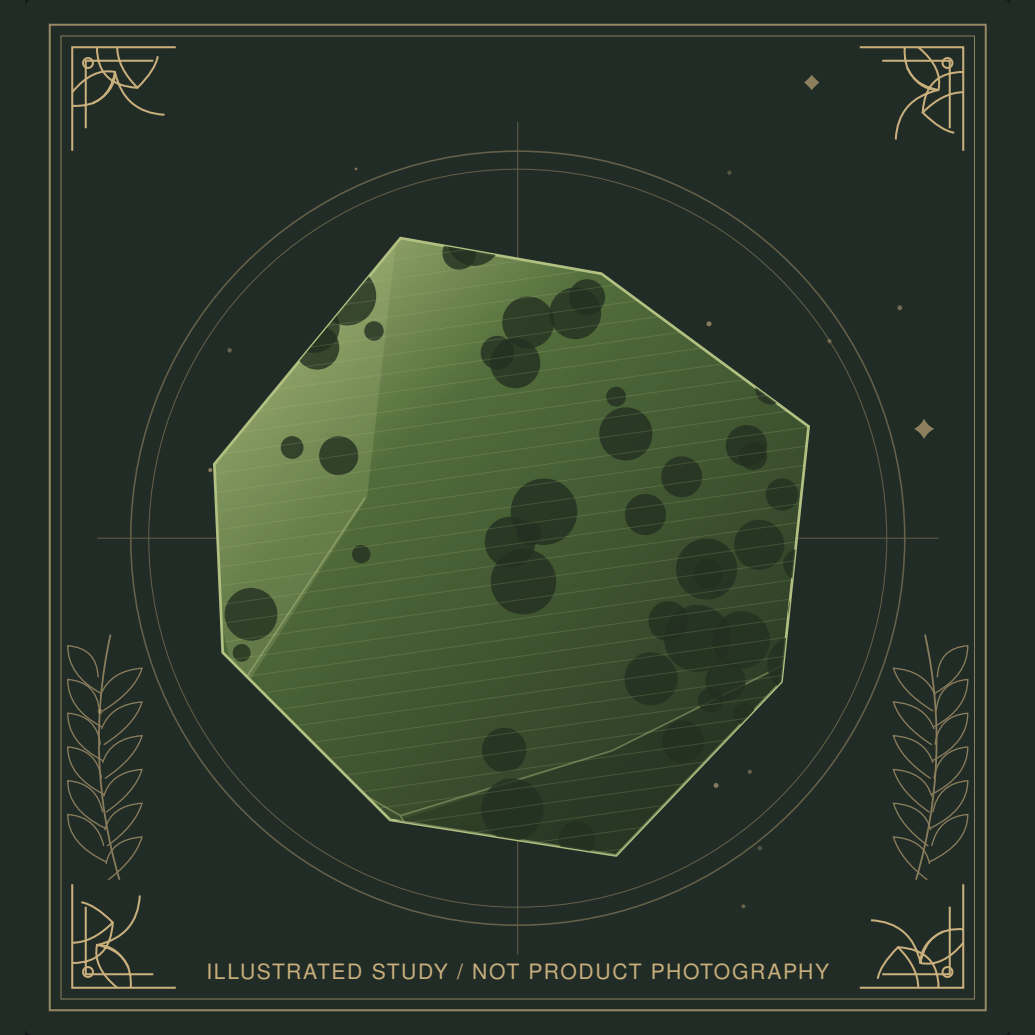
Material
Natural impact-generated glasses derived from terrestrial material. [5]
Family
Impact glass [5]
Appearance
Natural impact glass, often with bubbles and sculpted surfaces. [5]
Meaning & tradition
The Crystal Council: transformation, an attributed modern belief. [1]
In this guide
Visual identity & plain-language name
Moldavite belongs among tektites: natural glasses made from terrestrial material during a major impact event. It is not a fragment of the incoming meteorite. Green color and surface sculpture are familiar, but they are not by themselves proof that a shop piece is authentic moldavite. [5]
Earth story: formation, structure & color
Research on moldavite examines glass structure, inclusions and impact-related history. Bubbles, flow features and mineral inclusions record rapid melting and cooling. Unlike a conventional mineral crystal, this glass lacks a single regular crystal structure. Its geological connection to an impact does not make manufactured green glass equivalent. [5]
Tektites are natural glasses connected with impact melting of terrestrial material. GIA's investigation explains that extreme heat and pressure can melt rock, followed by rapid cooling, with the glass's bulk composition reflecting the affected source material. The distinction is crucial: the incoming meteorite initiates the event, while the resulting glass is not simply a melted fragment of that meteorite. Moldavite's regional identity belongs to a particular impact-glass occurrence rather than to all green glass. [5][4]
The glass can contain bubbles, flow features and mineral inclusions, and a raw surface may retain sculpture or later weathering. It lacks the conventional regular crystal lattice of a mineral crystal. GIA relates famous southern Bohemian moldavites to the Ries impact in Germany, while its report on Vietnamese tektite examines a different regional material. A faceted gem has had natural surfaces removed by cutting; an etched imitation can create surface features deliberately. Interior structure, composition and provenance are consequently important alongside external texture. [5][4]
Varieties & look-alikes
Compare documented moldavite, other tektite glasses, raw surface sculpture and cut gem material. Indochinite and other regional tektite names identify different occurrences. A heavily sculpted surface can be imitated, and cut pieces lose some exterior clues. Black or green glass cannot be assigned an impact origin from color. [5]
- Moldavite
- Moldavite is a regional tektite glass associated with the Ries impact context. Green appearance and sculpted rough are familiar but not sufficient authentication. A faceted piece may lack its original surface entirely. Preserve geological provenance and suitable material examination, and separate a gem's cutting history from the formation of the natural glass. [3][5]
- Indochinite
- Indochinite is regional vocabulary for material of the Australasian tektite context, including Southeast Asian occurrences. GIA discusses Vietnamese examples and their natural-glass features. The regional category should not become a moldavite synonym. A piece's individual source and identification still need evidence, while black or dark-green color alone cannot assign a strewn field. [4]
- Other tektites
- Natural tektite occurrences share an impact-glass category while differing in region, source material and history. A collector should retain the supported regional name rather than choose the best-known one for all products. Bulk composition and examination add evidence beyond appearance. An unidentified black glass can remain unidentified until its origin has actually been established. [4]
- Libyan Desert Glass comparison
- Libyan Desert glass is a distinct pale yellow to greenish natural impact-glass comparison. GIA's 2023 report describes silica-rich material in a bangle and discusses its properties. It is not simply yellow moldavite. Preserve the particular natural-glass identity, origin evidence and object manufacture rather than merging different regional impact products under one colorful trade label. [2]
Human story: objects, names & cultural context
Scientific investigation connects particular tektite distributions with impact events and terrestrial source material. That is a measurable geological account. Modern trade adds cutting, carving and marketing histories. An astronomical association may be personally meaningful, but it should not be presented as an ancient tradition without an individually documented source. [5]
Modern scientific investigation connects glass distributions, source rocks and impact processes, while collectors and lapidaries add the history of individual objects. GIA's Vietnamese study describes a specific specimen with a large fluid inclusion examined against reference material. Such a record anchors a remarkable visual feature in an actual investigation. A modern spiritual interpretation of transformation belongs to its named practitioner account, not to an inferred ancient tradition based solely on astronomical imagery or the specimen's geological age. [5][4]
Meaning & practice: attributed traditions
The Crystal Council associates moldavite with transformation. This is a contemporary spiritual belief, not proof that an object causes rapid life changes or bodily sensations. [1]
An editorial transformation intention can identify one change you choose and the smallest practical step toward it. The impact story may serve as a metaphor, while the decision remains yours. There is no need to seek intense physical sensations as evidence of authenticity or spiritual value.
Material truth: trade names & treatments
Ask for provenance and examination when an unusual or valuable piece is offered. Natural impact glass, manufactured glass and meteorite are different material categories. Surface texture alone is insufficient. Keep raw fragile edges supported, and describe polishing or carving as manufacturing rather than a natural crystal habit. [5]
GIA's 2021 imitation investigation identified manufactured glass after microscopic clues were checked with FTIR spectroscopy. The studied object had surface features resembling flow lines, demonstrating why sculpted texture alone is insufficient. The conclusion belongs to that examined specimen, not a universal photographic rule. A valuable or unusual piece benefits from provenance and suitable examination. Natural impact glass, colored manufactured glass and a meteorite are three material-origin categories that should remain distinguishable in labels. [3]
Record whether the specimen is rough, polished, carved or faceted and whether its origin comes from a report, collection record or seller. Under gentle magnification, bubbles and surface features can be described without interpreting each as decisive proof. Different tektite regions have their own histories, so a black tektite is not a darker variety of moldavite by default. Your description can honestly preserve a documented tektite identity, regional attribution and manufactured form while leaving unresolved claims out of the material account.
Sources & related specimens
The research paper grounds impact-glass identity and structure. The Crystal Council supplies modern symbolism. Compare obsidian for volcanic glass and moissanite for why astronomical occurrence and ordinary retail origin must be kept distinct.
- Moldavite: contemporary meanings
The Crystal Council · Contemporary symbolic associations attributed to The Crystal Council · Accessed October 9, 2026
- Libyan Desert Glass Bangle Bracelet: Spring 2023 Lab Notes
Gemological Institute of America · Mineralogy, geology, naming and documented material history · Accessed October 9, 2026
- Imitation Moldavite (2021)
Gemological Institute of America · Mineralogy, geology, naming and documented material history · Accessed October 9, 2026
- Tektite with a Large Fluid Inclusion (2017)
Gemological Institute of America · Mineralogy, geology, naming and documented material history · Accessed October 9, 2026
- Quantitative Study of Porosity in Moldavites
Published scientific research / PubMed Central · Identity and natural history · Accessed October 9, 2026