
A play of color
Opal
Hydrated silica material; precious opal shows play-of-color and common opal does not.
Hydrated silica material; commonly described as a mineraloid
Opal is hydrated silica.
Geology · Human history · Attributed traditions
Explore the specimen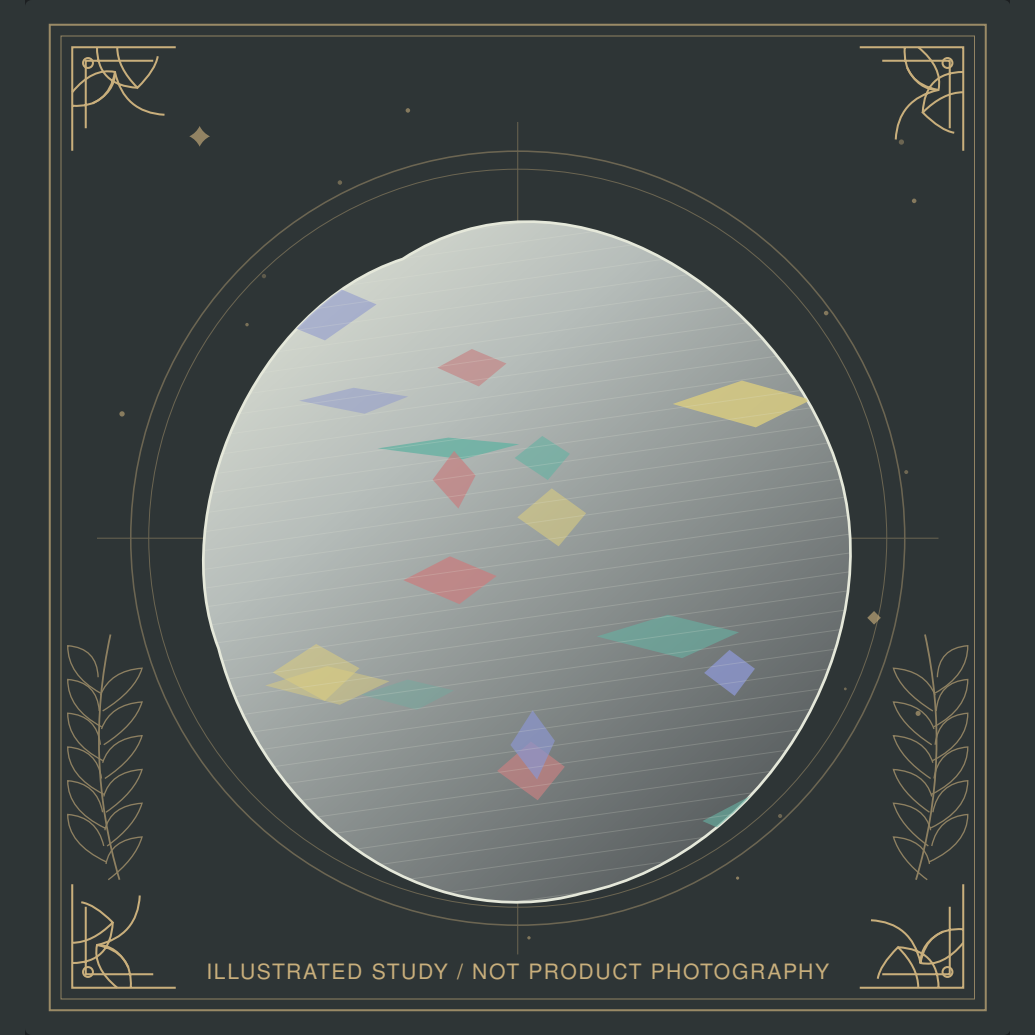
Material
Hydrated silica material; precious opal shows play-of-color and common opal does not. [1]
Family
Hydrated silica [1]
Appearance
Hydrated silica; precious material displays play-of-color. [1]
Meaning & tradition
GIA records attributed historical lore; Kynes: romance. [7]
In this guide
Visual identity & plain-language name
Opal is hydrated silica. Precious opal’s shifting color flashes differ from its underlying bodycolor, while common opal lacks that play-of-color and can still be attractive. A colored glass product called opalite is manufactured material, not a pale variety of natural opal. [1]
Earth story: formation, structure & color
GIA explains play-of-color as diffraction associated with ordered arrays of tiny silica spheres. Arrangement matters as much as bodycolor. Common opal lacks the same visible effect. Water content and structure distinguish opal from ordinary crystalline quartz; the material has no conventional quartz crystal habit. [1]
Opal is hydrated silica, SiO2·nH2O, with variable water content and structure. Its atomic order can range from amorphous material to poorly ordered silica phases, so calling every opal a conventional crystal oversimplifies the identity. The 2025 GIA nanotexture review distinguishes opal-A, opal-CT and opal-C and explains why the mineral name is often accompanied by the descriptive category mineraloid. These structural classifications are different from commercial bodycolor categories. [1][3]
Precious opal's play-of-color arises from appropriately arranged microscopic silica structures interacting with light. Common opal lacks that play-of-color but can still make an attractive gem. Bodycolor, changing spectral flashes and milky scattering are different observations. Mineral-bearing water can deposit silica in cracks or spaces within host rocks, while local conditions influence texture. GIA records hardness around 5–6.5 and low density compared with many gemstones; water content and aggregate behavior make sudden changes and treatment questions more consequential than that hardness figure alone suggests. [1][3]
Varieties & look-alikes
Compare white, black, boulder and common opal, keeping bodycolor, host attachment and optical effect separate. Fire opal is a bodycolor/trade category and need not always show play-of-color. Doublets and triplets are assembled products; synthetic opal and opalite glass require different origin statements. [1]
- White and black opal
- These categories describe contrasting background colors against which play-of-color appears. White or light backgrounds and dark backgrounds are not separate chemical species. The strength and range of flashes are additional observations. A black background may be natural or involve an assembled backing or treatment, so appearance, construction and color origin deserve separate assessment. [5]
- Boulder opal
- Boulder opal retains surrounding host rock as part of the finished gem. The opal seam and matrix are different materials within one object. The backing is not automatically evidence of an artificial doublet: a natural host association must be distinguished from assembled construction. Describe the known relationship and examine the complete piece rather than only its colorful face. [5]
- Fire opal
- Fire opal names yellow, orange or red bodycolor in transparent to translucent opal. It may show play-of-color or lack it, so fire is not a synonym for spectral flashes. A Mexico-style trade label also does not prove a country of origin. Record bodycolor, transparency and any observed play-of-color independently. [5]
- Pink and blue Peruvian comparisons
- Pink and blue are bodycolor descriptions; Peruvian adds an origin claim requiring evidence. GIA's 2006 account documents studied Peruvian lapidary material and pink opal associated with palygorskite. That report should not be converted into a universal coloring recipe for every pink bead. A mineral mixture and an opal host can be described together when examined. [4]
- Green and dendritic opal
- Green describes bodycolor, while dendritic describes branch-like inclusions or markings. Neither word establishes one coloring substance or a plant fossil. The 2025 nanotexture review emphasizes varied inclusions and structures in common opal. Confirm the host and interpret visible features separately, leaving their exact composition unresolved when no examination has established it. [3]
- Ethiopian and hydrophane opal
- Ethiopian is an origin category; hydrophane refers to water-absorbing behavior. They are not synonymous for every specimen. GIA records varying porosity and changes in transparency or appearance in examined material. Dye and impregnation are additional questions. Preserve the measured behavior and treatment findings instead of testing a finished gem by unqualified immersion. [2]
Human story: objects, names & cultural context
GIA’s history account summarizes Roman love-and-hope associations and later changing luck narratives as lore. Such accounts describe human interpretation, not an ability of ownership to change fortune. Historical reputation also does not identify whether one modern retail cabochon is natural, assembled or synthetic. [8]
GIA's historical overview describes Roman admiration for opal and later changes in European reputation, including the influence of nineteenth-century fiction. These are attributed cultural and literary histories rather than physical measurements. They should not be flattened into the claim that all past societies agreed opal was lucky or unlucky. Modern mining, cutting and collection have added further documented contexts. A current owner can choose a positive personal meaning without needing to erase the diversity of historical accounts. [8]
Meaning & practice: attributed traditions
Sandra Kynes gives opal a romance correspondence in her 2018 article. This is a contemporary spiritual interpretation, separate from GIA’s summary of earlier lore. [7]
An editorial romance intention can focus on an act that makes time together more attentive. Changing flashes can remind you to notice another viewpoint. The choice and action remain human, while diffraction explains the optical observation.
Material truth: trade names & treatments
Describe natural opal, synthetic opal, assembled doublet or triplet and glass imitation distinctly. Opal’s relatively modest hardness and variable water behavior matter for jewelry condition. Do not assume an unknown assembled piece tolerates soaking or heat. Attractive flashes alone cannot settle origin or reveal every product layer. [1][6]
An opal doublet or triplet is an assembled product; laboratory-created material and glass imitations are different categories. Some natural opal is treated with processes affecting color, apparent stability or porosity. GIA's Ethiopian-material account notes varying degrees of hydrophane behavior, meaning water absorption, and cautions that responses differ among specimens. Absorption does not itself prove dye. Preserve origin, treatment, assembly and identity as separate statements rather than using natural to silently answer them all. [2][6][1]
For observation, distinguish ordinary bodycolor from the flashes produced as the stone or light moves. Note whether the opal forms a thin seam on matrix, a transparent body or an opaque aggregate. A photograph chosen at one favorable angle cannot show the whole effect or reveal every layer of an assembled object. Keep care guidance tied to the particular material and any treatment report; soaking an unknown opal is a poor authentication experiment. The description can be detailed without assigning a fixed water percentage or one universal stability rule.
Sources & related specimens
GIA establishes silica identity, optical effects and attributed historical lore. Kynes documents a modern correspondence. Compare quartz for crystalline silica and the treatment discussion for assembled or manufactured alternatives.
- GIA: Opal
Gemological Institute of America · Identity and natural history · Accessed October 9, 2026
- Ethiopian Opal: Spring 2019 Gems & Gemology
Gemological Institute of America · Mineralogy, geology, naming and documented material history · Accessed October 9, 2026
- Structures Behind the Spectacle: Optical Effects and Nanotextures (2025)
Gemological Institute of America · Mineralogy, geology, naming and documented material history · Accessed October 9, 2026
- Blue and Pink Opal from Peru: Summer 2006 Gem News
Gemological Institute of America · Mineralogy, geology, naming and documented material history · Accessed October 9, 2026
- Opal Quality Factors
Gemological Institute of America · Mineralogy, geology, naming and documented material history · Accessed October 9, 2026
- GIA: An Introduction to Gem Treatments
Gemological Institute of America · Treatment categories, with specimen-specific disclosure still required · Accessed October 9, 2026
- Sandra Kynes: 365 Days of Crystal Feng Shui for Your Home (2018)
Llewellyn Worldwide · Sandra Kynes’s contemporary crystal-placement and intention framework · Accessed October 9, 2026
- GIA: Opal History and Lore
Gemological Institute of America · Historical reception and named cultural or literary contexts · Accessed October 9, 2026