
Fire in silicon carbide
Moissanite
Silicon carbide (SiC); rare natural mineral, with laboratory-created material supplying the gem trade.
Silicon carbide mineral; retail gems ordinarily laboratory-created
Moissanite deserves its own entry because its natural mineral identity and ordinary retail origin are easy to confuse.
Geology · Human history · Attributed traditions
Explore the specimen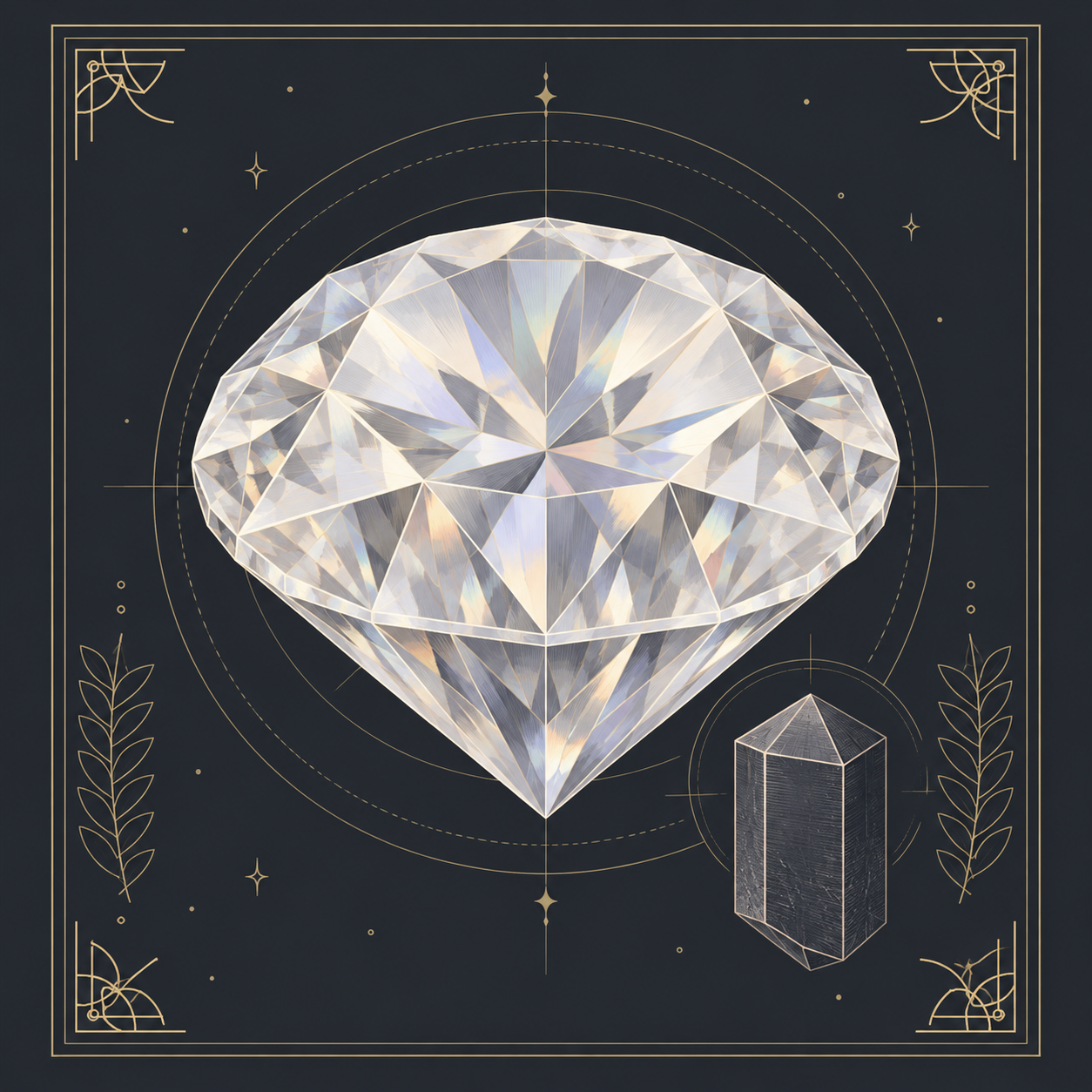
In this guide
Visual identity & plain-language name
Moissanite deserves its own entry because its natural mineral identity and ordinary retail origin are easy to confuse. A faceted gem is generally laboratory-created silicon carbide, not a recovered meteorite fragment. Diamond is carbon; moissanite is silicon carbide. Their visual similarity does not make them the same material. [3][1]
Earth story: formation, structure & color
The Handbook records natural SiC occurrences, multiple stacking polytypes and hardness 9.5. GIA’s 1997 study examines synthetic gem material, including strong dispersion, high refractive index and double refraction in the tested material. These optical properties help explain brilliance and identification; they do not establish natural origin for a shop gem. [3][1]
Moissanite is silicon carbide, SiC, rather than diamond's elemental carbon. Its several polytypes arrange similar atomic layers in different stacking sequences. The Handbook describes natural hexagonal plates and records intergrown polytypes; its reference data for the 6H form include uniaxial optics. A schematic SiC crystal illustrates mineral architecture, while the large faceted gem in this entry's artwork represents laboratory-created material commonly found in jewelry commerce. [3][1]
The natural mineral has Mohs hardness 9.5, measured density about 3.1–3.29 and conchoidal fracture in the Handbook record. Hardness is exceptionally high but does not mean immunity to edge chips or fractures. Natural material can show green, blue, black and other appearances, with rare pale or colorless examples. Such a mineral reference does not prove a particular faceted retail gem was mined or has the same polytype as every natural specimen. [3][1]
GIA's 1997 study examines synthetic gem moissanite and its high refractive index, strong dispersion and double refraction in the studied material. These properties explain bright sparkle and rainbow-like fire, while offering gemological identification clues. They do not make moissanite a diamond, nor establish geological origin. Natural occurrences and deliberate crystal growth share the SiC material concept while representing different formation histories. The ordinary jewelry supply should therefore be described as laboratory-created unless reliable evidence supports a different origin. [3][1]
Varieties & look-alikes
Compare scientifically documented natural grains, laboratory-grown rough and faceted retail gems. Colorless and colored laboratory products need origin wording. Diamond, cubic zirconia and glass are separate material categories. Natural, synthetic and simulant answer different questions: origin, correspondence to a natural substance and resemblance to another gem. [3][1]
- Natural moissanite
- Rare natural silicon carbide is documented in meteorite and terrestrial geological settings. A recovered grain or mineral specimen needs source and identification evidence and should not be conflated with an ordinary retail faceted gem. Natural rarity does not authenticate a seller's claim. Preserve the geological context, examined identity and sample history where established. [3][1]
- Laboratory-grown rough
- Deliberate crystal growth creates SiC material with a manufacturing history. Rough can preserve growth architecture while a later cut changes the outward form. The created origin should be stated even when the material's chemistry and properties correspond to natural moissanite. An attractive crystal is not automatically a mined mineral specimen. [3][1]
- Colorless faceted gems
- Colorless describes appearance and faceted describes a cutter's chosen geometry. In ordinary moissanite commerce the material is laboratory-created SiC. Strong fire and brilliance do not transform it into diamond or prove meteorite origin. A clear label and suitable examination preserve identity while allowing the gem to be valued for its actual optical qualities. [3][1]
- Colored laboratory material
- A colored created product needs both SiC identification and growth-origin wording. The specific cause of color or any surface treatment requires its own evidence. A colored appearance is not a newly named natural mineral species. Keep treatment findings and the report's limits alongside the manufacturer's or seller's information. [3][1]
- Diamond and other simulants
- Diamond is elemental carbon; moissanite is silicon carbide; cubic zirconia and glass have other identities. Simulant is a relational word describing resemblance, not one shared composition. A created moissanite gem can imitate diamond while remaining honestly valuable as moissanite. Identification methods and origin statements should follow the actual substance rather than its visual similarity. [3][1]
Human story: objects, names & cultural context
The name honors Henri Moissan, who recognized the mineral in Canyon Diablo meteorite material. Natural occurrences also include terrestrial geological settings. The development of usable synthetic gems produced a distinct modern commercial history. Neither the name nor natural occurrence proves a faceted stone came from space. [3][1]
The name honors Henri Moissan and is linked with recognition of silicon carbide in Canyon Diablo meteorite material. The Handbook also documents terrestrial geological occurrences, so natural does not automatically mean extraterrestrial. GIA's 1997 synthetic-gem investigation marks a specific modern commercial and research context. A faceted gem's manufacturing date, cutting and acquisition form its own biography; it should not inherit the age or provenance of the meteorite associated with the species name. Scientific rarity and technological production are both interesting without an invented ancient spiritual pedigree. [3][1]
Meaning & practice: attributed traditions
This entry does not assign Moissanite an invented ancient correspondence. An owner may choose a laboratory-created gem as a symbol of commitment, ingenuity or deliberate choice, but those meanings are personal editorial interpretations.
An editorial commitment practice can record what the object represents and the action that will keep that promise meaningful. A created material can carry a chosen personal story without misrepresenting its origin. The symbolic value belongs to the relationship or intention, while SiC describes the material.
Material truth: trade names & treatments
Label ordinary gem material laboratory-created moissanite. GIA classifies synthetic moissanite as an important diamond imitation because it differs from diamond chemically and optically. Origin and identity should not be shortened to real versus fake. A valuable stone is better examined with suitable gemological methods than judged by sparkle, fog or improvised heat tests. [2][1][3]
Synthetic in gemological language describes laboratory-created correspondence to a naturally occurring material, while simulant describes resemblance to another gem. Moissanite can therefore be laboratory-created SiC and a diamond simulant at the same time. Cubic zirconia and glass are separate substances, not lower grades of moissanite. Identity, growth origin, color treatment and manufacture should all remain explicit. Sparkle, fogging or improvised heat tests are inadequate substitutes for appropriate gemological examination, especially when an item's price depends on a natural-origin claim. [2][1][3]
Read a label as a set of specific findings. Laboratory-created moissanite identifies material and growth origin; colorless or colored describes appearance; a named cut describes manufacture. A report may identify the material without assigning every production detail or treatment history. Preserve its actual scope. An owner can choose the gem for commitment, ingenuity or visual fire while recognizing that those meanings arise from human decisions. The faceted illustration celebrates the common created-gem form, with the small schematic crystal supplying a separate geological reference.
Sources & related specimens
The Handbook documents natural mineral identity and occurrence; GIA establishes properties and the synthetic-gem history. Compare spinel for another natural/laboratory distinction and moldavite for why impact glass is different from a meteorite mineral.
- Synthetic Moissanite: A New Diamond Substitute
Gemological Institute of America · Identity and natural occurrence · Accessed October 9, 2026
- Gem Imitations: Synthetic Moissanite
Gemological Institute of America · Mineralogy, geology, naming and documented material history · Accessed October 9, 2026
- Handbook of Mineralogy: Moissanite
Mineralogical Society of America · Identity and natural occurrence · Accessed October 9, 2026