
A carbon rich rock
Shungite
Name used for carbon-rich mineraloid and carbon-bearing rock from Karelia.
Carbon-rich geological material and rock assemblages
Shungite is used both for carbon-rich material and for associated carbon-bearing rocks, especially from Karelia.
Geology · Human history · Attributed traditions
Explore the specimen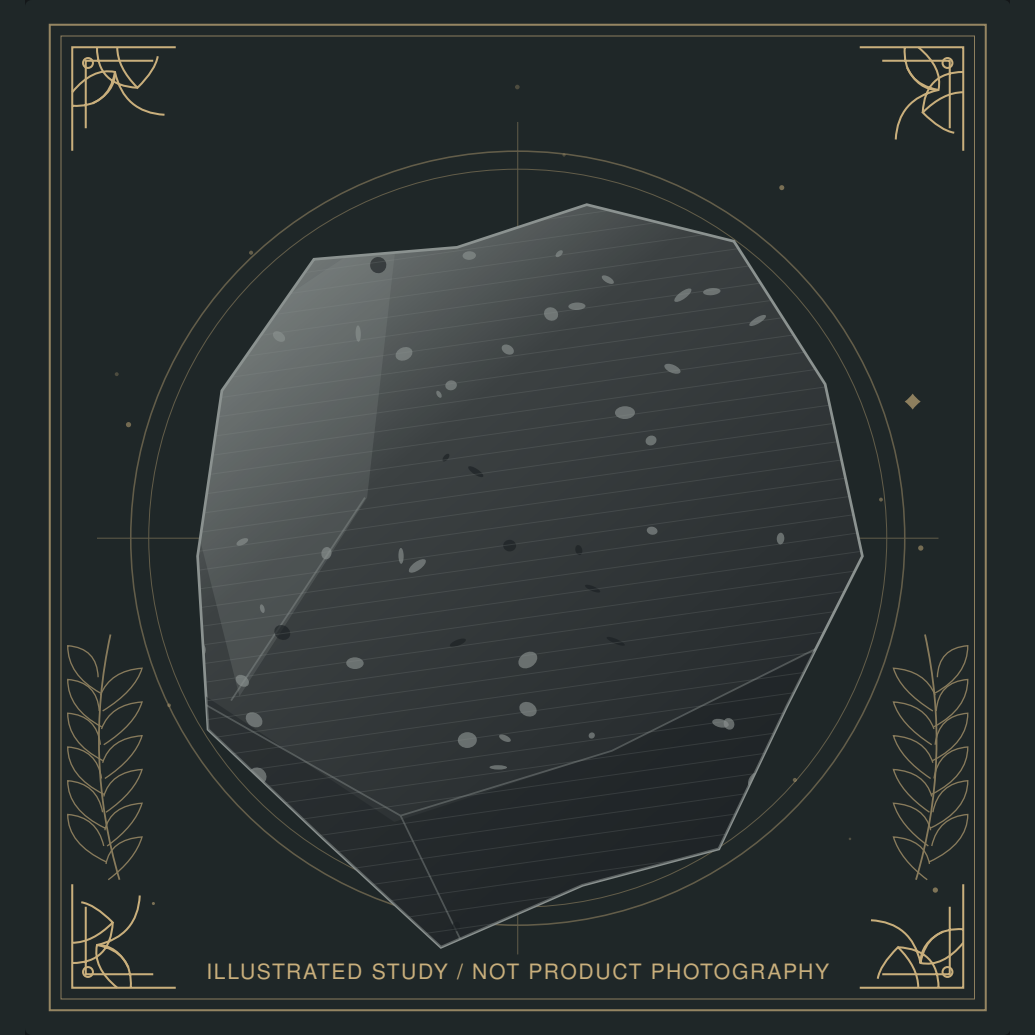
Material
Name used for carbon-rich mineraloid and carbon-bearing rock from Karelia. [2]
Family
Carbon-rich rock [2]
Appearance
Black carbon-rich material and carbon-bearing rock. [2]
Meaning & tradition
The Crystal Council: symbolic protection; no efficacy claim. [1]
In this guide
Visual identity & plain-language name
Shungite is used both for carbon-rich material and for associated carbon-bearing rocks, especially from Karelia. Carbon content and other constituents vary considerably. A polished black sphere does not establish one pure mineral formula or one consistent microstructure. [2]
Earth story: formation, structure & color
The 1997 research paper describes Lower Proterozoic carbon-bearing rocks near Lake Onega, with localized very carbon-rich glassy material. It documents structural heterogeneity and debates over origin. This is a geological carbon story, not a conventional single crystal species. Electrical properties studied in samples should not be converted into promises about an untested retail pendant. [2]
Shungite refers to carbon-rich geological material associated with the Lake Onega region, not one crystalline mineral species with a universal ideal formula. The Canadian Mineralogist study by Buseck and colleagues investigates structurally heterogeneous carbon in rocks of Lower Proterozoic age, about 2.0–2.1 billion years in the studied setting. Carbon-rich zones, mineral matrix and compositional differences are central to the research. A commercial stone can therefore vary substantially in carbon content and bulk properties. [2]
The paper reports low crystallinity, glassy carbon-rich material and local high-carbon examples. It discusses possible origins and does not settle every sample with one simple universal formation story. Some measured material is extremely brittle and has density around 1.9–2 and hardness near 3.5; those specimen-dependent observations should not become a guarantee for all shungite products. Conductivity is a physical measurement requiring a material and test context. It does not by itself establish a health benefit, a useful shielding performance or the identity of an untested black object. [2]
The cited research separates evidence for carbon structure from broader formation interpretations. A local analysis or observation of fullerene-related material cannot be converted into a constant fullerene concentration for every carbon-rich rock in the deposit or every shaped product. Mineral matrix and carbon-rich regions occur at different scales. Preserving that heterogeneity is essential to an accurate material label and prevents one celebrated research finding from becoming a universal composition claim. [2]
Electrical conductivity describes tested material behavior under stated conditions, not a universal finished-product performance. [2]
Varieties & look-alikes
Compare highly carbon-rich lustrous material, lower-carbon mixed rock and polished products. Elite or noble are trade descriptors rather than analytical certificates. Black glass, jet and other dark materials can resemble the appearance without sharing the composition. A photograph cannot measure carbon proportion. [2]
- Shungite
- The broad name covers carbon-rich geological material with variable matrix and structure. A confirmed locality and composition provide more useful detail than a black color or smooth polish. The research describes heterogeneity, so one formula, density or carbon percentage should not be assigned indiscriminately. Identify the rock or material category and retain analytical context. [2]
- Elite or noble grades
- These are commercial grading terms rather than formal mineral species. They may emphasize shiny fracture or high-carbon material, but an exact composition needs measurement of the particular sample. A grade name cannot establish fullerene abundance, therapeutic value or performance of a finished product. Preserve the seller's terminology separately from the examined material description. [2]
Human story: objects, names & cultural context
Scientific research uses Shunga-area material to discuss early carbon-rich geology. The authors retain competing interpretations of its origin rather than one simple formation myth. That scholarly history is valuable context, while modern product branding is another chapter. A regional geological age cannot certify the exact source or composition of every shop object. [2]
The scientific account relates the name to the regional occurrence and investigates a geologically old carbon material using modern analytical methods. That age belongs to the studied rocks, not to a carving's manufacturing date or a demonstrated ancient ritual use. Modern retail categories such as elite or noble add a trade history with grading vocabulary of their own. A documented collection locality and analytical record are more informative than attaching one exact geological age to every stone sold under the broad commercial name. [2]
Meaning & practice: attributed traditions
The Crystal Council assigns shungite symbolic protection and cleansing meanings. These are contemporary beliefs. They do not establish the publisher’s separate medical, drinking-water or electromagnetic-protection claims. [1]
An editorial protection reflection can ask what information and physical safeguards a situation actually needs. Use the object as a reminder to check evidence before accepting an impressive technical-sounding claim.
Material truth: trade names & treatments
Ask for carbon content evidence and material condition where purity is emphasized. A conductive sample is not automatically a tested protective product. Describe coating or stabilization when present. Do not infer safety or water-purification performance from a decorative stone’s name or from a laboratory study on different material. [2]
Elite and noble labels do not replace measured composition or a mineralogical description. A shiny fracture, black residue or conductivity may guide questions but cannot establish a standardized carbon percentage, fullerene content or product performance. The research discusses carbon structure and particular analyses; marketing should not extrapolate those findings into claims that a bead cleans drinking water or protects a person from radiation. A seller's laboratory report is useful only within its stated sample and measurement scope. [2]
Keep a carbon-rich rock's provenance, assessed constituents and physical condition in the collection record. Note whether surfaces are polished, glossy from fracture or coated, and whether brittle edges are intact. Avoid preparing powders or drinking-water treatments from an ornamental specimen. For a personal symbolic use, choose a meaning deliberately and separate it from electrical or chemical claims. The object can be valued as a striking geological material without turning its carbon content into a universal spiritual grade.
Sources & related specimens
The research paper supports geology, variable carbon content and origin debates. The Crystal Council supplies modern symbolic language. Compare jet for another carbon-rich gem material and obsidian for dark natural glass.
- The Crystal Council: Shungite
Primary publication · Contemporary symbolic associations attributed to The Crystal Council · Accessed October 9, 2026
- Shungites: The C-rich rocks of Karelia, Russia
The Canadian Mineralogist · Mineralogy, geology, naming and documented material history · Accessed October 9, 2026