
Iron mirror
Hematite
Iron oxide (Fe2O3).
Mineral species; ornamental specimens may include other minerals
Hematite is iron oxide, Fe2O3.
Geology · Human history · Attributed traditions
Explore the specimen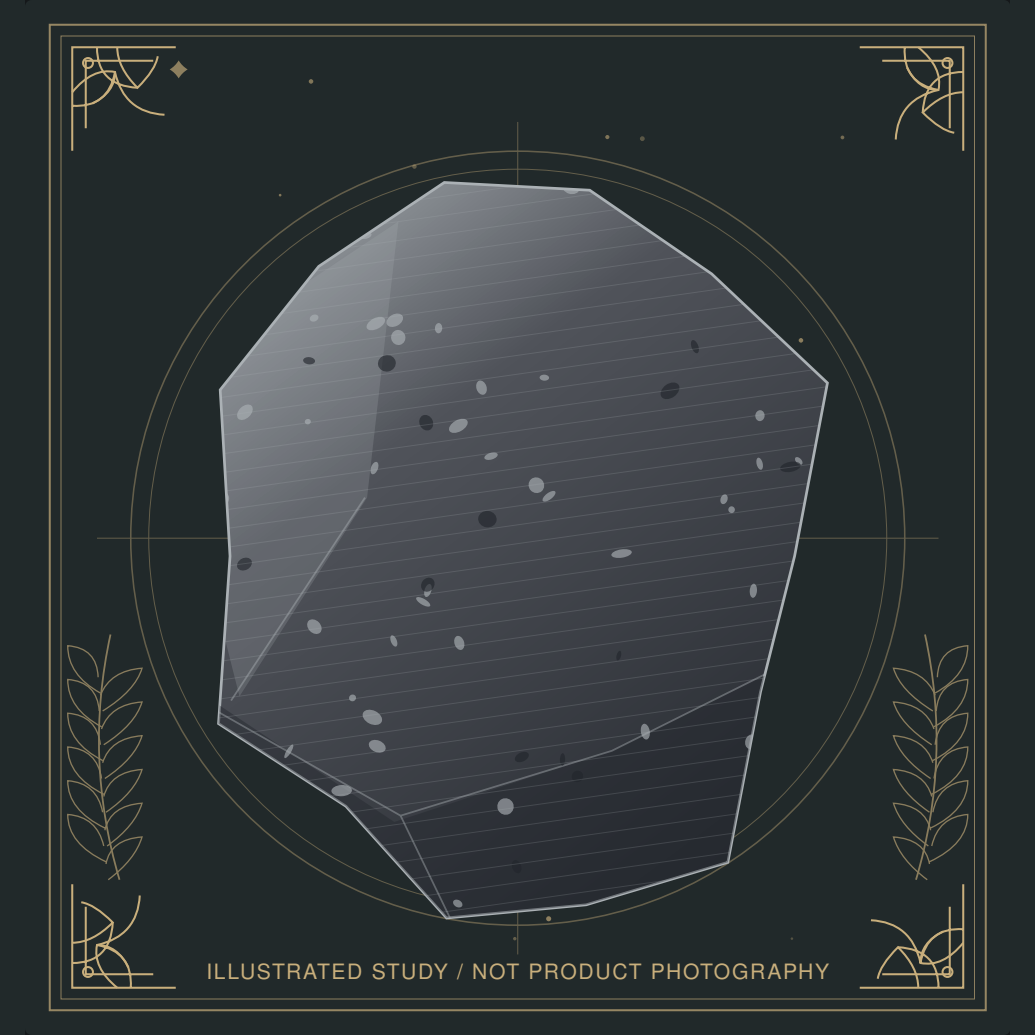
Material
Iron oxide (Fe2O3). [3]
Family
Iron oxides [3]
Appearance
Metallic gray surfaces, red-brown earthy material and iron-rose plates. [3]
Meaning & tradition
Emily Carlin: a contemporary protective-charm practice. [1]
In this guide
Visual identity & plain-language name
Hematite is iron oxide, Fe2O3. A polished metallic-gray bead and an earthy red-brown mass can be the same mineral category. Fine material gives a characteristic red-brown streak even when a whole specimen looks nearly black. Specular plates and iron-rose aggregates reveal other natural habits. [3]
Earth story: formation, structure & color
The Handbook records trigonal structure and hardness commonly around 5–6, with variable aggregate behavior. Hematite forms in several iron-bearing geological settings, including major sedimentary iron deposits and other environments. Metallic luster describes reflection, not the presence of native iron metal. [3]
Hematite is iron oxide, α-Fe2O3, with trigonal symmetry represented within the hexagonal system. It can appear as bright metallic gray plates, tabular rosettes, rounded masses, red earthy material or fine glittering grains. Its cherry-red to reddish-brown streak contrasts with the steel-gray surface of a polished piece. That powder color is a mineralogical clue, but it does not justify scratching a finished object unnecessarily. [3]
The Handbook gives hardness 5–6 and density about 5.26. Dense pieces can feel surprisingly heavy for their size, although other heavy materials can do the same. Hematite forms in diverse geological contexts and can occur with several other iron minerals. Its apparent metallic solidity should not erase brittle behavior or the possibility of separate constituents. A glossy bead, an iron rose and a red earthy coating express different morphology and texture without requiring different ideal oxide formulas. [3]
Red earthy and bright specular presentations show how different texture can alter surface appearance without replacing the iron-oxide identity. [3]
Varieties & look-alikes
Specular hematite, earthy hematite, iron roses and rounded masses are useful comparisons. Magnetite is another iron oxide with different chemistry and magnetic behavior. Magnetic hematite jewelry may be manufactured or a different product; GIA’s 1984 laboratory note also shows why magnetic response alone is not a universal identity rule. [3]
- Polished hematite
- A polished compact aggregate often shows a smooth metallic gray surface. The underlying oxide remains distinct from its manufactured shape and from any applied coating or assembled construction. Density, powder color and appropriate analytical properties can support identification, while shine alone cannot. A finished bead should not be damaged to reproduce a textbook streak illustration. [3]
- Specular hematite
- Specular material contains conspicuous reflective plates or grains, producing bright glitter. This is a texture of hematite rather than a gold-bearing glass or a different metallic species. The orientation of plates affects which flashes appear under a moving light. Loose or delicate surfaces deserve supported display and gentle handling instead of repeated rubbing. [3]
- Rainbow hematite
- Rainbow describes an iridescent appearance, which must be distinguished from any manufactured surface enhancement. The Handbook records iridescent tarnish in natural hematite, but that does not authenticate every multicolored retail object. A complete label identifies the substrate and any assessed coating separately. Illumination angle can strongly influence the displayed colors. [3]
- Iron roses
- Rose-like groups are built from hematite plates arranged as rosettes. The name refers to outward morphology rather than botanical origin or an independent mineral species. Thin plates can be fragile despite the mineral's high density. Natural arrangement, condition and any repair deserve documentation because they are part of the specimen's collector value. [3]
Human story: objects, names & cultural context
The Met records Egyptian hematite heart amulet 10.130.1796, dated 664–332 BCE. This provides a material-specific historical object, not evidence for modern magnetic-health or grounding claims. The object’s context deserves its own reading rather than a broad claim that every hematite bead has the same ancient meaning. [4]
The Metropolitan Museum identifies a hematite heart amulet from Egypt's Late Period, 664–332 BCE, as a specific material and object. That is documented historical use in a named cultural setting. It does not establish that every present-day hematite bead carries the same function or that modern protection wording reproduces its ancient meaning. The specimen name's connection with blood-red appearance belongs to another account, the history of mineral naming. Keeping those histories distinct makes both more informative. [4]
Meaning & practice: attributed traditions
Emily Carlin includes hematite in her protective-charm practice published May 12, 2026. This documents a contemporary belief rather than demonstrated protection. [1]
An editorial protection intention can focus on an ordinary boundary: choose what information to share, what situation to leave or whom to contact for help. The object can recall that boundary; it is not a substitute for protective action.
Material truth: trade names & treatments
GIA examined confusing magnetic hematite and hematite-imitation material in a 1984 laboratory report. Its findings show that a magnet, fracture and streak must be interpreted together rather than reduced to one simple rule. Do not damage finished jewelry for a casual test. Describe manufactured magnetic material and known coatings honestly. [2][3]
GIA's discussion of manufactured hematite-like products warns against treating a magnet response as a complete identification. Artificial material sold under names such as Hemetine belongs to a different material category, but mixtures and unusual natural material complicate simplistic tests. Report examined identity and manufacture rather than applying the rule magnetic means fake to every object. A lustrous surface and heavy feel are likewise observations, not conclusive proof of natural hematite. [2][3]
For a collection, compare the metallic face with a documented red earthy specimen without damaging either. Record whether an object is confirmed natural hematite, hematite-bearing rock or a manufactured magnetic product. A naturally iridescent surface and an applied colored coating are separate possibilities that need assessment. Preserve the distinction in jewelry labels and inherited collection notes. The visual appeal of a metallic bead does not depend on hiding manufacture or on assigning it the entire geological history of natural iron oxide.
Sources & related specimens
The Handbook establishes the iron-oxide identity. The Met supplies a dated object, GIA discusses identification complications, and Carlin supplies the modern practice. Compare magnetite for a separate magnetic iron mineral.
- Emily Carlin: Protection Charm (2026)
Llewellyn Worldwide · Emily Carlin’s contemporary protective-charm symbolism · Accessed October 9, 2026
- GIA: Spring 1984 Lab Notes on magnetic hematite and Hemetine
Gemological Institute of America · Magnetism alone cannot categorically distinguish natural hematite from a simulant · Accessed October 9, 2026
- Handbook of Mineralogy: Hematite
Mineralogical Society of America · Identity and natural history · Accessed October 9, 2026
- Met: Hematite heart amulet 10.130.1796
The Metropolitan Museum of Art · Material and dating of one identified Egyptian hematite heart amulet · Accessed October 9, 2026