
A veined green landscape
Serpentine
Serpentine-group minerals and serpentine-rich rock
Hydrous magnesium silicate mineral group and related serpentinite rocks
Serpentine names a mineral group, while serpentinite is a rock dominated by serpentine minerals. Green carving material can include antigorite or lizardite, but a decorative photograph cannot establish its precise components. The group also includes fibrous chrysotile, making a species-level distinction consequential.
Geology · Human history · Attributed traditions
Explore the specimen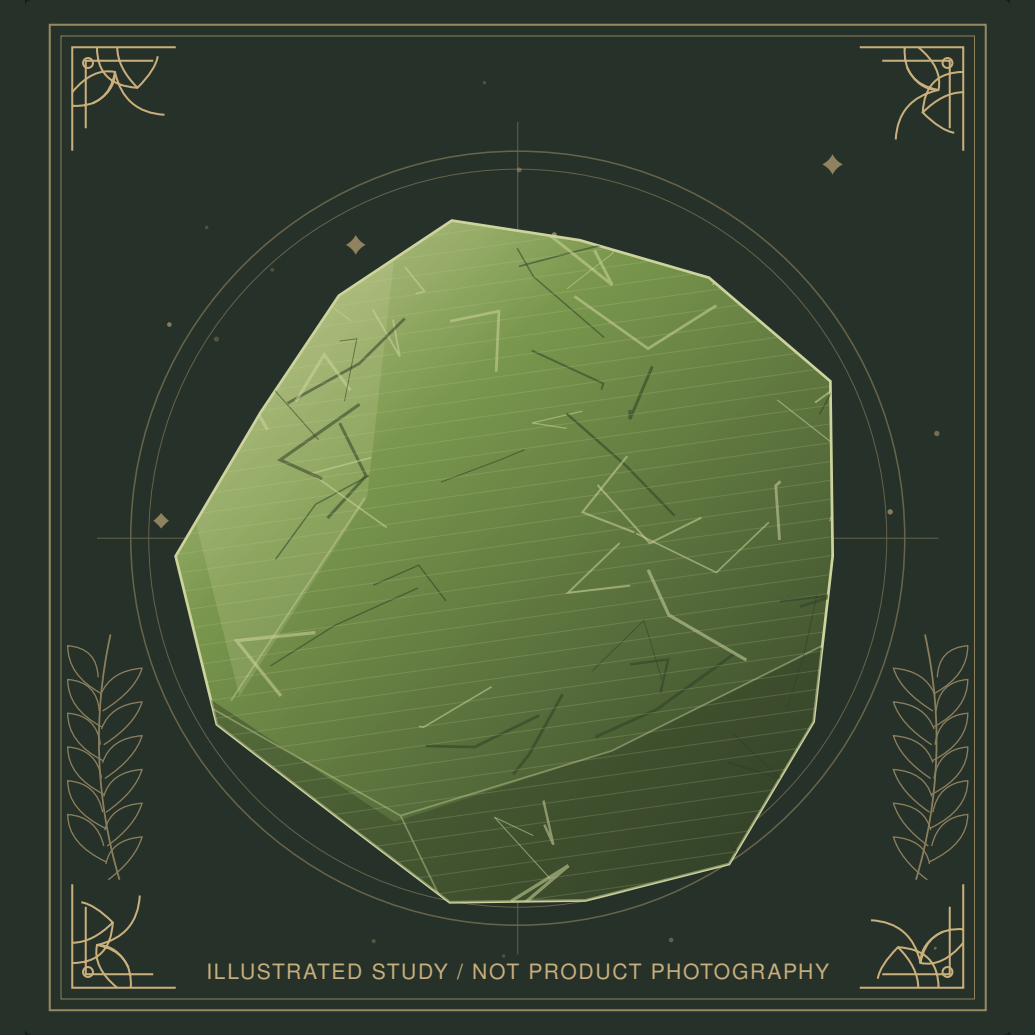
Traditions
The Crystal Council uses nature connection and kundalini imagery in its contemporary serpentine account. [10]
In this guide
Visual identity
Serpentine names a mineral group, while serpentinite is a rock dominated by serpentine minerals. Green carving material can include antigorite or lizardite, but a decorative photograph cannot establish its precise components. The group also includes fibrous chrysotile, making a species-level distinction consequential. [1][2][3][4]
Green may be pale, yellowish, dark or mottled, and included dark minerals or veins can produce a patterned object. Those textures deserve to remain visible in an illustration, because they distinguish many serpentine-rich stones from a uniformly translucent gem. The smooth shape of a palm stone is manufactured, while grain boundaries and contrasting areas belong to the material. A brittle mineral fragment, a coherent carving and a fibrous geological sample also represent different physical forms, even when they are discussed within the same group. [1][2][4]
Earth story: geology and formation
The Handbook of Mineralogy describes magnesium-rich layered silicates associated with alteration of ultramafic rocks. Antigorite and lizardite differ structurally. Stichtite can occur with serpentinite and contribute purple areas. This assemblage is a rock-level relationship rather than one uniformly colored crystal species. Antigorite is recorded as replacing ultramafic rocks and sometimes forming crosscutting veinlets. Lizardite commonly replaces earlier olivine or pyroxene during alteration. Their associated phases can include magnetite, chromite and other serpentine minerals. Such a rock retains a sequence of reactions, not simply one green substance. A polished slice can reveal veins and contrasting components while laboratory analysis is needed to identify them precisely. [1][2][3][4]
Antigorite and lizardite are layered magnesium silicates with related but distinct structures. The Handbook records antigorite hardness around 2.5–3.5 and lizardite about 2.5, much lower than quartz; their density ranges and cleavage also differ. These are species reference properties rather than a certification of an unknown mixed carving rock. Serpentinite can retain other minerals and textures from the alteration of an earlier ultramafic rock. A veined polished surface displays part of that aggregate, while laboratory examination is needed for its detailed composition and any fibrous components. [1][2]
Serpentine-group minerals commonly develop through alteration of magnesium-rich rocks, including the replacement of olivine and pyroxene. Antigorite and lizardite are different structural members; related rocks can also contain magnetite, chromite and other phases. A serpentine-rich carving is therefore often a rock or aggregate rather than an isolated pure crystal of one species. The original ultramafic material, the alteration and any later veins form different parts of its geological history. A uniform polished green surface can conceal much of that mixed and changing texture. [1][2]
Varieties and lookalikes
These names describe different levels of information: a mineral species, a visual variety, a crystal habit or a retail label. The distinctions below keep the recognizable shop vocabulary alongside its material explanation.
New jade, Chinese jade and similar green-stone names need a geological qualifier wherever the actual material is serpentine. The decorative resemblance does not make it jadeite or nephrite. Bowenite is also used for compact serpentine material in the trade, rather than supplying a third approved jade species. Atlantisite commonly refers to a serpentine-rich material containing purple stichtite; identifying both components explains its contrasting colors more clearly than calling it a new single crystal species. [5][6][7][3][8]
- Antigorite and lizardite
- Distinct serpentine-group minerals with differing structures. A finished green object requires evidence before either is named specifically. [1][2][3][4]
- Bowenite and new jade
- Bowenite is a recognized serpentine variety name in the gemological literature, while new jade is a trade label that needs an explicit host identification. GIA documents serpentine’s use as a jadeite or nephrite imitation. Te Papa also identifies bowenite in its culturally specific account of tangiwai pounamu. These different naming contexts should not be merged into a third approved jade species or treated as permission to apply a Māori term to every imported green serpentine carving. [5][6][11]
- Infinite stone
- Infinite Stone is an evocative commercial label used within contemporary serpentine commerce. Its appearance or spiritual branding does not establish a fixed approved mineral species or complete formula. An offered specimen needs its host and components identified independently. The Crystal Council names Infinite in its Atlantisite comparison, which documents the current commercial vocabulary without certifying the exact composition of every object sold with that word. [7][1][2]
- Atlantisite/stichtite-bearing serpentinite
- The Crystal Council uses Atlantisite for a serpentine-and-stichtite decorative combination. This source establishes current retailer terminology, while the Handbook separately documents stichtite’s mineral identity and association with serpentine-rich material. The green and purple parts represent different components rather than one approved Atlantisite mineral species. The trade name alone does not authenticate a Tasmanian source or identify every visible purple inclusion in an unfamiliar green rock. [7][3]
Human story: history and naming
British Museum EA56465 is a black-brown serpentine magical amulet from the eastern Mediterranean, dated to the fourth–fifth centuries CE. Its engraved imagery includes an ibis, serpents and an ouroboros. The object supports a specific Late Roman history of engraved amulets, not a universal power attached to all green serpentine. [9]
The British Museum’s Late Roman amulet EA56465 combines black-brown serpentine with an engraved image and inscription. Its record identifies a fourth- to fifth-century eastern Mediterranean context and describes imagery including an ibis, serpents and a key-related motif. This documents a particular worked magical object. It does not establish that modern green tumbles were historically used for the same purpose. Material history is strongest when the stone, image, date and context remain linked, rather than separating the rock name from all the other evidence. [9]
Meaning and practice: attributed traditions
The Crystal Council uses nature connection and kundalini imagery in its contemporary serpentine account. This is an attributed modern framework, distinct from the Late Roman object and from mineral structure. The interpretation does not establish a physiological activation or a treatment for trauma. [10]
An optional transformation reflection can consider one ordinary change of habit. The veined rock is a chosen metaphor, not an agent changing the body.
The Crystal Council describes nature connection and kundalini imagery in its modern serpentinite-related spiritual account. The imagery is an attributed interpretation, not a demonstration that a hydrous magnesium silicate activates a physiological energy system. A reader can adopt an intended meditation on renewal or connection with landscape while retaining the rock’s actual mineral description. The modern practice, the Late Roman engraved object and the geological alteration history are three distinct contexts; a shared material name does not collapse their meanings into one continuous tradition. [10]
Material identity and trade terminology
New jade can be serpentine, not nephrite or jadeite. Infinite stone and Atlantisite are trade names whose composition needs disclosure. Species, fibrous character and source cannot be inferred simply from green color. USGS material on asbestos explains why unidentified fibrous rough should not be ground or subjected to casual destructive tests. [1][2][3][4]
Fibrous chrysotile belongs to the serpentine family, but not every compact serpentine object has the same visible form or exposure conditions. The USGS account is useful for distinguishing mineral family membership from an assessment of a particular specimen. Rough material with loose or unidentified fibers calls for professional identification rather than exploratory grinding. The relevant handling distinction concerns whether material can release respirable fibers or dust. It should not be turned into either a blanket assurance about every carved object or a claim that all polished green serpentine is visibly asbestos. [4]
Sources and related specimens
The references below distinguish mineral identification and physical properties from historical interpretation and practitioner symbolism. A cited material category describes a kind of stone; it does not certify the identity, treatment or provenance of an untested individual retail specimen.
- Handbook of Mineralogy: Antigorite
Mineralogical Society of America · Mineral composition, structure, physical properties and occurrence · Accessed October 9, 2026
- Handbook of Mineralogy: Lizardite
Mineralogical Society of America · Mineral composition, structure, physical properties and occurrence · Accessed October 9, 2026
- Handbook of Mineralogy: Stichtite
Mineralogical Society of America · Mineral composition, structure, physical properties and occurrence · Accessed October 9, 2026
- USGS: Asbestos Geology, Mineralogy, Mining and Uses
US Geological Survey · Geological, gemological or documented material-history evidence · Accessed October 9, 2026
- Gems & Gemology Summer 2009: Cat’s-eye serpentine
Gemological Institute of America · Geological, gemological or documented material-history evidence · Accessed October 9, 2026
- Serpentine Cabochon with an Unusual Olive Green Color (2015)
Gemological Institute of America · Geological, gemological or documented material-history evidence · Accessed October 9, 2026
- The Crystal Council: Atlantisite
The Crystal Council · Contemporary practitioner symbolism and retailer terminology; distinct from mineralogical evidence · Accessed October 9, 2026
- GIA: Jade Description
Gemological Institute of America · Geological, gemological or documented material-history evidence · Accessed October 9, 2026
- British Museum: Late Roman serpentine magical gem EA56465
British Museum · Documented museum object, material and historical context · Accessed October 9, 2026
- The Crystal Council: Serpentine
The Crystal Council · Contemporary practitioner symbolism and retailer terminology; distinct from mineralogical evidence · Accessed October 9, 2026
- Te Papa: Pounamu
Museum of New Zealand Te Papa Tongarewa · Documented museum object, material and historical context · Accessed October 9, 2026