
The ember pebble
Carnelian
Orange to reddish chalcedony.
Patterned or colored microcrystalline silica aggregate
Carnelian is orange-to-red chalcedony, commonly translucent at a thin edge and smooth or waxy in its polished appearance. Its fine texture makes it suitable for small carvings and engraved surfaces rather than large visible pointed crystals.
Geology · Human history · Attributed traditions
Explore the specimen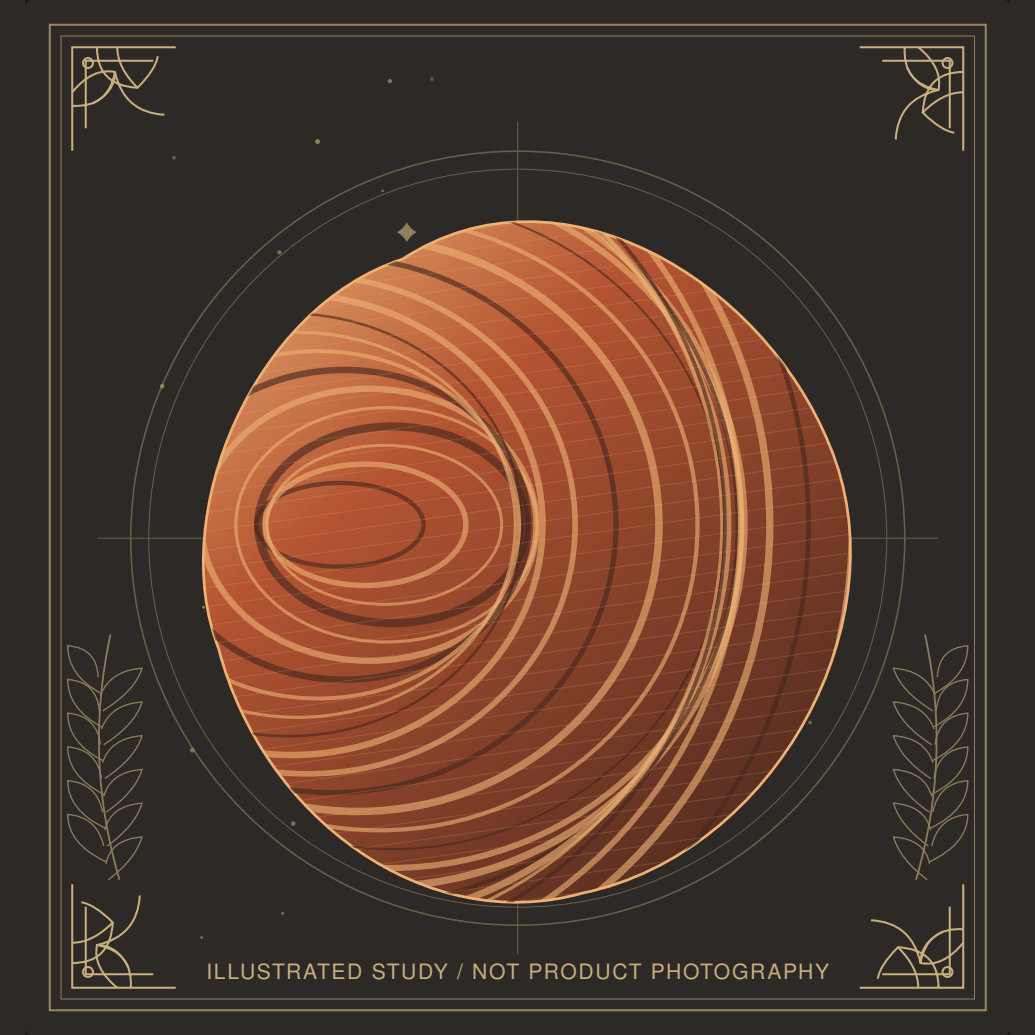
Traditions
Stephanie Rose Bird’s 2003 account associates carnelian with vitality and protection in her discussion of contemporary Hoodoo practice. [7]
In this guide
Visual identity
Carnelian is orange-to-red chalcedony, commonly translucent at a thin edge and smooth or waxy in its polished appearance. Its fine texture makes it suitable for small carvings and engraved surfaces rather than large visible pointed crystals. [1][2]
Carnelian’s warm color can be pale orange, orange-red or a deeper brownish red, with enough translucency in many pieces for light to soften thin edges. Sard describes the browner end of this related chalcedony range in conventional gem terminology. The boundaries are descriptive rather than different mineral formulas. A finished bead may be evenly colored because the cutter selected one part of a varied rough piece; another object may preserve clouds or faint layers. Neither appearance alone tells the complete treatment history. [1][3]
Earth story: geology and formation
The Australian Museum places carnelian within microcrystalline quartz. A cut surface can show even color or bands; the darker brown related trade variety is commonly called sard. A piece’s color may also have been changed by heating or dyeing, so its geological material and color history remain distinct. [1][2]
Fine-grained silica differs visually from a single clear quartz crystal: its tiny crystallites and inclusions scatter light and produce a waxy or softly glassy surface. The Australian Museum gives microcrystalline quartz a hardness around 6.5, refractive indices of approximately 1.530–1.539, and specific gravity around 2.57–2.64. These are reference ranges, not a certificate for every rock sold under a related trade name. Many fine-grained silica materials accept artificial color because their microstructure can admit a staining solution. The visible pattern, the aggregate structure and any treatment must therefore be considered together. A highly polished surface reveals contrast in a cut section; it does not show the complete shape in which the material originally formed. [1]
The fine-grained host is not a single large orange quartz crystal. Color-bearing material within silica contributes to the appearance, while polishing exposes a continuous-looking surface composed of much smaller crystalline units. The general quartz-family occurrence includes sedimentary and hydrothermal settings, but that broad information should not be mistaken for a known origin of every carnelian bead. A locality attribution connects a specimen to geological context only when the collection or supply history has preserved that link. [1][4]
Varieties and lookalikes
These names describe different levels of information: a mineral species, a visual variety, a crystal habit or a retail label. The distinctions below keep the recognizable shop vocabulary alongside its material explanation.
A carved intaglio places its design below the stone’s surface, whereas a cameo is carved in relief. Chalcedony’s suitability for these processes helped sustain its long use in gem carving. A plain carnelian object can therefore be understood as one member of a much wider worked-silica tradition, without assigning an ancient date to the individual object. Red jasper is a useful visual comparison, but its generally opaque character and broader mixed-material naming differ from the translucent carnelian category. [5][1]
Human story: history and naming
The British Museum’s nineteenth-century Iranian wrestler’s armband, 2008,6040.1, holds carnelian and chalcedony amulets engraved with Qur’anic verses. Its talismanic meaning belongs to that inscribed object and Iranian wrestling context. It is stronger evidence than asserting one magical use for all carnelian across cultures. Vapriikki connects the carnelian name with the color of the cornel cherry. That naming explanation is a separate linguistic history from the Iranian armband’s ritual context. The armband includes multiple engraved pieces rather than one undifferentiated orange stone. Its inscriptions and arrangement show deliberate human choices; neither the Arabic verses nor the wrestler’s social context can be inferred from a loose modern carnelian tumble. [6]
The British Museum’s documented Iranian armband joins stone identity to a very specific use: carnelian and chalcedony amulets mounted in leather and carrying inscriptions. Its nineteenth-century setting is evidence for that object and period. It should not be stretched into a claim that all orange chalcedony was used in the same way throughout the Islamic world. Material, inscription, manufacture and recorded cultural setting together give an amulet a history that a loose modern tumble does not carry by color alone. [6]
Meaning and practice: attributed traditions
Stephanie Rose Bird’s 2003 account associates carnelian with vitality and protection in her discussion of contemporary Hoodoo practice. These are attributed meanings within the author’s framework. They can coexist with the specific Iranian object history without merging two traditions into a universal stone correspondence. [7]
A personal vitality reflection can focus on one chosen activity rather than a promised effect. A warm-colored carving can function as its visual reminder.
Material identity and trade terminology
Heating and dyeing may alter color. Sard and banded carnelian describe related silica appearances, not new unrelated mineral species. An object’s material, inscription and treatment are separate features; none can be established simply from an orange photograph. [1][2]
An orange appearance may be natural or enhanced, and the treatments chapter belongs to the finished stone’s description. GIA’s treatment overview explains that heating and dyeing can change gemstone appearance; chalcedony is particularly important in the dyeing trade. A seller’s statement of natural material should not be read as a statement of natural color unless it explicitly addresses both. Nor does a reddish-brown shade guarantee antiquity: modern carving and enhancement can reproduce colors familiar from museum objects. [2][5]
Sources and related specimens
The references below distinguish mineral identification and physical properties from historical interpretation and practitioner symbolism. A cited material category describes a kind of stone; it does not certify the identity, treatment or provenance of an untested individual retail specimen.
- Quartz
Australian Museum · Geological, gemological or documented material-history evidence · Accessed October 9, 2026
- GIA: An Introduction to Gem Treatments
Gemological Institute of America · Geological, gemological or documented material-history evidence · Accessed October 9, 2026
- Natural Gemstones: Mineral Gemstones
US Geological Survey · Geological, gemological or documented material-history evidence · Accessed October 9, 2026
- Handbook of Mineralogy: Quartz
Mineralogical Society of America · Mineral composition, structure, physical properties and occurrence · Accessed October 9, 2026
- Gem Cutters Reveal the Beauty of Chalcedony
Gemological Institute of America · Geological, gemological or documented material-history evidence · Accessed October 9, 2026
- British Museum: Iranian wrestler’s armband
British Museum · Documented museum object, material and historical context · Accessed October 9, 2026
- Stephanie Rose Bird: Using Stones, Minerals, and Metals for a Charmed Life (2003)
Llewellyn Worldwide · Contemporary practitioner symbolism and retailer terminology; distinct from mineralogical evidence · Accessed October 9, 2026