
Parallel strata
Onyx and Sardonyx
Parallel-banded chalcedony; sardonyx includes sard-colored bands.
Patterned or colored microcrystalline silica aggregate
Onyx and sardonyx are layered chalcedony materials. Straight or nearly parallel contrasting bands offer a carver a deliberate relationship between image and ground. Sardonyx includes reddish-brown layers; the retail name onyx also needs separation from softer banded carbonate.
Geology · Human history · Attributed traditions
Explore the specimen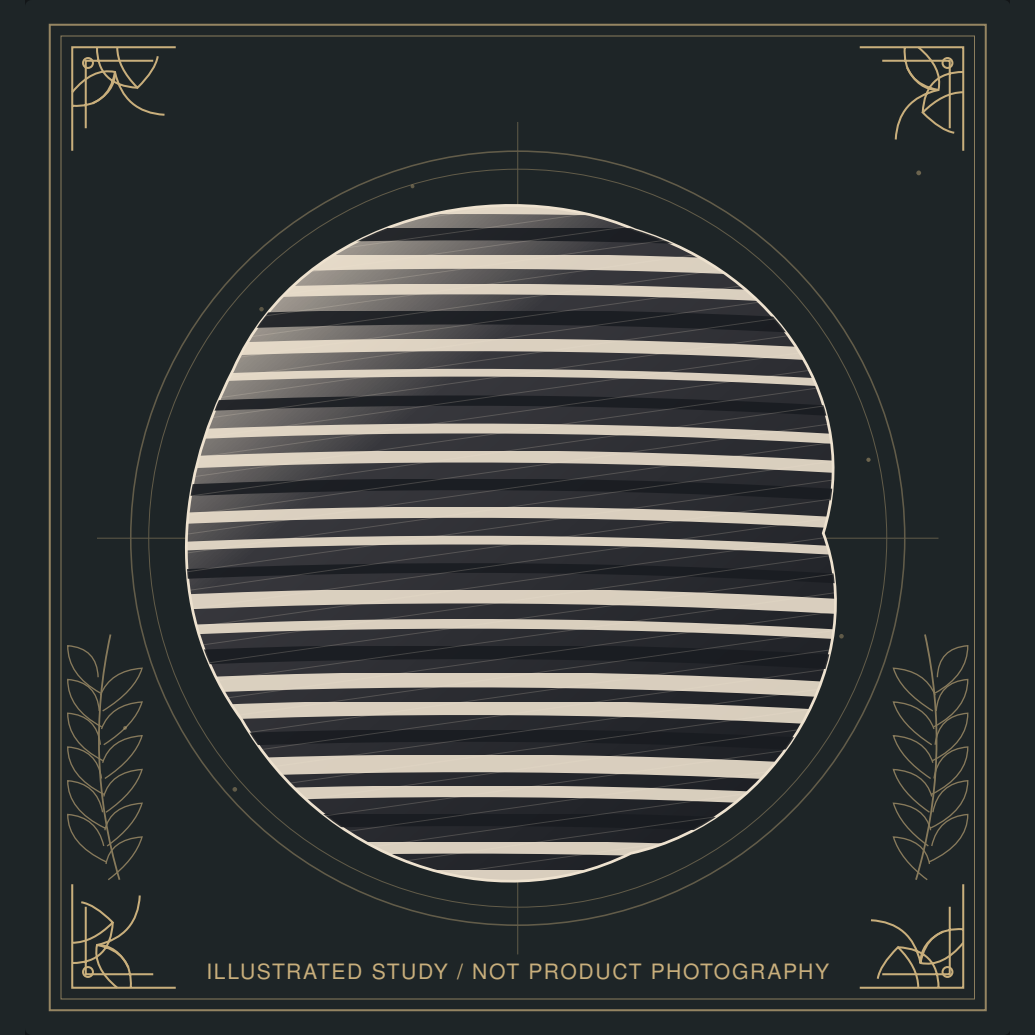
Traditions
Stephanie Rose Bird’s 2003 account includes onyx in protection-oriented symbolism. [8]
In this guide
Visual identity
Onyx and sardonyx are layered chalcedony materials. Straight or nearly parallel contrasting bands offer a carver a deliberate relationship between image and ground. Sardonyx includes reddish-brown layers; the retail name onyx also needs separation from softer banded carbonate. [1][2][3]
Contrasting layers make these materials particularly suited to an image carved through one color into another. Straight or comparatively parallel bands are the conventional distinction from the more curved layering commonly associated with agate. Sardonyx adds the warm brown to reddish-brown sard component to the naming. A solid-looking black object, however, does not automatically reveal naturally black onyx: black color may have been introduced into a chalcedony host, and the finished surface may conceal its original layering. [2][1][3]
Earth story: geology and formation
The Australian Museum and US Geological Survey place these names within microcrystalline silica. A sliced surface exposes layers, while a uniformly dark polished object may conceal both its starting pattern and any color treatment. Banding is a texture, not evidence that carbonate and quartz have become the same mineral. [1][2][3]
Fine-grained silica differs visually from a single clear quartz crystal: its tiny crystallites and inclusions scatter light and produce a waxy or softly glassy surface. The Australian Museum gives microcrystalline quartz a hardness around 6.5, refractive indices of approximately 1.530–1.539, and specific gravity around 2.57–2.64. These are reference ranges, not a certificate for every rock sold under a related trade name. Many fine-grained silica materials accept artificial color because their microstructure can admit a staining solution. The visible pattern, the aggregate structure and any treatment must therefore be considered together. A highly polished surface reveals contrast in a cut section; it does not show the complete shape in which the material originally formed. [1]
Fine-grained silica provides the host framework, while successive contrasting deposits provide the visual layering. The layer pattern remains visible after a rough object is cut, but the number and thickness of bands exposed depend on orientation. A small pendant may show only two contrasting regions that are part of a more complex larger nodule. The polished face thus presents a selected section through the geological material, rather than a complete view of the original deposit or all its internal structures. [1][4]
Varieties and lookalikes
These names describe different levels of information: a mineral species, a visual variety, a crystal habit or a retail label. The distinctions below keep the recognizable shop vocabulary alongside its material explanation.
Banded calcite sold as onyx marble belongs to a different composition and has much lower hardness than quartz-rich chalcedony. The familiar word onyx therefore needs a material qualifier when used for a carved bowl, lamp or architectural object. A natural layered chalcedony cameo, dyed black chalcedony and banded carbonate ornament may all be attractive, but their durability and identity are not interchangeable. The appropriate comparison asks what the host is before interpreting the visible bands as proof of a particular onyx category. [5][4][2]
Human story: history and naming
Carved layered chalcedony belongs to the history of gem engraving. Vapriikki explains the long use of separate names for fine-grained silica appearances. A cameo can exploit contrasting layers as a technical choice; the object’s historical meaning still depends on its image, inscription, date and use. [6]
Gem engraving uses the contrast within a layered stone as part of the design. Raised cameo carving and recessed intaglio engraving are different techniques, each supported by the long chalcedony craft history described by GIA. A cutter can choose layers to separate a figure from its background or emphasize details. The result joins a natural pattern to a deliberate human composition. Attribution of the image, workshop and period still requires the object’s own evidence; layer colors do not date the carving. [7]
Meaning and practice: attributed traditions
Stephanie Rose Bird’s 2003 account includes onyx in protection-oriented symbolism. This is an attributed practitioner interpretation within her discussion of contemporary Hoodoo. It does not establish that all black stones or every sardonyx carving shares the same tradition. [8]
An optional reflective prompt is to consider which boundaries help preserve attention. The layered surface provides a metaphor without prescribing a protective outcome.
Bird’s protection-oriented onyx discussion belongs to an identifiable contemporary practitioner publication. It can be respected in that setting without assigning one belief to every historical cameo or every black decorative stone. The image carved into an antique sardonyx object may communicate family, political or religious meaning of its own, distinct from a present-day crystal correspondence. An owner can select a protective symbolic theme while retaining that distinction between material history, object imagery and modern personal practice. [8][7]
Material identity and trade terminology
Uniform black onyx may be dyed chalcedony. Mexican, green or Pakistan onyx can instead denote banded carbonate, which belongs with calcite or aragonite material. The decorative trade name alone is therefore insufficient; identity and color treatment are separate disclosures. A cameo can exploit different colored layers by cutting an image in relief against a contrasting ground. The resulting picture expresses a craft decision while the layers themselves predate the carving. By contrast, a banded carbonate bowl may use the onyx name in decorative commerce but differs in hardness and composition. Preserving this distinction prevents a discussion of silica engraving from being transferred automatically to a softer carbonate household object. [1][2][3]
Sources and related specimens
The references below distinguish mineral identification and physical properties from historical interpretation and practitioner symbolism. A cited material category describes a kind of stone; it does not certify the identity, treatment or provenance of an untested individual retail specimen.
- Quartz
Australian Museum · Geological, gemological or documented material-history evidence · Accessed October 9, 2026
- Natural Gemstones: Mineral Gemstones
US Geological Survey · Geological, gemological or documented material-history evidence · Accessed October 9, 2026
- GIA: An Introduction to Gem Treatments
Gemological Institute of America · Geological, gemological or documented material-history evidence · Accessed October 9, 2026
- Handbook of Mineralogy: Quartz
Mineralogical Society of America · Mineral composition, structure, physical properties and occurrence · Accessed October 9, 2026
- Handbook of Mineralogy: Calcite
Mineralogical Society of America · Mineral composition, structure, physical properties and occurrence · Accessed October 9, 2026
- Chalcedonies
Vapriikki Mineral Museum · Geological, gemological or documented material-history evidence · Accessed October 9, 2026
- Gem Cutters Reveal the Beauty of Chalcedony
Gemological Institute of America · Geological, gemological or documented material-history evidence · Accessed October 9, 2026
- Stephanie Rose Bird: Using Stones, Minerals, and Metals for a Charmed Life (2003)
Llewellyn Worldwide · Contemporary practitioner symbolism and retailer terminology; distinct from mineralogical evidence · Accessed October 9, 2026