
A mineral garden
Moss and Tree Agate
Chalcedony with mineral inclusions resembling moss or branches.
Patterned or colored microcrystalline silica aggregate
Moss and tree agate contain mineral patterns that resemble small gardens or branches. The resemblance is descriptive: no plant needs to be present. Tree-agate retail material often emphasizes green marks against a paler field, while a more translucent background can make moss-like inclusions appear deeper.
Geology · Human history · Attributed traditions
Explore the specimen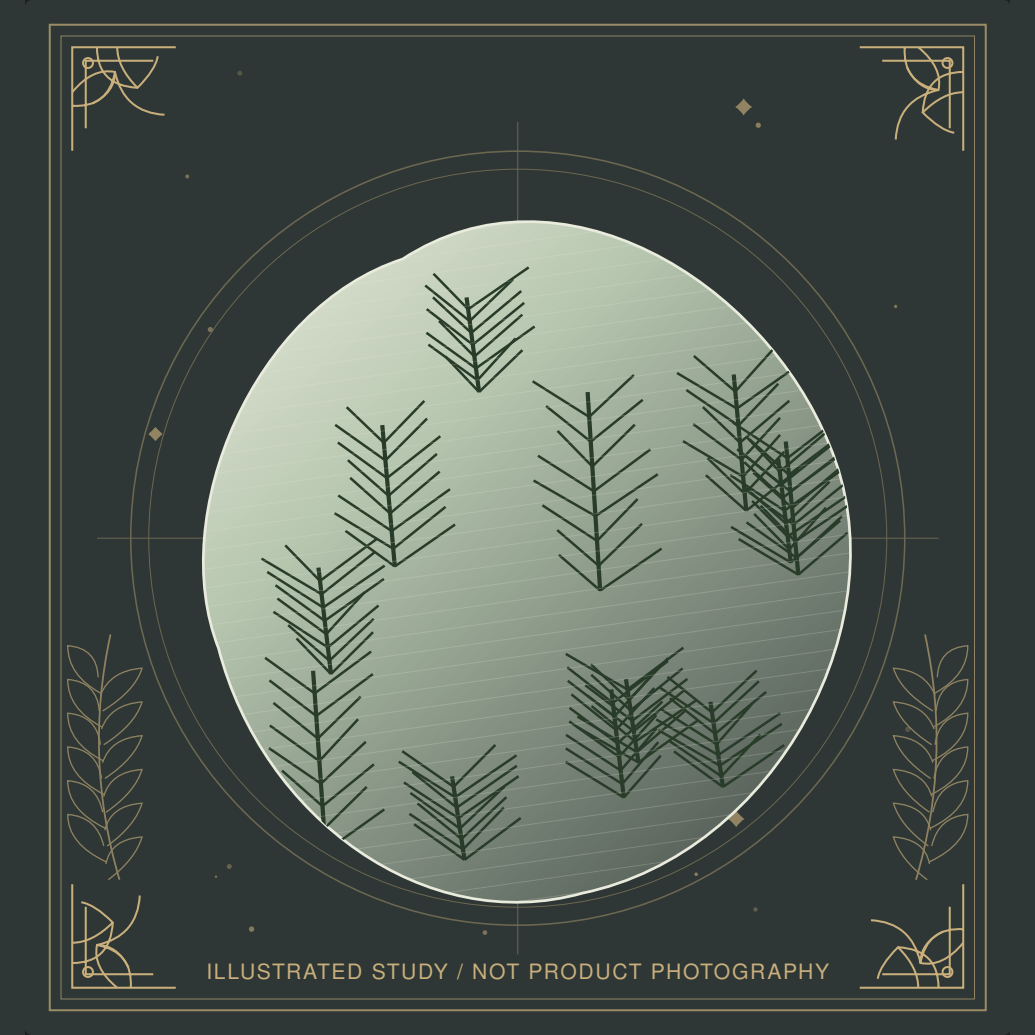
Traditions
Margaret Ann Lembo’s 2013 chart places green moss agate with compassion, companionship and heart-related symbolism. [5]
In this guide
Visual identity
Moss and tree agate contain mineral patterns that resemble small gardens or branches. The resemblance is descriptive: no plant needs to be present. Tree-agate retail material often emphasizes green marks against a paler field, while a more translucent background can make moss-like inclusions appear deeper. [1][2]
The green inclusions can appear as sparse twigs, dense clouds or broader branching areas. Moss agate often allows light through its background, while tree-agate goods are commonly presented with a more opaque white field. These are visual trade distinctions inside a fine-grained silica family, and intermediate appearances occur. The attractive botanical resemblance belongs to the pattern: the terms do not identify petrified leaves or establish that a living moss plant was entombed in the stone. [1][3]
Earth story: geology and formation
The Australian Museum lists moss agate as translucent silica with fern-like mineral inclusions. GIA’s inclusion research demonstrates why shape alone cannot identify an inclusion mineral. A plant-like pattern and a fossil are different kinds of object, and the host can contain several components. [1][2]
Fine-grained silica differs visually from a single clear quartz crystal: its tiny crystallites and inclusions scatter light and produce a waxy or softly glassy surface. The Australian Museum gives microcrystalline quartz a hardness around 6.5, refractive indices of approximately 1.530–1.539, and specific gravity around 2.57–2.64. These are reference ranges, not a certificate for every rock sold under a related trade name. Many fine-grained silica materials accept artificial color because their microstructure can admit a staining solution. The visible pattern, the aggregate structure and any treatment must therefore be considered together. A highly polished surface reveals contrast in a cut section; it does not show the complete shape in which the material originally formed. [1]
The host and the green-looking inclusions should be described separately. A silica-rich host can remain pale or translucent while small quantities of other mineral matter produce a branching scene. The inclusions may be too fine to identify by eye, and green color alone cannot determine their exact composition. Geology explains how contrasting phases become part of a solid material; the landscape perceived in a polished slice is the viewer’s reading of that contrast. Different cut directions can expose quite different apparent scenes. [1][4]
Varieties and lookalikes
These names describe different levels of information: a mineral species, a visual variety, a crystal habit or a retail label. The distinctions below keep the recognizable shop vocabulary alongside its material explanation.
Moss and dendritic agate overlap in the language of branching, but the latter term describes a shape rather than specifically a green color. Dendritic agate may show dark brown or black branching on a pale host. A seller can accurately use a familiar pattern name while also explaining whether the piece has visible banding. The name agate is widespread in the trade even for patterned chalcedony that does not exhibit the strict banding many geological descriptions associate with agate. [1][3]
Human story: history and naming
Vapriikki describes moss agate among chalcedonies named for appearance. This naming history explains the appeal of landscape language without supplying a universal ancient nature rite. The mineral texture can be appreciated as an image while the scientific description remains a record of host and inclusions. [3]
Meaning and practice: attributed traditions
Margaret Ann Lembo’s 2013 chart places green moss agate with compassion, companionship and heart-related symbolism. The attribution is specific to her contemporary framework. Tree-agate material should not automatically inherit every claimed association merely because a retailer displays it nearby. [5]
A personal nature reflection can begin by comparing the mineral pattern with an actual leaf or branch, noticing both the resemblance and the differences.
In Lembo’s green-stone correspondences, moss agate sits beside green aventurine, jade and calcite. Nature, kindness and abundance can be understandable interpretive themes, yet the grouping is spiritual symbolism rather than a botanical or mineral taxonomy. The branching inclusions may become a focus for a personally chosen reflection on growth or patience. This use should remain distinct from a prediction about gardening success, rainfall, fertility or prosperity, none of which follows from the specimen’s silica composition. [5]
Material identity and trade terminology
The apparent greenery is mineral, not fossil moss. Moss and tree names describe related trade categories rather than separate mineral species. A green branch does not identify chromium, iron, manganese or another component on its own; testing is needed for a precise inclusion claim. A branch visible through a translucent field can appear three-dimensional, while the same texture exposed on a polished face looks flatter. These views do not require separate species. The pattern can occur along growth structures or within a mineral aggregate, and the host’s actual transparency matters to how it is perceived. Naming the confirmed host and leaving the inclusion unspecified where necessary preserves more accuracy than equating every green branch with one mineral. [1][2]
A moss-like pattern is not a locality certificate. Descriptions that claim a particular source need documentation separate from the trade name, especially after a piece has been cut and separated from its original geological setting. Likewise, a pleasing natural-looking green does not establish untreated status. GIA documents dyeing in the broader chalcedony trade. An informative listing can retain the evocative pattern name and supply the more concrete facts of host identity, treatment declaration and source history wherever those are known. [6][1]
Sources and related specimens
The references below distinguish mineral identification and physical properties from historical interpretation and practitioner symbolism. A cited material category describes a kind of stone; it does not certify the identity, treatment or provenance of an untested individual retail specimen.
- Quartz
Australian Museum · Geological, gemological or documented material-history evidence · Accessed October 9, 2026
- Inclusions in Gemstones
Gemological Institute of America · Geological, gemological or documented material-history evidence · Accessed October 9, 2026
- Chalcedonies
Vapriikki Mineral Museum · Geological, gemological or documented material-history evidence · Accessed October 9, 2026
- Handbook of Mineralogy: Quartz
Mineralogical Society of America · Mineral composition, structure, physical properties and occurrence · Accessed October 9, 2026
- Margaret Ann Lembo: Colors, Enlivening the Rainbow Body (2013)
Llewellyn Worldwide · Contemporary practitioner symbolism and retailer terminology; distinct from mineralogical evidence · Accessed October 9, 2026
- Gem Cutters Reveal the Beauty of Chalcedony
Gemological Institute of America · Geological, gemological or documented material-history evidence · Accessed October 9, 2026