
Branches in stone
Dendritic Agate
Chalcedony with branching mineral inclusions.
Patterned or colored microcrystalline silica aggregate
Dendritic agate contains branching inclusions in fine-grained silica. Dark twigs against a white, gray or translucent field create miniature landscapes. Dendritic describes a growth pattern, not a fossil tree or a single chemical species.
Geology · Human history · Attributed traditions
Explore the specimen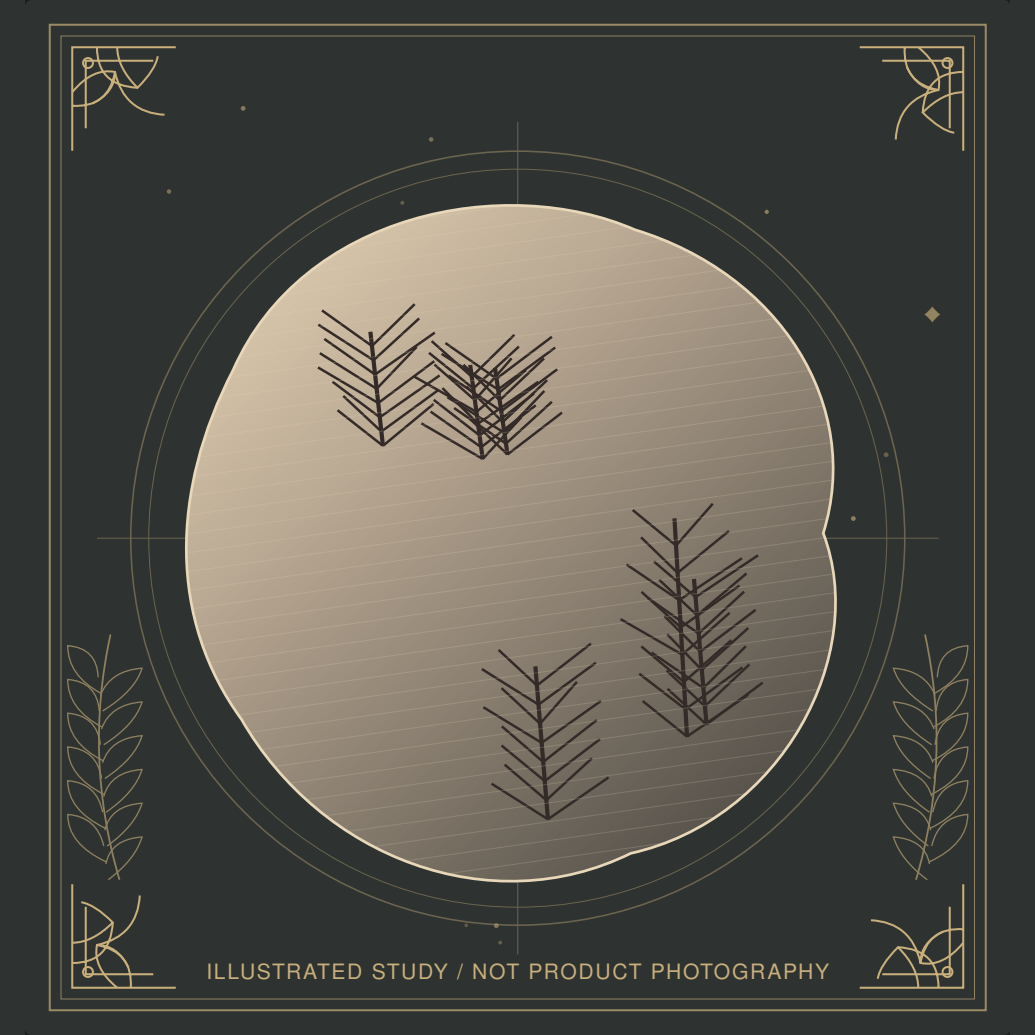
Traditions
The Crystal Council interprets dendritic agate through connection with nature, grounding and gentle self-expression. [5]
In this guide
Visual identity
Earth story: geology and formation
GIA has documented branching inclusions in silica with analytical identification of their components. Such research shows that an apparent branch can be mineral deposition within or along a host’s structures. A branch-like image alone cannot identify the component or distinguish chalcedony from a similarly patterned opal. The term dendritic is used across mineralogy for branching forms. A similar shape in another host therefore does not prove the same chemistry or depositional sequence. GIA’s analytical examples show why microscopy and spectroscopy can distinguish components that appear broadly alike to the eye. A collector can record the branches’ color, position and apparent depth as observations without pretending that those observations alone identify the inclusion species. [1][2]
Fine-grained silica differs visually from a single clear quartz crystal: its tiny crystallites and inclusions scatter light and produce a waxy or softly glassy surface. The Australian Museum gives microcrystalline quartz a hardness around 6.5, refractive indices of approximately 1.530–1.539, and specific gravity around 2.57–2.64. These are reference ranges, not a certificate for every rock sold under a related trade name. Many fine-grained silica materials accept artificial color because their microstructure can admit a staining solution. The visible pattern, the aggregate structure and any treatment must therefore be considered together. A highly polished surface reveals contrast in a cut section; it does not show the complete shape in which the material originally formed. [1]
Dendritic means tree-like. The branching form can arise in mineral material and is not evidence of a preserved tree, even where a slice resembles a wooded horizon. GIA illustrates a Brazilian agate scene in which goethite and hematite form the inclusions. This documented example shows why the silhouette and the mineral identity are separate questions. It also demonstrates that a named pattern can be composed of more than one included phase, rather than a single universal ingredient shared by every dendritic agate. [3]
Varieties and lookalikes
These names describe different levels of information: a mineral species, a visual variety, a crystal habit or a retail label. The distinctions below keep the recognizable shop vocabulary alongside its material explanation.
A dendritic specimen can have a pale, gray or warm-colored host, and the visible branches may be brown to nearly black. Landscape and scenic names describe the image a cut reveals; they do not establish a separate geological species. Moss agate supplies a related comparison, especially where green inclusions suggest vegetation. A specimen may satisfy more than one descriptive label. Retaining the underlying chalcedony identity allows those labels to remain useful without pretending that each image-based name has a fixed chemical boundary. [1][4]
- Dendritic agate
- Branches within a fine-grained silica host provide the visual category. Their shape does not establish that organic matter is present. [1][2]
- Dendritic chalcedony
- The broader chalcedony name may be more useful where banding is absent. The host remains important to the description. [1][2]
- Dendritic opal or merlinite comparison
- A branching inclusion pattern can occur in different hosts. Opal is hydrated silica with a material structure distinct from ordinary crystalline quartz, so dendritic opal should retain that identity where confirmed. Merlinite is an ambiguous commercial name and needs the offered stone’s host specified. The branch pattern alone cannot identify chalcedony, opal or a different rock. Naming the visible pattern and the actual material separately preserves the attractive retail vocabulary without asserting a fixed Merlinite species. [1][7]
Human story: history and naming
The broader chalcedony naming history records many varieties chosen for visible patterns. Dendritic agate belongs to that history of looking, cutting and describing stone. A landscape resemblance supports its decorative appeal; it does not independently establish ancient fertility or nature rituals. [4]
Chalcedony’s use in seals and carving supplies a documented material history, although that history cannot be assigned automatically to every modern dendritic label. The human decision to cut across a nodule, polish a surface and select an evocative scene is itself a meaningful chapter. GIA’s photographed Brazilian slice was cut perpendicular to its original layering. The resulting imagined skyline comes from real mineral inclusions revealed by that choice of cut, linking geological texture and contemporary lapidary observation. [3]
Meaning and practice: attributed traditions
The Crystal Council interprets dendritic agate through connection with nature, grounding and gentle self-expression. This is a present-day publisher’s spiritual profile. Its relationship to moss and tree agate in that system is an interpretive comparison, separate from analytical mineral identification. [5]
An optional observation exercise is to follow where a branch divides and where it stops. The pattern can inspire reflection without requiring the image to be a plant.
The Crystal Council describes dendritic agate through nature, grounding and self-expression. Those themes reflect a modern reading of the branching appearance. They can be presented alongside, rather than substituted for, the mineral explanation. A chosen practice might invite the owner to observe the pattern slowly and consider a connection with the natural world. The personal meaning belongs to the participant; an inclusion that looks like a tree does not make the stone an ecological instrument or provide evidence of a physiological grounding effect. [5]
Material identity and trade terminology
Dendritic opal and dendritic chalcedony have different hosts despite similar branching marks. The term merlinite also occurs in retail language and is not sufficient scientific identification. A precise caption names the confirmed host before describing the visible branches. [1][2]
Careful identification avoids diagnosing inclusion minerals from shape alone. A branch can be described as dark, fine or feathery without claiming it is a particular manganese or iron mineral. Analytical identification may establish that further detail for a studied sample. Enhanced color is another independent question: a natural-looking scene can coexist with a treated host. The most useful distinction is between observable pattern, confirmed components and seller-supplied history, with each recorded at the level of evidence actually available. [3][6]
Sources and related specimens
The references below distinguish mineral identification and physical properties from historical interpretation and practitioner symbolism. A cited material category describes a kind of stone; it does not certify the identity, treatment or provenance of an untested individual retail specimen.
- Quartz
Australian Museum · Geological, gemological or documented material-history evidence · Accessed October 9, 2026
- Inclusions in Gemstones
Gemological Institute of America · Geological, gemological or documented material-history evidence · Accessed October 9, 2026
- Gem Cutters Reveal the Beauty of Chalcedony
Gemological Institute of America · Geological, gemological or documented material-history evidence · Accessed October 9, 2026
- Chalcedonies
Vapriikki Mineral Museum · Geological, gemological or documented material-history evidence · Accessed October 9, 2026
- The Crystal Council: Dendritic Agate
The Crystal Council · Contemporary practitioner symbolism and retailer terminology; distinct from mineralogical evidence · Accessed October 9, 2026
- GIA: An Introduction to Gem Treatments
Gemological Institute of America · Geological, gemological or documented material-history evidence · Accessed October 9, 2026
- Natural Gemstones: Mineral Gemstones
US Geological Survey · Geological, gemological or documented material-history evidence · Accessed October 9, 2026