
Ochre and wine
Mookaite
Silicified radiolarian sedimentary material from Western Australia.
Siliceous radiolarian-derived sedimentary rock and lapidary material
Mookaite is an Australian decorative rock with cream, ochre, red and wine-colored fields. Its opaque polish can resemble familiar jasper, but the material’s specific rock context is more useful than treating the name as a new mineral crystal.
Geology · Human history · Attributed traditions
Explore the specimen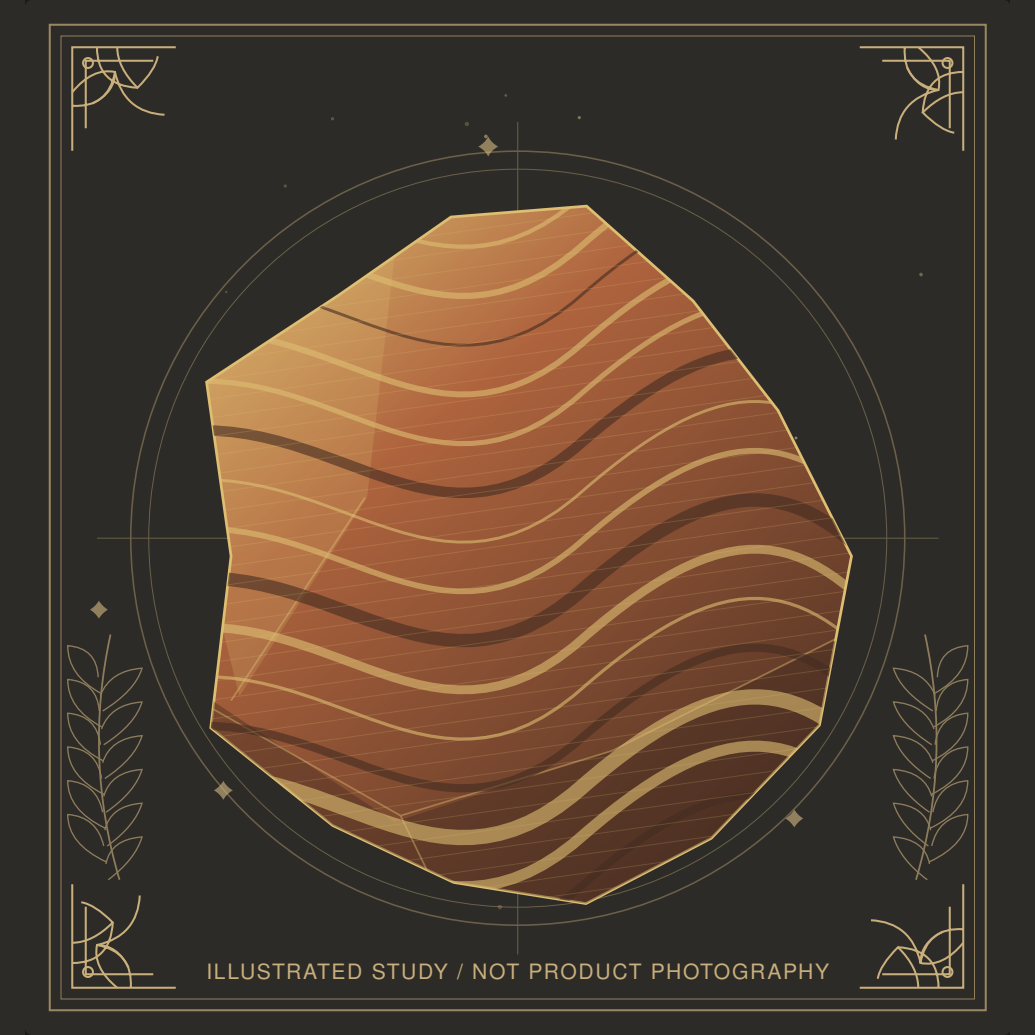
Material
Silicified radiolarian sedimentary material from Western Australia. [1]
Family
Siliceous sedimentary rock [1]
Appearance
Broad flowing patterns [1]
Traditions
The Crystal Council links mookaite with nature connection and attention to the present. [2]
In this guide
Visual identity
Mookaite is an Australian decorative rock with cream, ochre, red and wine-colored fields. Its opaque polish can resemble familiar jasper, but the material’s specific rock context is more useful than treating the name as a new mineral crystal. [1]
A slab can reveal adjacent mustard-yellow, cream, red or deeper purplish areas; a small tumble may preserve only one part of that wider palette. The changing colors are part of the recognizable lapidary appearance, and contrasting areas can be especially prominent in carved forms. An individual object does not need to contain every characteristic shade to belong to the material. Conversely, a matching red-and-yellow palette in a different rock does not authenticate the Western Australian source associated with the name. [1]
Earth story: geology and formation
The Geological Survey of Western Australia describes mookaite as an opalized form of radiolarite in the Cretaceous Windalia Radiolarite. Radiolarian-rich marine sediment provides the geological context. The amount and form of silica can vary, so quartz’s properties should not be assigned uncritically to every piece. [1]
The GSWA report places the material in the Windalia Radiolarite and explicitly uses mookaite as an informal lapidary name. Radiolarite refers to sediment associated with siliceous microscopic organisms; opalization and silica-rich texture belong to the subsequent rock history. A polished color field is not a direct view of one surviving organism. The formation’s geological age, the alteration of the rock, the commercial extraction of a piece and its final carving are separate stages. Without compositional analysis, one universal quartz density or hardness should not be assigned to every specimen marketed under this rock name. [1]
The GSWA report places the lapidary material within the Windalia Radiolarite and describes it as opalized radiolarite. Radiolarian remains provide a biological contribution to a siliceous sedimentary rock, and later silicification or opalization changes its material condition. This makes mookaite a rock with a geological sequence, not a single approved mineral named Mookaite. The fine texture can look continuous on a polished surface even though its identity concerns a sedimentary material and later alteration. [1]
Varieties and lookalikes
These names describe different levels of information: a mineral species, a visual variety, a crystal habit or a retail label. The distinctions below keep the recognizable shop vocabulary alongside its material explanation.
The same regional report distinguishes mookaite from peanut wood, another attractive siliceous lapidary material. Peanut wood concerns silicified wood with pale fillings in borings, whereas mookaite belongs to the radiolarite account. A pale spot or similar warm color is therefore not enough to merge the two. This comparison also shows why geological description matters more than a broad jasper shelf label: different sedimentary histories and original materials can converge on colors that appeal to the same carver or collector. [1]
- Mookaite jasper and Mookite
- These are retail spellings and naming variants for the decorative material. Jasper is a familiar shop comparison, not a complete mineralogical classification. [1]
- Yellow, red and cream mookaite
- Color fields are visible features within a rock. A small tumble can expose only one field, while a slice makes the broader pattern easier to see. [1]
Human story: history and naming
The GSWA report derives the informal name from Mooka Station and distinguishes the utilized deposits from the proposed Kennedy Range National Park. This is a specific documented place history. It does not authorize attributing present-day crystal correspondences to Aboriginal Australian communities. The GSWA report treats mookaite as lapidary stone rather than an approved species, and distinguishes it from another regional material, peanut wood. That comparison shows why a geographic region can supply several different decorative rocks. The report’s place name is useful provenance context, but a similar palette on an unlabelled tumble cannot independently reconnect it to a particular deposit or collection site. [1]
The report’s discussion is tied to mapping, regional resources and a proposed national park. That setting preserves a record of where lapidary material was being obtained and how it was discussed by geologists at the time. It is a different kind of history from retail correspondences, and a more precise one than general statements about all Australian stones. The name’s association with Mooka Station should be retained as a documented naming context rather than replaced by an unverified translation offered in a sales description. [1]
Meaning and practice: attributed traditions
The Crystal Council links mookaite with nature connection and attention to the present. These are that publisher’s modern meanings. A material from Australia does not make the interpretation an Indigenous tradition; cultural attribution requires the relevant community’s own evidence. [2]
A present-moment reflection can begin by naming the visible colors without assigning a cultural story. The rock can then serve as a personal reminder to attend to its geological scale.
The Crystal Council’s attention-to-the-present theme can be recorded as a contemporary practice. It does not establish that the rock was historically used with that meaning by Aboriginal communities. A reader may choose to work with its varied earthy colors as a reminder to observe the immediate surroundings or accept changing perspectives. That interpretation belongs to the practitioner and participant. The scientific chapter separately explains a radiolarian-derived sedimentary material, whose biological origin does not itself confer a spiritual authority. [2]
Material identity and trade terminology
Mookaite or Mookite is a rock and trade name, not a distinct mineral species. A yellow-red polished piece needs its own identity and source information. The marine sediment story is better grounded than classifying every object as a single quartz crystal or assuming all similarly colored stone is Australian mookaite. [1]
Sources and related specimens
The references below distinguish mineral identification and physical properties from historical interpretation and practitioner symbolism. A cited material category describes a kind of stone; it does not certify the identity, treatment or provenance of an untested individual retail specimen.
- Geology and Mineral Resources of the Proposed Kennedy Range National Park (1992/4)
Geological Survey of Western Australia · Geological, gemological or documented material-history evidence · Accessed October 9, 2026
- The Crystal Council: Mookaite
The Crystal Council · Contemporary practitioner symbolism and retailer terminology; distinct from mineralogical evidence · Accessed October 9, 2026