
Soft green clusters
Prehnite
Calcium aluminium silicate, often pale green and botryoidal.
Calcium-bearing hydroxyl silicate mineral species
Prehnite is a calcium aluminium silicate, often pale green with rounded or botryoidal surfaces. A polished mass can appear softly cloudy; dark associated crystals add a very different texture. Rounded habit does not identify every component inside a piece.
Geology · Human history · Attributed traditions
Explore the specimen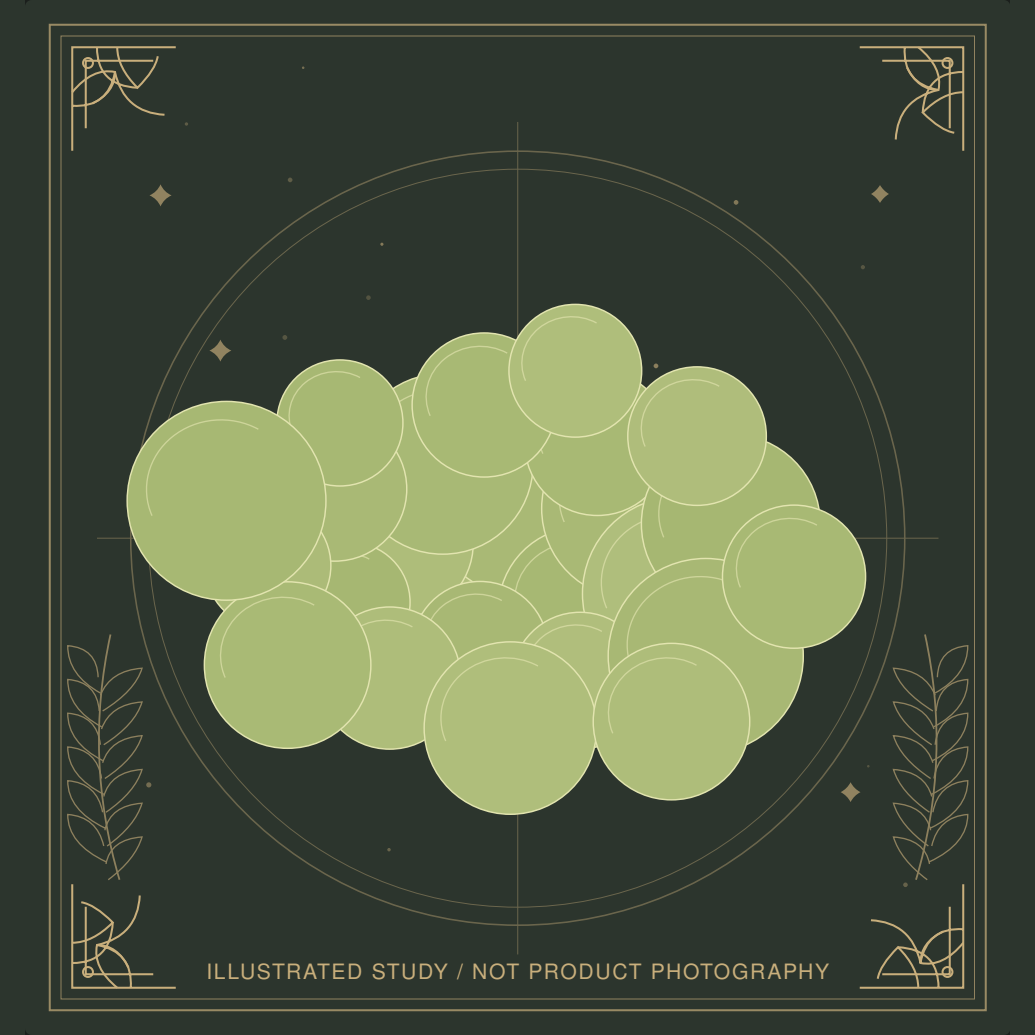
Material
Calcium aluminium silicate, often pale green and botryoidal. [1]
Family
Calcium aluminum silicate [1]
Appearance
Soft internal clouding [1]
Traditions
The Crystal Council interprets prehnite through heart-and-will imagery, meditation and connection with nature. [6]
In this guide
Visual identity
Prehnite is a calcium aluminium silicate, often pale green with rounded or botryoidal surfaces. A polished mass can appear softly cloudy; dark associated crystals add a very different texture. Rounded habit does not identify every component inside a piece. [1]
Rounded or botryoidal aggregates can present an apple-green to pale-green field with a soft translucency, while individual crystals can be less conspicuous in a rounded mass. A polished surface exposes an interior view of the aggregate rather than a naturally smooth crystal face. The general appearance can include pale regions or darker included material. Those inclusions should be described separately from the host, because a dark needle seen inside a green tumble is not identified as epidote merely by the familiar combination advertised in shops. [1][2]
Earth story: geology and formation
The Handbook of Mineralogy records prehnite in cavities, veins and altered volcanic rocks. Its secondary growth can preserve relationships with other minerals, including epidote. The green host and a darker inclusion retain separate identities; their contrast is a specimen feature rather than a new species. Recorded associations include zeolites, calcite, epidote and copper. The Handbook lists examples in Namibia, India, New Jersey and Australia, among numerous localities. A rounded aggregate in a cavity records a different spatial arrangement from a vein-filled mass. A polished specimen can show the contrasting components attractively, but appearance alone should not assign a dark included crystal to whichever mineral is most familiar in a shop description. [1]
Prehnite has orthorhombic symmetry and is a calcium aluminium silicate containing hydroxyl. The Handbook records hardness 6–6.5, density around 2.80–2.95 grams per cubic centimetre, good cleavage in one direction and brittle uneven fracture. Its typical rounded or fan-like aggregates need not expose individual crystal faces. Semi-transparent and translucent material can scatter enough light to appear clouded. A polished cabochon shows a worked surface through that aggregate; a rough botryoidal crust shows the original form of growth. These textures are independent of whether an associated dark crystal has been analytically identified. [1]
Prehnite is a calcium-aluminum hydroxyl silicate with orthorhombic symmetry. The Handbook describes secondary and hydrothermal occurrences, including veins and cavities in volcanic rocks, and low-grade metamorphic settings. Associated zeolites, calcite and epidote can help establish a specimen’s context where the matrix is preserved. These relationships explain why crystals sold side by side may come from a common cavity while belonging to different mineral families. A free polished prehnite object no longer shows all the geological relationships of the original cavity. [1]
Varieties and lookalikes
These names describe different levels of information: a mineral species, a visual variety, a crystal habit or a retail label. The distinctions below keep the recognizable shop vocabulary alongside its material explanation.
Green prehnite is a color description within the species; yellowish or nearly colorless material need not represent a separate mineral. Prehnite with epidote is a component-based description where both are confirmed. Green calcite, jade and serpentine provide visual comparisons, but their compositions and structures differ. A green translucent appearance is thus a starting observation rather than a full identifier. A mixed specimen can be accurately described by naming the confirmed components, without promoting every inclusion-bearing form to a new species or an independently named spiritual stone. [1][2][3][4][5]
- Green and yellow prehnite
- Color descriptions within the mineral category require the same identification care. A pale shade does not make a separate species. [1]
- Prehnite with epidote
- This names a two-mineral association when confirmed. The dark crystal is not the identity of the entire green host. [1]
Human story: history and naming
The mineral name honors Hendrik von Prehn. This is a documented naming history, distinct from modern meditation associations. A named collector and a type occurrence can offer a substantial human connection without an unsupported ancient ritual story. [1]
The name honors Colonel Hendrik von Prehn, a specific human connection preserved in the mineral reference. The occurrence list includes Namibia, India, New Jersey and Australia, documenting several recognized collection contexts. These are not all one source or one tradition. A prehnite specimen with a locality label can preserve the history of where it was collected and how it entered a collection. A loose polished object without that information should not acquire a colonial-era date or a particular locality merely because the mineral’s name has that history. [1]
Meaning and practice: attributed traditions
The Crystal Council interprets prehnite through heart-and-will imagery, meditation and connection with nature. These are its present-day correspondences. The heart and solar-plexus framework should not be confused with calcium chemistry or treated as a universal tradition. [6]
An optional nature reflection can focus on how distinct components coexist within one specimen, using that observation as a personal reminder rather than a promised effect.
The Crystal Council’s heart-and-will account places prehnite within a modern meditation framework. Its nature-related language can be interpreted as a chosen reminder to observe landscape or consider an intention carefully. The calcium-bearing host does not establish a physiological connection between the heart and willpower. A participant can retain that personal meaning while learning that the mineral commonly occupies secondary cavities and veins. The contemplative use and geological formation are both intelligible subjects, provided that their different forms of evidence remain clear. [6]
Material identity and trade terminology
Dark inclusions should not automatically be called tourmaline or epidote from appearance. A botryoidal mass and a carved sphere have different origins of shape. The useful caption records prehnite, confirmed associated minerals and any known working or treatment. [1]
The Handbook gives hardness 6–6.5, density about 2.80–2.95 grams per cubic centimeter and brittle behavior with uneven fracture. A surface can therefore resist many casual scratches while a protrusion or thin edge remains vulnerable to impact. Host properties are not a guarantee about every mixed tumble, because included minerals and existing fractures contribute to the object. The best material description identifies the host and any confirmed inclusion before attaching a source claim or implying that a uniformly polished finish means a homogeneous interior. [1]
Sources and related specimens
The references below distinguish mineral identification and physical properties from historical interpretation and practitioner symbolism. A cited material category describes a kind of stone; it does not certify the identity, treatment or provenance of an untested individual retail specimen.
- Handbook of Mineralogy: Prehnite
Mineralogical Society of America · Mineral composition, structure, physical properties and occurrence · Accessed October 9, 2026
- Handbook of Mineralogy: Epidote
Mineralogical Society of America · Mineral composition, structure, physical properties and occurrence · Accessed October 9, 2026
- Handbook of Mineralogy: Calcite
Mineralogical Society of America · Mineral composition, structure, physical properties and occurrence · Accessed October 9, 2026
- GIA: Jade Description
Gemological Institute of America · Geological, gemological or documented material-history evidence · Accessed October 9, 2026
- Handbook of Mineralogy: Lizardite
Mineralogical Society of America · Mineral composition, structure, physical properties and occurrence · Accessed October 9, 2026
- The Crystal Council: Prehnite
The Crystal Council · Contemporary practitioner symbolism and retailer terminology; distinct from mineralogical evidence · Accessed October 9, 2026