
The green beryl chamber
Emerald
Green beryl in the gemological emerald range.
Colored beryl gem variety
Emerald is the green gem variety of beryl. Visible inclusions and fractures can be part of its geological record, while matrix retains relationships lost in a faceted stone. Not every pale green beryl is automatically identified as emerald.
Geology · Human history · Attributed traditions
Explore the specimen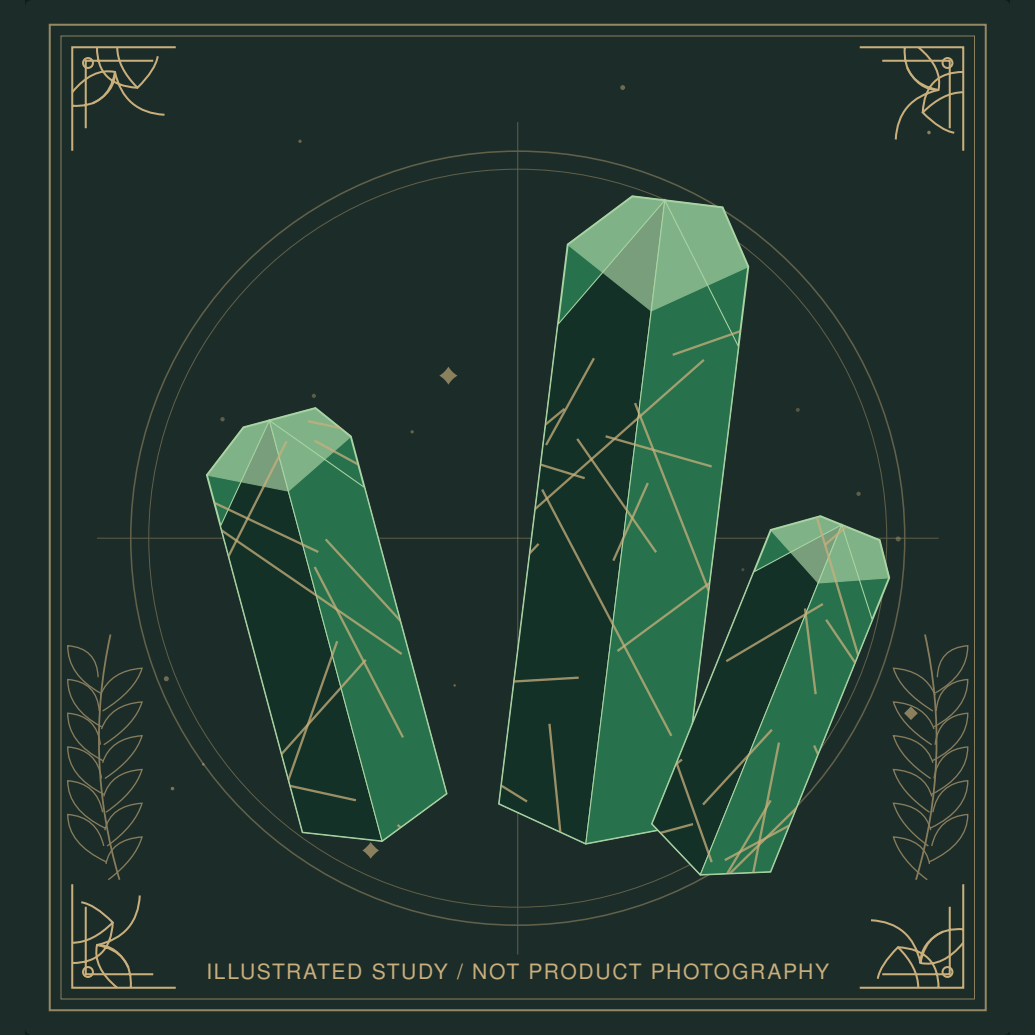
Traditions
Sandra Kynes’s 2018 correspondences include emerald in prosperity-oriented practice. [7]
In this guide
Visual identity
Emerald is the green gem variety of beryl. Visible inclusions and fractures can be part of its geological record, while matrix retains relationships lost in a faceted stone. Not every pale green beryl is automatically identified as emerald. [1][2][3]
Inclusions and fractures frequently contribute to an emerald’s appearance. They can form a visually busy internal field, often described poetically as a jardin. That word concerns what the inclusions look like, not evidence of trapped vegetation. A collector crystal may also retain pale host material around its green prism. The arrangement can be attractive and geologically informative even when it would not meet a faceted jewelry market’s preference for transparency. A useful illustration can show those real internal and attached features rather than rendering every specimen flawless. [1][2]
Earth story: geology and formation
GIA describes chromium and vanadium as important color-producing components. Emerald deposits involve particular chemical environments, so a general granite-pegmatite story cannot explain all sources. A trapiche pattern and a natural growth inclusion deserve description without being turned into proof of a claimed mine. [1][2][3]
Beryl is beryllium aluminium silicate, Be₃Al₂Si₆O₁₈, with hexagonal symmetry. The Handbook of Mineralogy lists hardness 7.5–8 and a measured density range of approximately 2.63–2.97 grams per cubic centimetre, varying with composition. Prismatic crystals can be columnar or tabular, and many terminate in a flat face. Cleavage is imperfect, while breakage may be curved or uneven. Beryl is hard but brittle; a network of fractures can make a particular crystal more vulnerable than its hardness suggests. Granite and granite pegmatite are important settings, but beryl also occurs in metamorphic rocks and hydrothermal veins. The relationship between color, trace chemistry and growth environment is more informative than assigning every beryl one deposit model. [2]
Emerald’s green is associated with chromium and/or vanadium in the beryl framework. Its identity is not determined by an ideal pure green photograph alone. GIA notes that the boundary between green beryl and emerald involves the strength and character of color and that authorities can differ in their usage. This is a meaningful trade-definition limit. The mineral framework can be established while the appropriate gem variety name still depends on an agreed descriptive standard, especially for pale or borderline material. [1][2]
Varieties and lookalikes
These names describe different levels of information: a mineral species, a visual variety, a crystal habit or a retail label. The distinctions below keep the recognizable shop vocabulary alongside its material explanation.
Green tourmaline, peridot and dyed or manufactured materials can resemble emerald in limited views. Their properties and structures differ, and a particular vivid green does not prove chromium-bearing beryl or a Colombian source. A precise origin assessment is a laboratory question involving more than overall hue. Likewise, a quartz matrix beside a green prism can be described where confirmed, but it does not authenticate a famous mine by appearance alone. The mineral identity, variety boundary, enhancement and source are distinct levels of a complete account. [1][3][2][4][5]
- Emerald
- A gem-color designation within beryl with material-specific color and identification criteria. It is not a synonym for every green beryl. [1][2][3]
- Emerald in matrix
- The included emerald and surrounding host are distinct components. A mixed specimen should preserve both names where confirmed. [1][2][3]
- Trapiche emerald
- Trapiche emerald has a growth-related pattern with spoke-like divisions around a core, rather than an externally carved star. The GIA study of Colombian examples examined distinct crystal sectors and included matrix material, proposing a formation model tied to fluid pressure changes in the deposits. The pattern is a textural variety subject, not a new emerald mineral species. A specific source claim still needs the specimen’s own evidence. [8]
Human story: history and naming
GIA records Egyptian emerald use and later Colombian material entering international jewelry traditions. It also recounts truth and prophecy beliefs as lore. A dated cultural use and an attributed legend are different evidence, and historical gemstone names sometimes need modern identification. [6]
GIA’s historical account links emerald to ancient Egyptian mining and to later Colombian material that became important in trade. These different source histories should not be flattened into one continuous story about every present-day gem. An old text’s praise of a green stone may also precede modern mineral classification. Where the material is securely identified, mining and exchange provide a supported human history. Statements of prophecy or truthfulness remain reported beliefs whose historical setting and attribution deserve to be retained. [6]
Meaning and practice: attributed traditions
Sandra Kynes’s 2018 correspondences include emerald in prosperity-oriented practice. Her home-focused symbolic list is a contemporary source. Its abundance theme does not prove ancient continuity or predict financial success. [7]
An optional abundance reflection is to appreciate a resource without requiring a flawless object. The inclusion-bearing gem can be a reminder that value and visible complexity can coexist.
Kynes includes emerald among prosperity-related correspondences for the home. The meaning is an attributed contemporary choice, distinct from the mining histories and reported older lore in GIA’s account. A participant can use the object to focus attention on stewardship, appreciation or an intended action. Its association in that practice does not guarantee material gain. The richness of emerald’s color and human history can inform reflection while the physical chapter continues to explain beryl, color-bearing elements and visible inclusions. [7]
Material identity and trade terminology
Fracture filling can improve appearance, and laboratory-grown emerald has a human growth origin despite sharing beryl identity. Disclosure matters for both. The green content of a mixed rock cannot automatically make the entire host emerald; glass and other green gems are different materials. An inclusion-rich appearance is often called a garden in gem descriptions, but the metaphor should not identify a particular mineral or mine. Filling a fracture changes how it interacts with light without requiring a new beryl species. A synthetic gem can also contain growth features. Appropriate examination distinguishes these histories more reliably than a claim that all inclusions prove natural, untreated emerald. [1][2][3]
Fracture filling introduces a substance into surface-reaching breaks to reduce their visibility. GIA’s treatment discussion distinguishes that process from the growth of a synthetic gemstone. A filled natural emerald remains a natural host with a declared enhancement, whereas synthetic emerald has been grown by people and can still share the beryl structure and composition. Glass imitation is a third category. The words real, natural and clear are therefore insufficient by themselves to communicate all the relevant distinctions about an offered green stone. [3][1]
Sources and related specimens
The references below distinguish mineral identification and physical properties from historical interpretation and practitioner symbolism. A cited material category describes a kind of stone; it does not certify the identity, treatment or provenance of an untested individual retail specimen.
- GIA: Emerald
Gemological Institute of America · Geological, gemological or documented material-history evidence · Accessed October 9, 2026
- Handbook of Mineralogy: Beryl
Mineralogical Society of America · Mineral composition, structure, physical properties and occurrence · Accessed October 9, 2026
- GIA: An Introduction to Gem Treatments
Gemological Institute of America · Geological, gemological or documented material-history evidence · Accessed October 9, 2026
- GIA: Tourmaline Description
Gemological Institute of America · Geological, gemological or documented material-history evidence · Accessed October 9, 2026
- GIA: Peridot
Gemological Institute of America · Geological, gemological or documented material-history evidence · Accessed October 9, 2026
- GIA: Emerald History and Lore
Gemological Institute of America · Historical naming, material use and explicitly attributed lore · Accessed October 9, 2026
- Sandra Kynes: 365 Days of Crystal Feng Shui for Your Home (2018)
Llewellyn Worldwide · Contemporary practitioner symbolism and retailer terminology; distinct from mineralogical evidence · Accessed October 9, 2026
- Colombian Trapiche Emeralds: Recent Advances in Understanding Their Formation (2015)
Gemological Institute of America · Geological, gemological or documented material-history evidence · Accessed October 9, 2026