
Blush beryl
Morganite
Pink to orange-pink beryl.
Colored beryl gem variety
Morganite is pink-to-peach beryl, often pale enough that a larger mass displays its color more strongly. A transparent gem and a rough architectural crystal show different aspects of the same mineral framework. It is neither rose quartz nor pink glass.
Geology · Human history · Attributed traditions
Explore the specimen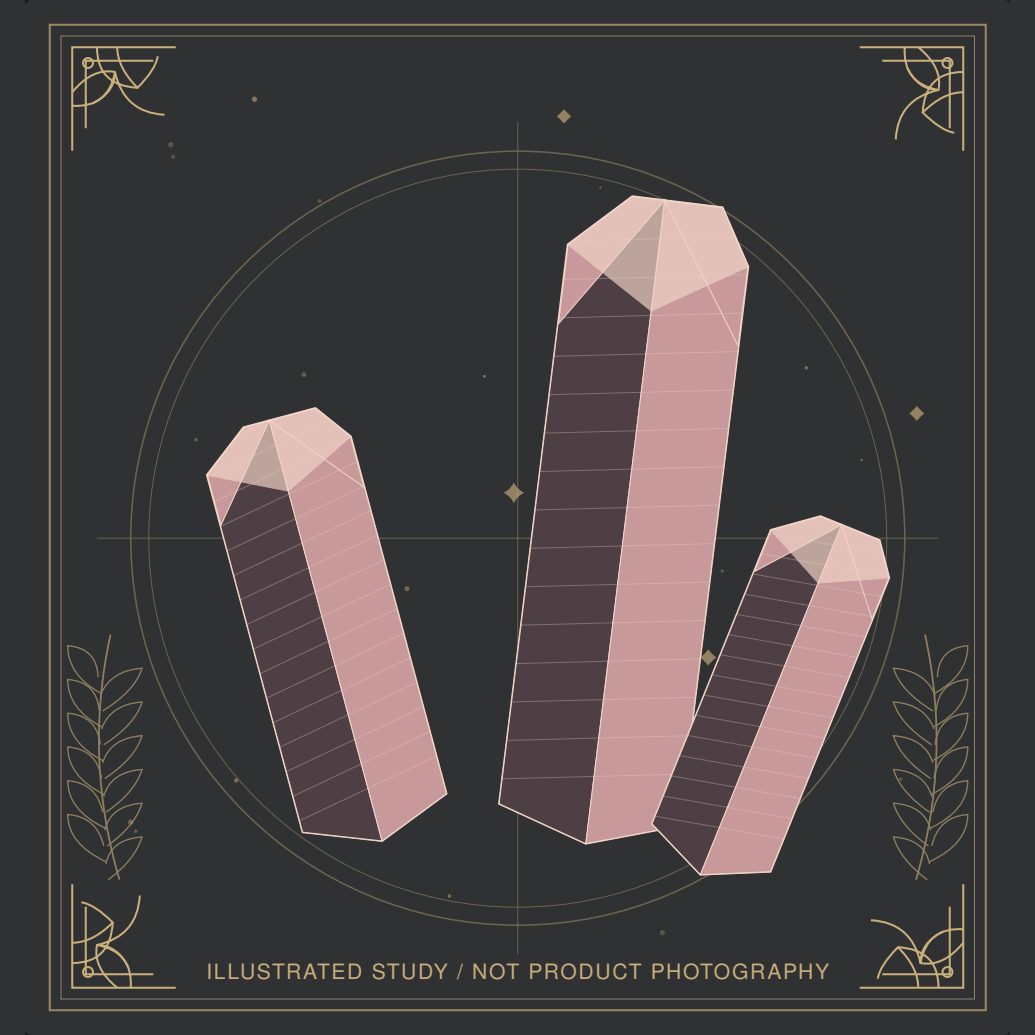
Traditions
The Crystal Council interprets morganite through love, compassion and heart-centered meditation. [7]
In this guide
Visual identity
Morganite is pink-to-peach beryl, often pale enough that a larger mass displays its color more strongly. A transparent gem and a rough architectural crystal show different aspects of the same mineral framework. It is neither rose quartz nor pink glass. [1][2][3]
The palette can include pale pink, peach and salmon-like tones. A faceted stone often emphasizes clean transparency, whereas a collector crystal can contain internal clouds or attached feldspar and mica. Flat hexagonal crystal outlines are compatible with the beryl family, although broken rough will not preserve every face. A worked heart or tower replaces that natural external surface with a chosen form. The object’s decorative shape therefore belongs to its lapidary history, while the color and inclusions belong to the material description. [1][2]
Earth story: geology and formation
GIA relates its pink color to manganese and describes heating used to modify peach or orange tones. Pegmatitic crystals can be large. Treatment changes part of the appearance history; it does not erase the geological growth or turn beryl into another species. [1][2][3]
Beryl is beryllium aluminium silicate, Be₃Al₂Si₆O₁₈, with hexagonal symmetry. The Handbook of Mineralogy lists hardness 7.5–8 and a measured density range of approximately 2.63–2.97 grams per cubic centimetre, varying with composition. Prismatic crystals can be columnar or tabular, and many terminate in a flat face. Cleavage is imperfect, while breakage may be curved or uneven. Beryl is hard but brittle; a network of fractures can make a particular crystal more vulnerable than its hardness suggests. Granite and granite pegmatite are important settings, but beryl also occurs in metamorphic rocks and hydrothermal veins. The relationship between color, trace chemistry and growth environment is more informative than assigning every beryl one deposit model. [2]
Manganese contributes to the pink to peach appearance of morganite, a beryl variety. GIA describes weak to moderate changes of color with orientation and notes that larger stones can show color more strongly than small pale pieces. A rough crystal, a thin slice and a large faceted gem consequently may not appear equally saturated even when cut from related material. The framework remains beryl; the pink color is a variety characteristic, not a separate crystal structure named Morganite. [1][2]
Varieties and lookalikes
These names describe different levels of information: a mineral species, a visual variety, a crystal habit or a retail label. The distinctions below keep the recognizable shop vocabulary alongside its material explanation.
Morganite is distinguished from rose quartz by its beryl host and from pink tourmaline by a different mineral family. Translucent pink carving material may hide the features that make transparent gem testing straightforward, so color remains an insufficient identifier. Peach and pink sorting describes appearance within the variety rather than separate species. A pale goshenite-to-morganite boundary also illustrates that a trade color name depends on how a visible tint is interpreted; the underlying beryl identity can remain clear when the variety terminology is less certain. [1][2][4][5]
Human story: history and naming
GIA dates George Kunz’s proposal of the name to December 1910, honoring J. P. Morgan’s support for gem collections and science. This is modern naming history. It cannot serve as evidence for an ancient goddess tradition under the modern morganite name. GIA connects the naming with Morgan’s support for arts and sciences and with major museum gem collections. It also documents the Rose of Maine specimen discovered in 1989, demonstrating that the modern variety name has a concrete collecting history. These episodes concern particular people and specimens. They offer sufficient human interest without converting a twentieth-century naming act into an ancient love-goddess tradition. [6]
GIA records George Frederick Kunz’s proposal to name the pink beryl for financier and gem collector J. P. Morgan in 1910. This gives the variety a specific modern naming history. The much larger Rose of Maine crystal, found in 1989, provides a later documented collector object rather than an ancient tradition. Naming, patronage, collecting and discovery are substantial parts of the human story. The stone’s pink appearance does not make a twenty-first-century spiritual correspondence older than the name itself. [6]
Meaning and practice: attributed traditions
The Crystal Council interprets morganite through love, compassion and heart-centered meditation. This is a named present-day practitioner framework, distinct from the mineral’s modern naming history. Its language offers a personal intention of gentleness without establishing a mechanism for healing trauma or changing another person’s feelings. [7]
For a personal meaning rather than an inherited claim, the peach-pink color can be chosen as a reminder to approach one conversation with gentleness.
The Crystal Council associates morganite with love, compassion and heart-centered meditation. These are modern practitioner themes, rather than evidence that manganese has a special emotional mechanism. A reader can choose a reflective activity concerned with kindness or self-appreciation while continuing to identify the object accurately. A pink beryl, a pink spodumene and rose quartz may all be used within similar symbolic practices, but shared intended meaning does not erase their different geology, hardness, cleavage or treatment possibilities. [7]
Material identity and trade terminology
Known heating, laboratory growth and imitation should be disclosed independently. A peach-to-pink transition alone cannot certify treatment status. The larger beryl family includes other color varieties, and a color similarity with rose quartz does not make their mineral properties interchangeable. [1][2][3]
Heating can reduce a yellowish component and leave a pinker appearance. This is why a natural morganite label and a statement of untreated color should not be assumed to mean the same thing. GIA’s treatment overview provides the wider distinction between enhancement, synthetic growth and imitation. Kunzite can offer a similar pale pink appearance but is spodumene, with different composition and prominent cleavage. The comparison should retain both materials’ accurate names instead of grouping all pink crystals as interchangeable heart stones. [1][3][8][9]
Sources and related specimens
The references below distinguish mineral identification and physical properties from historical interpretation and practitioner symbolism. A cited material category describes a kind of stone; it does not certify the identity, treatment or provenance of an untested individual retail specimen.
- GIA: Morganite
Gemological Institute of America · Geological, gemological or documented material-history evidence · Accessed October 9, 2026
- Handbook of Mineralogy: Beryl
Mineralogical Society of America · Mineral composition, structure, physical properties and occurrence · Accessed October 9, 2026
- GIA: An Introduction to Gem Treatments
Gemological Institute of America · Geological, gemological or documented material-history evidence · Accessed October 9, 2026
- GIA: Rose Quartz Description
Gemological Institute of America · Geological, gemological or documented material-history evidence · Accessed October 9, 2026
- GIA: Tourmaline Description
Gemological Institute of America · Geological, gemological or documented material-history evidence · Accessed October 9, 2026
- GIA: Morganite History and Lore
Gemological Institute of America · Historical naming, material use and explicitly attributed lore · Accessed October 9, 2026
- The Crystal Council: Morganite
The Crystal Council · Contemporary practitioner symbolism and retailer terminology; distinct from mineralogical evidence · Accessed October 9, 2026
- GIA: Kunzite
Gemological Institute of America · Geological, gemological or documented material-history evidence · Accessed October 9, 2026
- Handbook of Mineralogy: Spodumene
Mineralogical Society of America · Mineral composition, structure, physical properties and occurrence · Accessed October 9, 2026