
The rose cloud
Rose Quartz
Pink massive quartz / silicon dioxide
Quartz color variety
Typical rose quartz is a translucent pink mass with irregular surfaces and a softly clouded interior. Pale blush, richer rose color and a carved shape describe appearance and workmanship. The usual material does not grow as the generic pointed crystal sometimes shown in decorative imagery.
Geology · Human history · Attributed traditions
Explore the specimen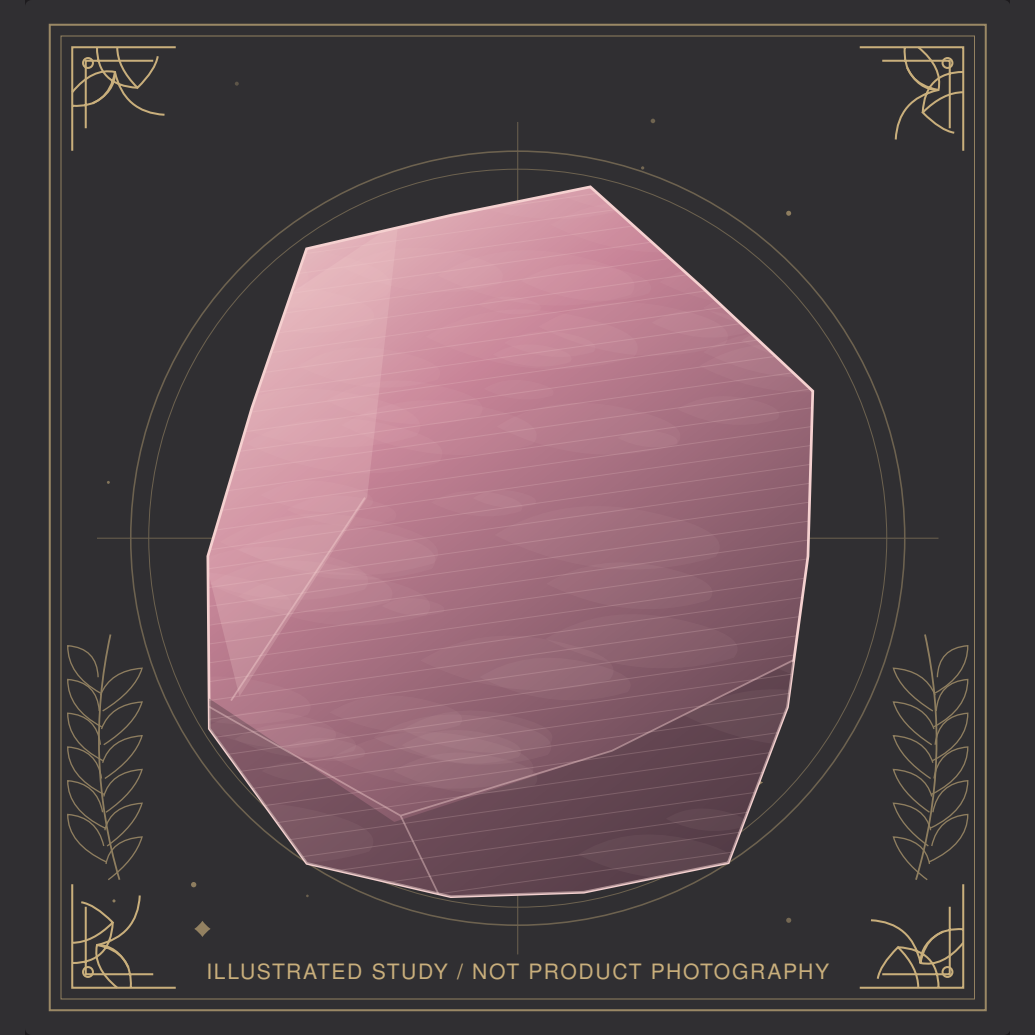
In this guide
Visual identity
Typical rose quartz is a translucent pink mass with irregular surfaces and a softly clouded interior. Pale blush, richer rose color and a carved shape describe appearance and workmanship. The usual material does not grow as the generic pointed crystal sometimes shown in decorative imagery. [1][2]
An irregular rose-quartz mass can show pale edges, more saturated thick regions and white fracture surfaces. Those contrasts are not necessarily stripes of different minerals. Light travels farther through a thick section and is scattered by microscopic components, so color and clarity should be described with the viewing conditions in mind. A carved heart communicates its maker’s intention through shape, while the pink cloudiness belongs to the underlying material. Distinguishing these two visual histories makes the object more interesting rather than less meaningful. [1]
Earth story: geology and formation
GIA attributes the pink color to microscopic silicate fibers related to, but not simply identical with, dumortierite. Their alignment can also produce a star in suitably oriented material. Rare transparent pink quartz with visible crystal faces has a different coloring mechanism and needs its own caption; it does not redefine the habit of ordinary massive rose quartz. GIA lists Brazil, India, Madagascar and Sri Lanka among sources. Those recorded source regions do not authenticate a specific carving’s origin. A sculptor may choose a thick mass because pale pink becomes more visible through greater material thickness. The resulting ring, animal carving or sphere expresses workmanship while retaining the internal fibers and fractures of the starting material. A star-bearing cabochon requires suitable orientation of those inclusions; simply carving a sphere cannot guarantee the effect. [1][2]
As a quartz variety, massive rose quartz shares the basic SiO₂ composition and hardness 7 of the broader mineral family. Quartz reference density is about 2.65 grams per cubic centimetre, with brittle curved fracture and a glassy surface where suitably polished. These properties do not give ordinary rose quartz a natural pointed habit: its familiar pink material is an interlocking mass lacking the regular exposed crystal faces of rock crystal. A six-sided polished tower is therefore a manufactured form unless the actual specimen is separately identified as rare crystalline pink quartz. A hard carving can still chip where a tip or existing fracture is vulnerable. [3][1]
GIA’s 2025 optical review discusses research on nanofibers from rose quartz and the differences from ordinary dumortierite. Advanced analysis is needed because the relevant structure is below the scale of normal visual inspection. Earlier explanations involving rutile should not be presented as a universal cause of the pink color. A strong pink appearance and a visible star are related to internal material and orientation, but they are different observations; one does not guarantee the other. [2]
Varieties and lookalikes
These names describe different levels of information: a mineral species, a visual variety, a crystal habit or a retail label. The distinctions below keep the recognizable shop vocabulary alongside its material explanation.
Human story: history and naming
GIA describes Assyrian rose-quartz jewelry around 800–600 BCE and Roman use in seals. These establish a history of working pink quartz, not every circulating origin story involving Cupid or Aphrodite. The material of an object and the literary origin of a belief are separate questions. [4]
GIA’s examples show how quartz can become jewelry, carved ornaments or a seal. These uses combine material availability, the stone’s working properties and a maker’s design. The presence of a pink object in a historical context establishes use of the material more directly than it establishes a particular love belief. Assigning a deity story requires a source for that narrative, and identifying one culture’s object does not make every modern rose-quartz heart a reproduction of its practice. [4]
Meaning and practice: attributed traditions
Energy Muse interprets rose quartz through love, compassion and heart-chakra symbolism. Margaret Ann Lembo’s 2013 chart also places it with pink stones associated with harmony and friendship. These are contemporary practitioner frameworks. Their language can express an intention of kindness without promising control over a relationship or another person’s feelings. [5][6]
An optional personal reflection is to choose one act of kindness that can be carried out today. The stone is a chosen reminder; the action and its consequences remain human.
Energy Muse’s heart-centered account presents the material as a companion to love and self-acceptance. Lembo’s chart approaches related meanings through pink color and the heart chakra. These are identifiable contemporary approaches, and their overlap does not require a single ancient origin. A reader can compare the two systems, adopt a personally meaningful intention or appreciate the pink mineral without adopting either. The historical seal, the carved modern heart and the practitioner’s correspondence therefore belong to connected but distinct stories. [5][6]
Material identity and trade terminology
A pink tower usually has a manufactured shape. Massive rose quartz, rare crystalline pink quartz and pink glass imitation should be distinguished. A deeper pink photograph does not certify quality, treatment or locality: size, lighting and material thickness affect how color appears. An asserted origin requires provenance attached to the actual piece. [1][2]
Sources and related specimens
The references below distinguish mineral identification and physical properties from historical interpretation and practitioner symbolism. A cited material category describes a kind of stone; it does not certify the identity, treatment or provenance of an untested individual retail specimen.
- GIA Mineral description
Gemological Institute of America · Geological, gemological or documented material-history evidence · Accessed October 9, 2026
- GIA: Optical Effects in Phenomenal Gemstones
Gemological Institute of America · Geological, gemological or documented material-history evidence · Accessed October 9, 2026
- Handbook of Mineralogy: Quartz
Mineralogical Society of America · Mineral composition, structure, physical properties and occurrence · Accessed October 9, 2026
- GIA: Rose Quartz History and Lore
Gemological Institute of America · Historical naming, material use and explicitly attributed lore · Accessed October 9, 2026
- Energy Muse Modern symbolism
Energy Muse · Contemporary practitioner symbolism and retailer terminology; distinct from mineralogical evidence · Accessed October 9, 2026
- Margaret Ann Lembo: Colors, Enlivening the Rainbow Body (2013)
Llewellyn Worldwide · Contemporary practitioner symbolism and retailer terminology; distinct from mineralogical evidence · Accessed October 9, 2026