
Rose colored bands
Rhodochrosite
Manganese carbonate (MnCO3).
Mineral species; ornamental specimens may include other minerals
Rhodochrosite is manganese carbonate, MnCO3.
Geology · Human history · Attributed traditions
Explore the specimen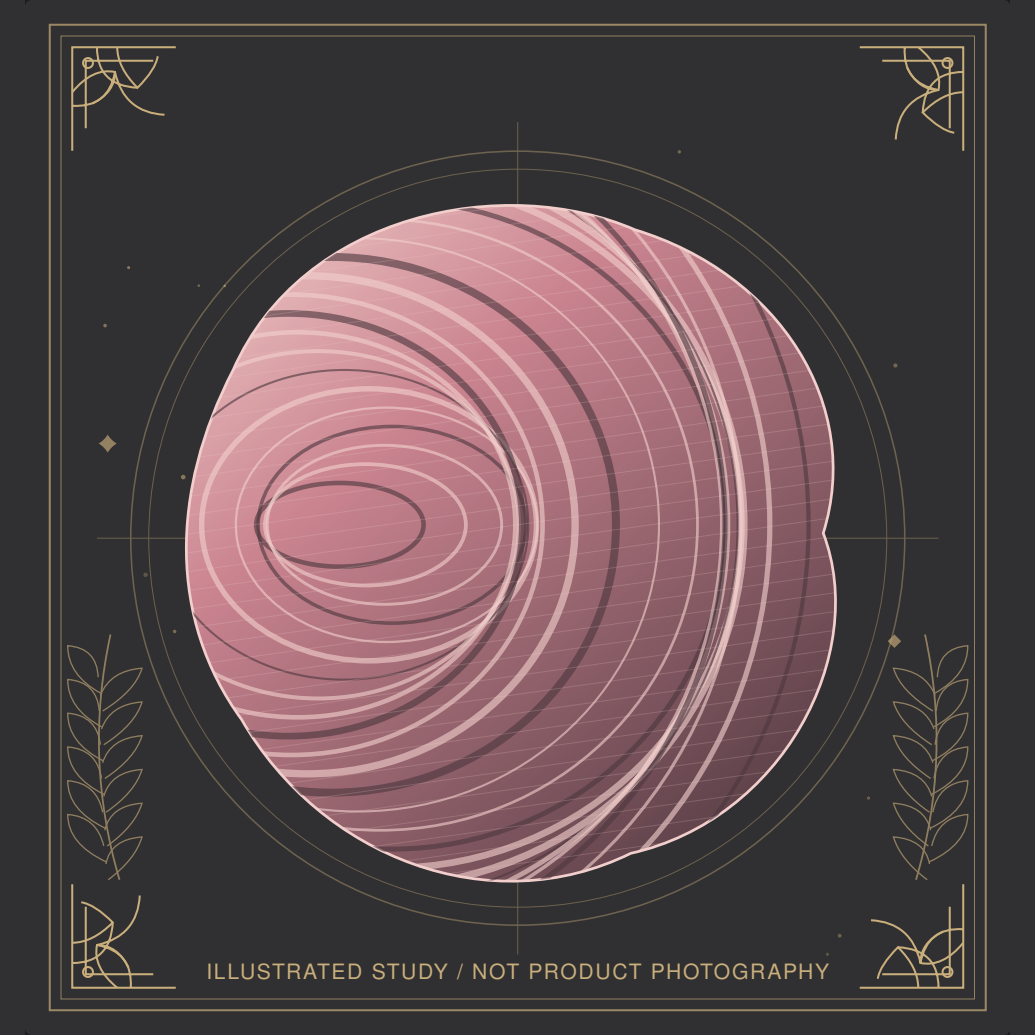
Material
Manganese carbonate (MnCO3). [1]
Family
Manganese carbonate [1]
Appearance
Rose-colored carbonate crystals and layered growth. [1]
Meaning & tradition
Lembo: love and friendship. [2]
In this guide
Visual identity & plain-language name
Rhodochrosite is manganese carbonate, MnCO3. Banded slices are only one expression: transparent crystals, rounded growths and stalactitic material can appear quite different. A crystal emphasizes geometry; a slice reveals successive deposition. Rhodonite’s related name does not make it the same mineral. [1]
Earth story: formation, structure & color
Trigonal structure, hardness 3.5–4 and rhombohedral cleavage place it in the calcite group. Manganese is essential to its composition; substitutions and companions can affect appearance. Hydrothermal and metamorphic occurrences are documented. Color boundaries do not require a separate species for every band. [1]
Rhodochrosite is a manganese carbonate, MnCO3, with a structure in the calcite family. It is distinct from rhodonite, whose manganese accompanies silicon and oxygen in a silicate structure. Pink to red bodycolor can occur in both, but the similarity is not a chemical relationship sufficient to merge their names. Rhodochrosite's documented colors also include yellowish and brownish appearances, reflecting compositional variation rather than a universal pure pink standard. [1]
Rhombohedral or scalenohedral crystals, bladed aggregates, rounded growths and stalactitic masses appear in the mineralogical record. Hardness 3.5–4, perfect rhombohedral cleavage and density about 3.70 characterize the mineral. It occurs in hydrothermal veins, sedimentary deposits, metamorphic settings and some carbonatites, with different associated minerals in each. The Handbook specifically lists banded ornamental material from Capillitas, Argentina, and exceptional crystals from South African and North American localities. These are documented examples; a shop's country claim still needs specimen provenance. [1]
The Handbook records compositional series with calcite and siderite. Those relations place rhodochrosite within carbonate crystal chemistry and permit variation rather than one identical composition in all specimens. The white streak and vitreous luster provide further properties, distinct from its pink bodycolor. A banded aggregate can also contain separate carbonate-rich zones. Confirmed constituent identity is therefore more informative than assigning every pale stripe the same composition as the saturated pink material beside it. [1]
Varieties & look-alikes
Banded pink material, red-pink crystals and mixed carbonate rock are useful descriptions. Rhodonite is a silicate with different properties. Pale pink calcite can resemble rhodochrosite. A stripe pattern or vivid hue cannot establish composition or prove a locality-specific trade claim. [1]
- Banded pink rhodochrosite
- Alternating pink and pale zones form many familiar ornamental pieces. Cutting direction influences whether layers appear as ribbons, rings or broad fields. Banded is an aggregate appearance description rather than a separate species. Identify any contrasting constituent when known, and do not let an attractive stripe pattern alone authenticate a material or its origin. [1]
- Stalactite slices
- A slice through a stalactitic or cylindrical aggregate can expose concentric growth patterns. The disk shape is created by cutting, while the internal pattern belongs to the original aggregate. Document whether the piece is a natural section, repaired slice or assembled product when that information is available. Color rings do not establish a complete growth chronology by themselves. [1]
- Red crystals
- Transparent or translucent red rhodochrosite crystals can show conspicuous natural faces and bright luster. They remain a soft, cleavable carbonate despite their gem-like appearance. A natural termination and a faceted gem need different observations because cutting removes growth geometry. Compare documented mineral properties rather than identifying either solely by saturated red color. [1]
Human story: objects, names & cultural context
Greek roots for rose and coloring underlie the name. That naming history explains a visual reference, not a worldwide love tradition. Scientific terminology and recent crystal-shop emotional correspondences are separate chapters in the human story. [1]
The name combines Greek roots referring to rose and coloring. Its human history includes the collection of exceptional crystals and the cutting of banded ornamental masses, which are different ways of presenting the same mineral. The Handbook's locality record supplies a supported geographical context without an invented precolonial legend. Calling a banded piece Inca rose in commerce does not by itself establish that the individual object was used by the Inca or that any specific ritual history applies to it. [1]
Meaning & practice: attributed traditions
Margaret Ann Lembo includes rhodochrosite among pink stones associated with love and friendship in her 2013 article. This is her modern interpretation. [2]
A friendship intention might record one act of care received and one act you can offer. Layering can serve as an editorial metaphor for accumulated experience. The act of reciprocity remains yours; mineral banding does not generate love.
Material truth: trade names & treatments
Relatively low hardness and strong cleavage make exposed crystals and thin slices vulnerable. Support them carefully. Do not assume a carbonate tolerates the same cleaning as quartz. Describe filling, joined slices or coating when documented, and distinguish a natural growth pattern from a manufactured sphere or pendant outline. [1]
Rhodochrosite's softness and excellent cleavage favor protected display and thoughtful jewelry design. A polished slice can include fractures, porous areas and other carbonates that differ from a clean single crystal. Any stabilization, filling or assembled construction should be described independently of the fact that some material is natural rhodochrosite. Its carbonate identity also makes acidic cleaning products inappropriate. Keep mineral specimens out of drinking-water preparations; ornamental appearance does not establish food suitability. [1]
In a banded specimen, note the direction, width and continuity of pink and pale zones. A circular pattern in a slice may reflect the cutting of a rounded or stalactitic growth, while a long section presents a different geometry. The shape selected by the cutter matters as much to the design as the original growth. A meaningful comparison retains both the specimen form and the mineral properties, rather than assuming that every striped pink stone comes from one locality or formation episode.
Sources & related specimens
The mineralogical source provides carbonate identity, habits and naming. Lembo supplies an attributed contemporary correspondence. Compare rhodonite and calcite when separating pink appearance from mineral classification.
- Handbook of Mineralogy: Rhodochrosite
Mineralogical Society of America · Identity and natural history · Accessed October 9, 2026
- Margaret Ann Lembo: Colors, Enlivening the Rainbow Body (2013)
Llewellyn Worldwide · Margaret Ann Lembo’s contemporary color and intention correspondences · Accessed October 9, 2026