
Pink crossed by black
Rhodonite
Manganese-rich silicate material, often pink with dark manganese oxides.
Mineral species; ornamental specimens may include other minerals
Rhodonite is a manganese-rich silicate.
Geology · Human history · Attributed traditions
Explore the specimen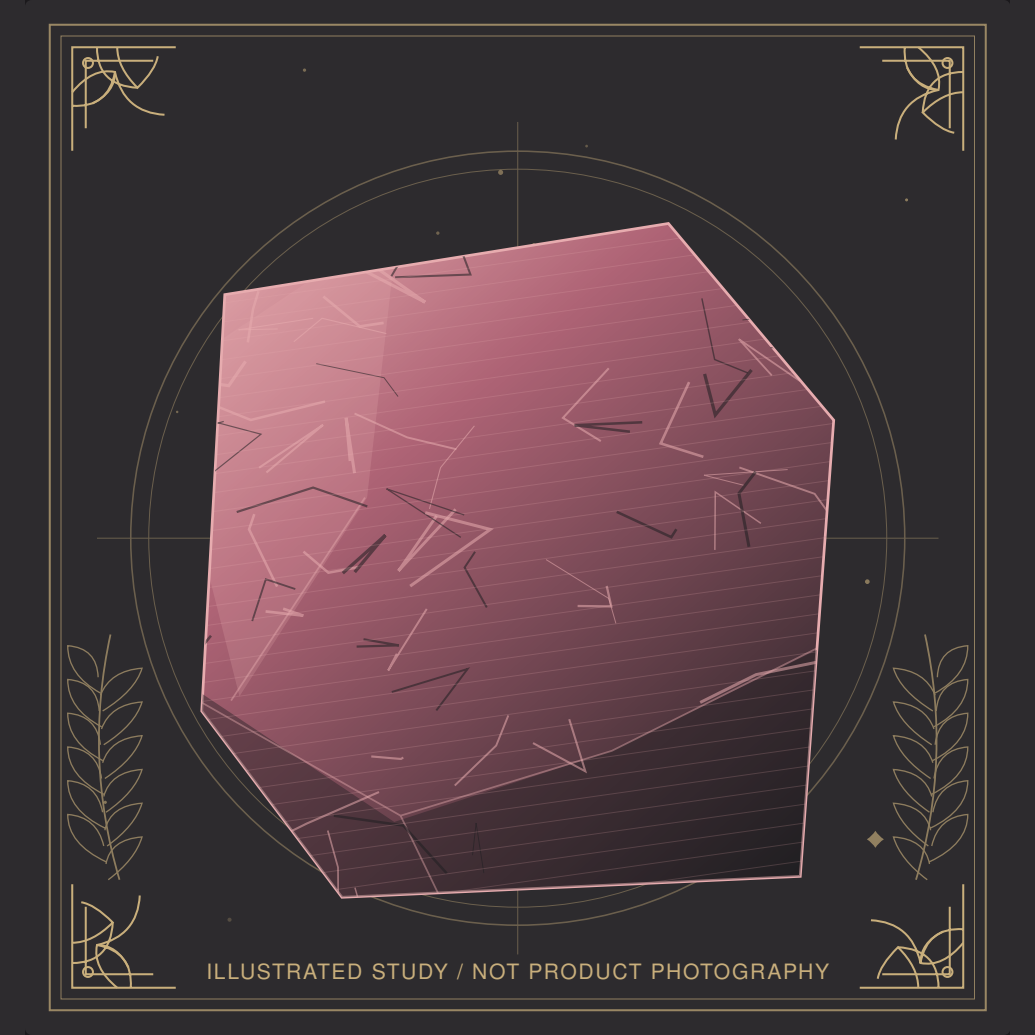
Material
Manganese-rich silicate material, often pink with dark manganese oxides. [1]
Family
Manganese silicate [1]
Appearance
Pink-red silicate with frequent dark manganese-oxide areas. [1]
Meaning & tradition
Lembo: comfort and harmony. [2]
In this guide
Visual identity & plain-language name
Rhodonite is a manganese-rich silicate. Familiar pink masses crossed by dark oxide-rich areas are often mineral assemblages rather than pure uninterrupted rhodonite. Its name and rhodochrosite both evoke rose colors, but the materials have different chemistry and structures. [1]
Earth story: formation, structure & color
The Handbook describes triclinic rhodonite with hardness around 5.5–6.5. Well-developed cleavage means resistance to scratching does not guarantee resistance to impact. Manganese-bearing geological settings supply the formation context. Dark exterior manganese oxides can coexist with fresh pink interiors. [1]
Rhodonite is a manganese-rich silicate with iron, magnesium and calcium participating in its composition. The Handbook presents a triclinic structure and a chain-silicate formula rather than a carbonate formula. This distinction explains why rhodonite and rhodochrosite should remain separate despite their shared pink coloration and manganese connection. Rhodonite commonly occurs as compact masses, while occasional well-developed crystals can be transparent enough for gem cutting. [1]
The reference gives hardness 5.5–6.5, density about 3.57–3.76, and several pronounced cleavage directions. Black material on surfaces or crossing pink areas can be manganese oxides. It is an additional component or alteration product rather than a required part of the ideal rhodonite formula. The mineral occurs in manganese-bearing settings formed by sedimentary, hydrothermal and metamorphic processes, with differing associated minerals. Specific examples include Franklin, New Jersey, and gem crystals from Broken Hill, Australia, and Minas Gerais, Brazil. Such examples demonstrate possible occurrence, not the origin of an unprovenanced bead. [1]
The Handbook lists a white streak and vitreous luster, with a somewhat pearly appearance on cleavage surfaces. These complement rather than duplicate pink color. Cleavage in several directions also means that an angular exposed surface may be a break rather than an original growth face. A mineral determination can use those relationships alongside chemical or optical evidence, while a polished cabochon may no longer present them visibly. [1]
Varieties & look-alikes
Compare massive pink-black lapidary rock, more evenly pink material and mineral crystals. Rhodochrosite is a generally softer manganese carbonate. Pink quartz or dyed ornamental rock may share color without sharing identity. A photograph can describe the dark network but cannot determine every mineral proportion. [1]
- Pink rhodonite
- Pink massive rhodonite is the familiar ornamental presentation. Its color identifies an appearance within manganese-rich silicate material, not a separate mineral species. Some pieces are comparatively uniform; others include oxides or additional minerals. The absence of black veining does not automatically exclude rhodonite, and the presence of veining does not establish it without supporting properties. [1]
- Black-veined rhodonite
- Dark manganese oxide areas can contrast with the pink silicate. Record the relationship and known component identities rather than assigning the whole stone the formula of pure rhodonite. Veining can make a memorable pattern, but similar contrasts occur in other materials. Matrix content, cracks and any filling can affect how a polished piece behaves. [1]
- Red gem rhodonite
- Transparent to translucent red or rose-colored crystals occupy a different visual end of the rhodonite range from opaque tumbles. The Handbook lists gem-crystal occurrences and documented cleavage. A cut gem needs identification through suitable gemological properties, not merely a comparison with a red photograph. Its clarity and cut describe quality and presentation, while the mineral name describes identity. [1]
Human story: objects, names & cultural context
The scientific name comes from a Greek reference to rose color. It captures a familiar appearance rather than proving one historical use or a universal symbolic meaning. Dark areas in a carving need mineralogical description, not a fabricated separate cultural pedigree. [1]
The name comes from a Greek reference to rose color. The Handbook's distribution record includes both historically studied mineral localities and sources of gem crystals, showing that scientific and ornamental interest overlap. A nineteenth-century mineral name and a modern pink cabochon can share a color vocabulary without sharing an ancient ritual history. A well-documented specimen's locality and collector history are worth preserving: they connect an individual object to that larger material history more securely than a generalized story about pink stones. [1]
Meaning & practice: attributed traditions
Margaret Ann Lembo includes rhodonite among pink stones linked with comfort and harmony in her 2013 color-and-chakra account. This is a contemporary spiritual correspondence. [2]
For an editorial harmony intention, choose a repairable disagreement and write a respectful next step. The pink-dark contrast can recall that difficult and pleasant experiences occupy the same story. It does not establish that manganese minerals resolve conflict.
Material truth: trade names & treatments
Describe whether a product is a mineral crystal, rhodonite-dominant mixed rock or an imitation. Black veining is not an authenticity certificate. Protect exposed cleavage surfaces and avoid storing delicate pieces loose with harder stones. Locality and treatment claims belong to the individual specimen record. [1]
A polished rhodonite-rich rock can include black oxides and other minerals with different polish and wear behavior. Its overall properties are consequently not identical to those of an isolated transparent rhodonite crystal. Hardness does not eliminate cleavage-related vulnerability, particularly near thin edges or drilled holes. The words red gem rhodonite should describe confirmed material rather than become a shortcut around distinguishing pink and red silicates, carbonates or dyed imitations. Treatment and origin claims require their own supporting information. [1]
In a black-veined specimen, study whether the dark material forms thin lines, broad patches or a surface crust. Describe those relationships before interpreting an alteration sequence. The vivid contrast can be appreciated without assuming that black content proves authenticity or that less-veined material is inferior. For transparent stones, faceting changes the silhouette and can obscure natural morphology. Keep the material determination, observed hue, degree of transparency and any documented treatment as separate items in your record.
Sources & related specimens
The Handbook establishes rhodonite’s properties and formation context. Lembo supplies the modern symbolism. Rhodochrosite offers the most useful comparison for separating two pink manganese materials.
- Handbook of Mineralogy: Rhodonite
Mineralogical Society of America · Identity and natural history · Accessed October 9, 2026
- Margaret Ann Lembo: Colors, Enlivening the Rainbow Body (2013)
Llewellyn Worldwide · Margaret Ann Lembo’s contemporary color and intention correspondences · Accessed October 9, 2026