
The beryl family
Other Beryl Varieties
Beryl family material outside the dedicated aquamarine, emerald and morganite pages.
Beryllium aluminum silicate mineral species and its color varieties
The extended beryl family connects colorless goshenite, golden heliodor and green beryl with better-known aquamarine, emerald and morganite. These gem names usually sort color appearances within one mineral species. The comparison reveals how shared structure can support different visual identities.
Geology · Human history · Attributed traditions
Explore the specimen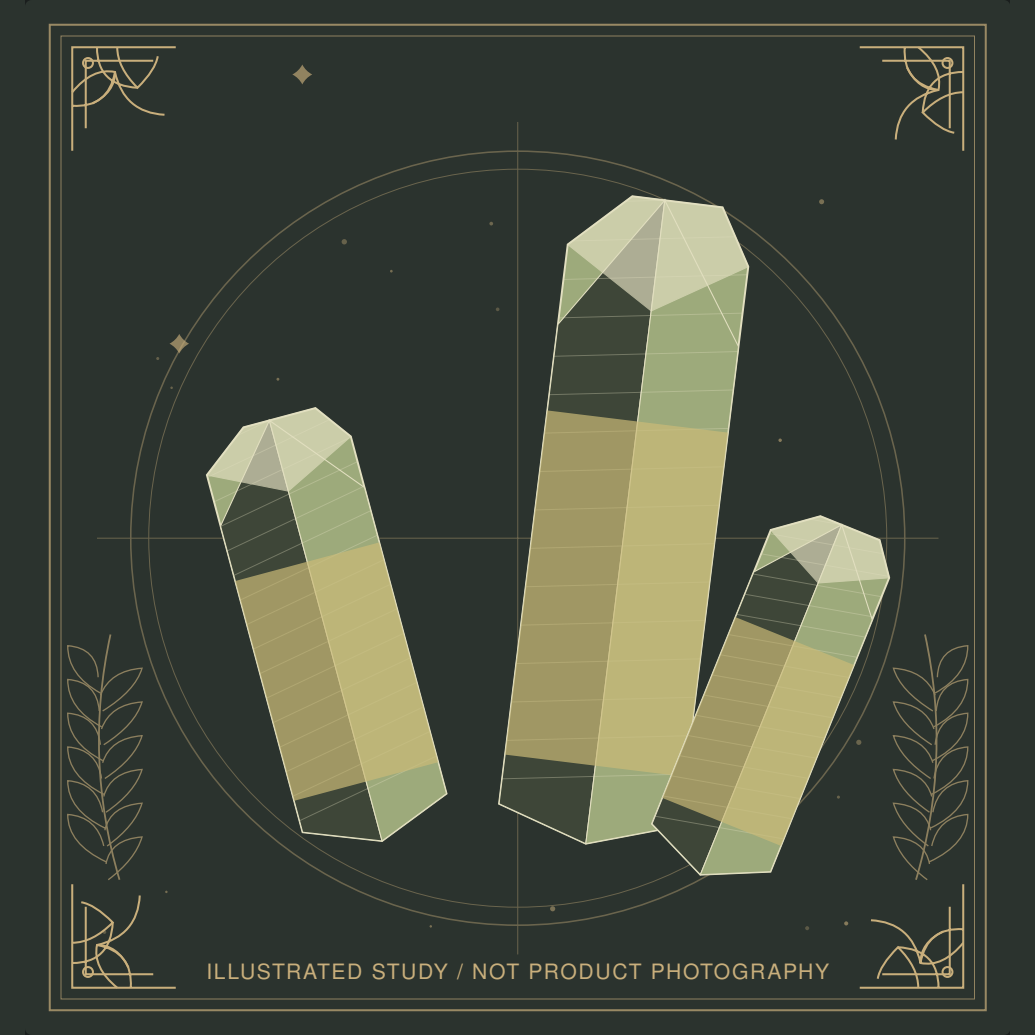
Material
Beryl family material outside the dedicated aquamarine, emerald and morganite pages. [1]
Family
Beryl [1]
Appearance
Contrasting color zones [1]
Traditions
Sandra Kynes’s 2018 article includes beryl in relationship-oriented correspondences. [9]
In this guide
Visual identity
The extended beryl family connects colorless goshenite, golden heliodor and green beryl with better-known aquamarine, emerald and morganite. These gem names usually sort color appearances within one mineral species. The comparison reveals how shared structure can support different visual identities. [1]
The most recognizable collector habit is a hexagonal prism, but beryl crystals can be long, short or tabular. A flat termination differs from a polished point, and a fractured end should not be illustrated as an intact natural face. Colorless, yellow, blue, pink and green varieties give the species a much broader appearance range than any single famous gem name suggests. Observing habit, internal clouding and attached material can be as worthwhile for a rough specimen as comparing the color of a transparent faceted jewel. [1]
Earth story: geology and formation
The Handbook of Mineralogy records beryl in granites, pegmatites, metamorphic rocks and hydrothermal settings. Minor chemistry and growth conditions affect color and other properties. A color name is consequently more specific than simply beryl, but does not independently prove a particular mine. The Handbook records beryl associated with quartz, feldspar, mica, spodumene and tourmaline in various geological environments. A natural crystal attached to that matrix can preserve relationships hidden in a faceted goshenite or heliodor. The shared framework links these varieties scientifically, while trace chemistry and environment affect appearance. A family article can therefore compare structure and names without claiming that all color varieties occur together in one deposit. [1]
Beryl is beryllium aluminium silicate, Be₃Al₂Si₆O₁₈, with hexagonal symmetry. The Handbook of Mineralogy lists hardness 7.5–8 and a measured density range of approximately 2.63–2.97 grams per cubic centimetre, varying with composition. Prismatic crystals can be columnar or tabular, and many terminate in a flat face. Cleavage is imperfect, while breakage may be curved or uneven. Beryl is hard but brittle; a network of fractures can make a particular crystal more vulnerable than its hardness suggests. Granite and granite pegmatite are important settings, but beryl also occurs in metamorphic rocks and hydrothermal veins. The relationship between color, trace chemistry and growth environment is more informative than assigning every beryl one deposit model. [1]
Beryl’s hexagonal framework can accommodate additional constituents that influence density and color, so a single density figure is inadequate for the entire species range. The Handbook lists a measured range extending from about 2.63 to 2.97 grams per cubic centimeter. Its geological occurrences include granitic and pegmatitic material, metamorphic rocks and hydrothermal veins. Associated quartz, feldspars, micas, spodumene and tourmaline help situate a collected specimen. Those associations are useful context where preserved, not a list of minerals that must accompany every beryl crystal. [1]
Varieties and lookalikes
These names describe different levels of information: a mineral species, a visual variety, a crystal habit or a retail label. The distinctions below keep the recognizable shop vocabulary alongside its material explanation.
Goshenite is colorless, aquamarine is blue to greenish blue, morganite is pink to peach and emerald is the recognized vivid green gem variety. Heliodor and golden beryl refer to yellow material in familiar terminology. These names organize color differences within one framework, while differing color-bearing chemistry and gem definitions deserve their own explanations. A green beryl that falls short of a particular emerald standard can still be a correctly identified beryl. Naming the host first helps preserve that distinction without turning every borderline color into a disputed species. [1][2][3][4][5]
- Heliodor and golden beryl
- Yellow-to-golden color varieties share beryl structure. The color name does not substitute for treatment disclosure. [1]
- Goshenite
- Colorless beryl belongs to the same species despite its very different visual impression. Colorless does not imply diamond. [1]
- Green beryl
- Green appearance alone is not an automatic emerald designation. A precise gem identification is preferable to a value-laden color claim. [1]
Human story: history and naming
The recorded family vocabulary distinguishes golden, colorless and green appearances. This is a history of mineral and gem naming rather than proof that all these varieties inherited one ancient ritual meaning. A specimen’s documented collection and cutting history can add a more specific human account. [1]
The variety pages supply several separate histories within the family. Aquamarine carries water-and-sea naming, emerald has documented mining and exchange histories, and morganite has an early twentieth-century naming connected to Kunz and Morgan. These are not one historical tradition attached uniformly to all beryl. A species-level entry is useful precisely because it lets readers compare the shared mineral framework with the distinct ways different colors have been named, traded, cut and interpreted over time. [6][7][8]
Meaning and practice: attributed traditions
Sandra Kynes’s 2018 article includes beryl in relationship-oriented correspondences. This is a modern family-level spiritual reference. It should not override more specific cultural histories or assign an identical meaning to every colored gem sold under a different beryl name. [9]
An optional relationship reflection is to notice what remains shared across different appearances, while still respecting the differences that matter.
Kynes includes beryl in relationship-oriented contemporary home correspondences. The broad family term in such a framework should be kept broad unless a source explicitly assigns a meaning to a particular color variety. Other practitioners give emerald, aquamarine or morganite their own associations. Comparing these accounts shows spiritual naming as a human interpretive system alongside mineral taxonomy. A reader’s intended use can be recorded without pretending that every beryl color has one universal historical meaning or one experimentally demonstrated relationship effect. [9]
Material identity and trade terminology
Golden beryl is not topaz or citrine. Green beryl should not automatically be marketed as emerald, and colorless goshenite is not diamond. A transparent photograph cannot settle mineral identity, treatment or provenance. Rare red beryl is not needed to make this family comparison useful. [1]
A gemstone can be a laboratory-grown beryl with the same broad mineral structure as its natural counterpart. That category differs from glass or another natural mineral used as an imitation. Treatment adds yet another layer: a natural host can be heated or have fractures filled. A clear catalogue description should therefore state the material identity, natural or laboratory origin where known, and any enhancement. The general name beryl answers the framework question, but it does not resolve all of these origin and treatment questions. [10][1]
Sources and related specimens
The references below distinguish mineral identification and physical properties from historical interpretation and practitioner symbolism. A cited material category describes a kind of stone; it does not certify the identity, treatment or provenance of an untested individual retail specimen.
- Handbook of Mineralogy: Beryl
Mineralogical Society of America · Mineral composition, structure, physical properties and occurrence · Accessed October 9, 2026
- GIA: Aquamarine
Gemological Institute of America · Geological, gemological or documented material-history evidence · Accessed October 9, 2026
- GIA: Emerald
Gemological Institute of America · Geological, gemological or documented material-history evidence · Accessed October 9, 2026
- GIA: Morganite
Gemological Institute of America · Geological, gemological or documented material-history evidence · Accessed October 9, 2026
- Natural Gemstones: Mineral Gemstones
US Geological Survey · Geological, gemological or documented material-history evidence · Accessed October 9, 2026
- GIA: Aquamarine History and Lore
Gemological Institute of America · Historical naming, material use and explicitly attributed lore · Accessed October 9, 2026
- GIA: Emerald History and Lore
Gemological Institute of America · Historical naming, material use and explicitly attributed lore · Accessed October 9, 2026
- GIA: Morganite History and Lore
Gemological Institute of America · Historical naming, material use and explicitly attributed lore · Accessed October 9, 2026
- Sandra Kynes: 365 Days of Crystal Feng Shui for Your Home (2018)
Llewellyn Worldwide · Contemporary practitioner symbolism and retailer terminology; distinct from mineralogical evidence · Accessed October 9, 2026
- GIA: An Introduction to Gem Treatments
Gemological Institute of America · Geological, gemological or documented material-history evidence · Accessed October 9, 2026