
Striated towers
Tourmaline
Borosilicate mineral supergroup / black tourmaline focus
Borosilicate mineral supergroup with multiple species and color varieties
Tourmaline is a chemically diverse borosilicate supergroup. Black striated prisms provide a familiar crystal-shop silhouette, but pink, green, blue and multicolored gems show a much wider range. Color names and mineral species answer different questions.
Geology · Human history · Attributed traditions
Explore the specimen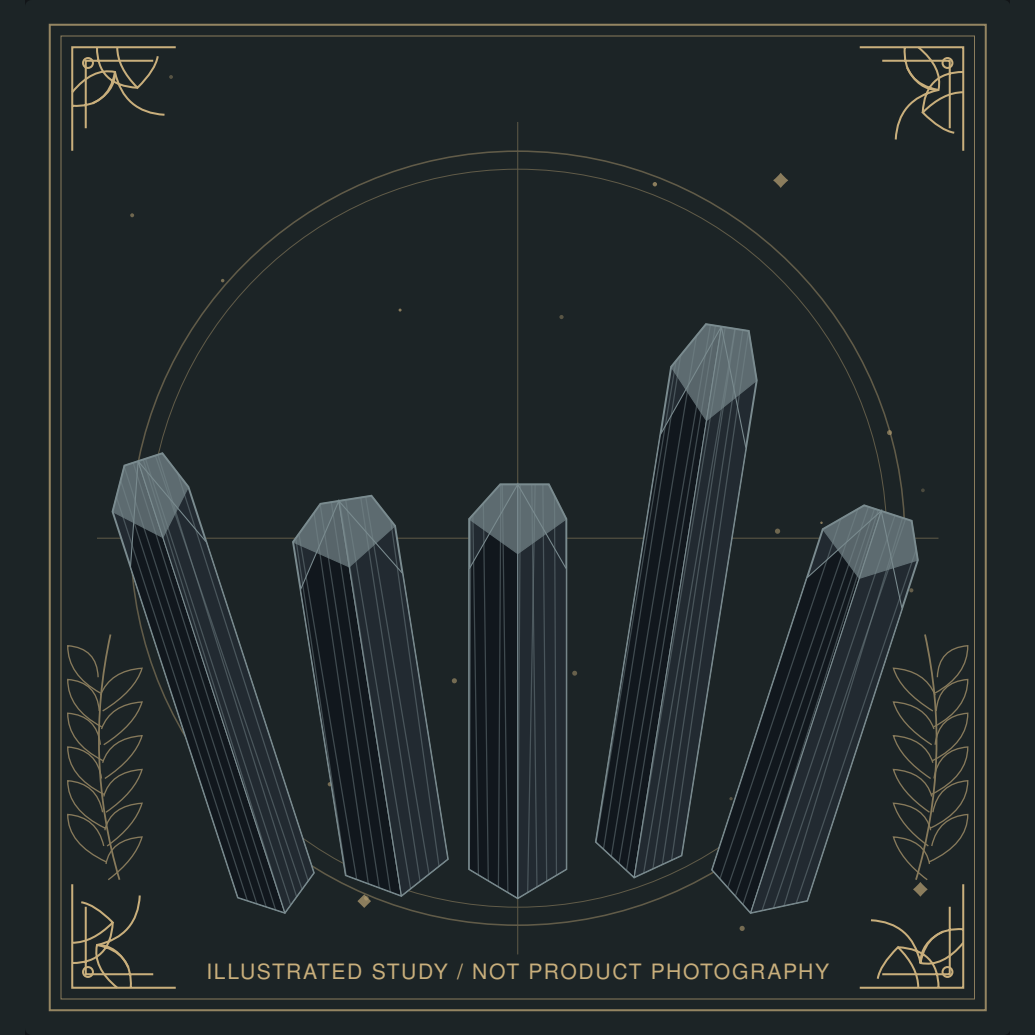
In this guide
Visual identity
Tourmaline is a chemically diverse borosilicate supergroup. Black striated prisms provide a familiar crystal-shop silhouette, but pink, green, blue and multicolored gems show a much wider range. Color names and mineral species answer different questions. [1][2][3][4]
Color zoning can occur along the length of a crystal or across a section. A watermelon slice exposes a cross-sectional arrangement, whereas a long bicolor crystal shows a sequence down its length. These are different views of growth zoning and can coexist within a more complex crystal. Cutting orientation makes particular relationships visible. A pink center and green rim are therefore a pattern description, not a separate approved species named Watermelon, and not evidence that every pink or green region has the same composition. [1][3]
Earth story: geology and formation
The Handbook of Mineralogy describes trigonal crystals of schorl, elbaite and dravite, with differing chemistry and geological associations. Pegmatites and metamorphic rocks host tourmalines. Internal zoning can preserve a changing growth environment. Black color is suggestive of schorl in common commerce, but does not alone determine a species. The Handbook relates elbaite strongly to granite pegmatites and records schorl and dravite in differing geological associations. In one multicolored crystal, zoning can reflect growth changes rather than a later assembly of differently colored pieces. A sliced watermelon cross-section and a longitudinal bicolor prism emphasize different axes. Color is therefore informative about appearance, but it cannot supply every major-element proportion needed for a species determination. [1][2][3][4]
Tourmaline crystals commonly have trigonal symmetry, elongated prisms and conspicuous lengthwise striations. The Handbook records hardness around 7 for schorl, elbaite and dravite, with poor cleavage and brittle fracture. Schorl’s measured density is about 3.18–3.22 grams per cubic centimetre, while the recorded ranges for elbaite and dravite differ. The contrast is a reminder that a group label cannot supply one exact property value for every member. Different compositions can share a similar prism, and one crystal can contain compositional or color zones. Analytical identification and optical description therefore complement rather than replace one another. [2][3][4]
Tourmaline is a mineral supergroup with a shared structural family and substantial chemical variation. Schorl, elbaite and dravite differ in major site constituents, so a single short formula cannot accurately stand for all specimens sold under the family name. The Handbook records iron-rich schorl, lithium-bearing elbaite and magnesium-bearing dravite separately. Their common elongated, often striated habit can make them visually related, while their chemistry and geological associations remain distinct. A black color is familiar for schorl but is not a full analytical species determination. [2][3][4][1]
Varieties and lookalikes
These names describe different levels of information: a mineral species, a visual variety, a crystal habit or a retail label. The distinctions below keep the recognizable shop vocabulary alongside its material explanation.
Rubellite and indicolite are familiar color-variety names, while Paraíba is tied to a copper-bearing gem category and its trade usage. Species names such as elbaite describe a different level of identification. The two vocabularies can be used together when their meaning is clear. A vivid hue alone cannot authenticate a specific locality or distinguish a tourmaline from another similarly colored gem. Raman, chemical and other laboratory work may be needed to answer questions that are beyond the visible pattern of an unlabelled crystal. [1][5]
- Black schorl and dravite
- Schorl is iron-rich tourmaline and dravite is magnesium-bearing. A black or brown color alone does not replace compositional identification. [1][2][3][4]
- Pink, rubellite, green/verdelite and indicolite
- These familiar gem color names help compare appearance but are not a complete species determination. [1][2][3][4]
Human story: history and naming
GIA relates tourmaline’s name to Sinhalese toramalli, used for mixed gems, and records the trade in California pink and red tourmaline for Chinese carving in the late nineteenth century. This family-level trade history is distinct from ancient evidence for black-tourmaline rituals. [6]
GIA describes the late nineteenth- and early twentieth-century trade linking California’s pink and red tourmaline to Chinese carving and jewelry demand. Changes in that market affected the mines and their production. This is a documented commercial relationship, not a universal symbolism assigned to a color. Later Brazilian and other discoveries expanded the range of material in the market. The story shows how geology, individual mines, makers and demand interact in the history of a mineral family that is now widely sold in crystal shops. [6]
Meaning and practice: attributed traditions
GIA’s October birthstone guide summarizes protective and self-confidence beliefs associated with black tourmaline. Michelle Welch’s 2021 practice also uses it in symbolic boundary work. These describe contemporary or reported beliefs, not proof of aura protection. Tourmaline’s real electrical behavior is a different scientific topic and does not authenticate a metaphysical outcome. [7][8]
An optional boundary reflection is to state one limit that can be expressed through an ordinary action. The crystal may symbolize that choice without producing protection by itself.
GIA reports a modern protection association for black tourmaline in its October birthstone discussion, while named practitioner publications use particular tourmaline colors within their own frameworks. These attributions should remain color-specific where the source is color-specific. An intention of protection can mean a chosen boundary or reflective reminder; it does not establish a measurable shield around a person or electronic device. The family’s chemical diversity likewise does not validate assigning one physical spiritual mechanism to every tourmaline species. [7][9]
Material identity and trade terminology
Schorl, elbaite and dravite are mineralogical names; rubellite, indicolite and watermelon generally describe gem appearances. Paraíba is a specific gem-trade designation requiring more than a vivid blue-green color. Treatment and origin claims should be supported independently from a family identification. [1][2][3][4]
Sources and related specimens
The references below distinguish mineral identification and physical properties from historical interpretation and practitioner symbolism. A cited material category describes a kind of stone; it does not certify the identity, treatment or provenance of an untested individual retail specimen.
- GIA: Tourmaline Description
Gemological Institute of America · Geological, gemological or documented material-history evidence · Accessed October 9, 2026
- Handbook of Mineralogy: Schorl
Mineralogical Society of America · Mineral composition, structure, physical properties and occurrence · Accessed October 9, 2026
- Handbook of Mineralogy: Elbaite
Mineralogical Society of America · Mineral composition, structure, physical properties and occurrence · Accessed October 9, 2026
- Handbook of Mineralogy: Dravite
Mineralogical Society of America · Mineral composition, structure, physical properties and occurrence · Accessed October 9, 2026
- GIA: An Introduction to Gem Treatments
Gemological Institute of America · Geological, gemological or documented material-history evidence · Accessed October 9, 2026
- GIA: Tourmaline History and Lore
Gemological Institute of America · Historical naming, material use and explicitly attributed lore · Accessed October 9, 2026
- GIA October birthstone lore
Gemological Institute of America · Geological, gemological or documented material-history evidence · Accessed October 9, 2026
- Michelle Welch: 14 Crystals for Clearing, Protecting, and Transmuting (2021)
Llewellyn Worldwide · Contemporary practitioner symbolism and retailer terminology; distinct from mineralogical evidence · Accessed October 9, 2026
- Margaret Ann Lembo: Colors, Enlivening the Rainbow Body (2013)
Llewellyn Worldwide · Contemporary practitioner symbolism and retailer terminology; distinct from mineralogical evidence · Accessed October 9, 2026