
A paired spodumene story
Kunzite and Hiddenite
Colored varieties of spodumene.
Colored spodumene varieties within one mineral species
Kunzite and hiddenite are gem varieties of spodumene. Pink-to-violet kunzite and green hiddenite share elongated crystal forms and a lithium-bearing pyroxene framework. The paired names do not mean their color causes or spiritual associations are identical.
Geology · Human history · Attributed traditions
Explore the specimen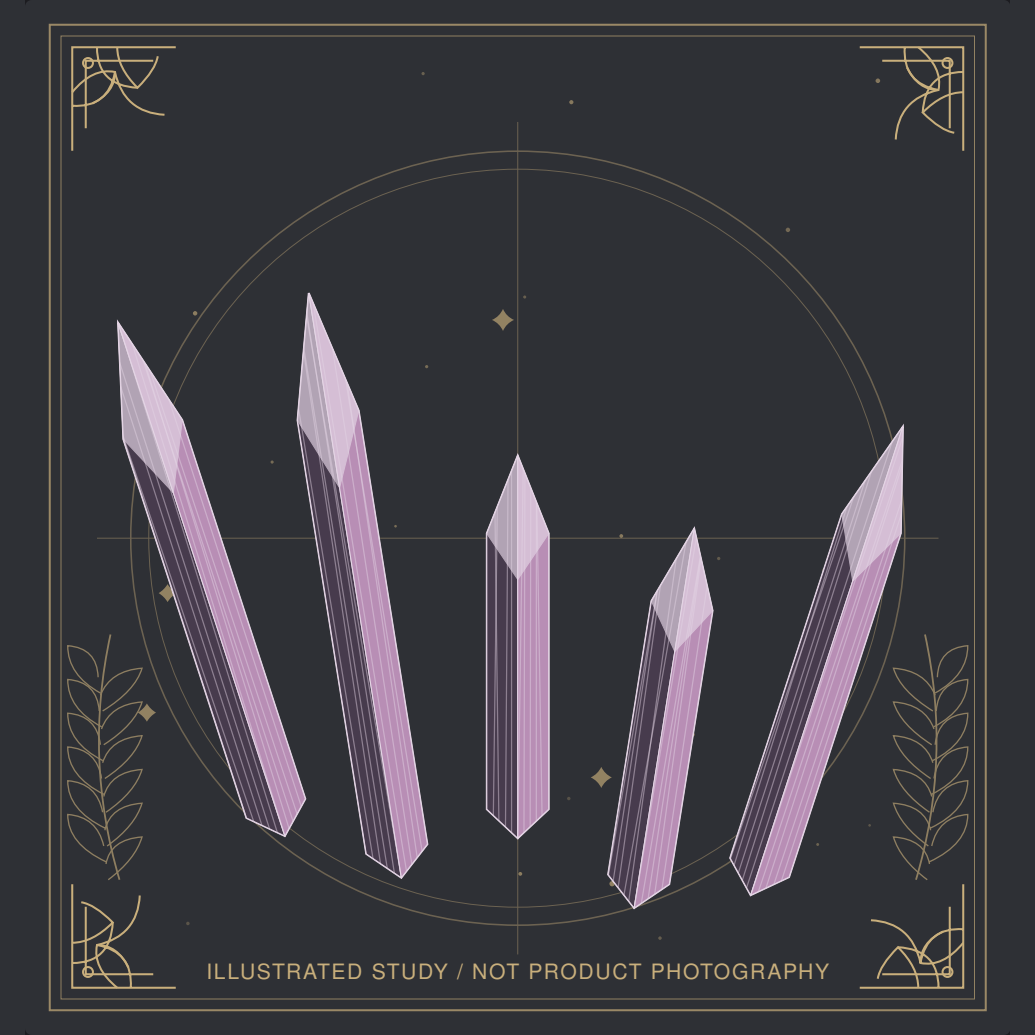
In this guide
Visual identity
Kunzite and hiddenite are gem varieties of spodumene. Pink-to-violet kunzite and green hiddenite share elongated crystal forms and a lithium-bearing pyroxene framework. The paired names do not mean their color causes or spiritual associations are identical. [1][2]
Kunzite can show a different intensity of pink when seen along different directions, and crystal orientation therefore affects how its color is displayed in a cut object. Its elongated habit and prominent cleavage differ from the flat-ended hexagonal habit of beryl. A pale pink polished stone may resemble morganite or rose quartz in a simple image, but those host minerals have different structures. A detailed comparison preserves the shared color theme while recording that a pink appearance is not a complete mineral identification. [2][1][3][4]
Earth story: geology and formation
Spodumene occurs especially in lithium-rich pegmatites. Its strong cleavage and directional color behavior make orientation relevant both to cutting and to viewing a rough crystal. Strict hiddenite usage refers to chromium-related green material; an arbitrary green spodumene color should not settle that designation. The Handbook lists spodumene in lithium-rich granite pegmatites, associated with minerals including quartz, albite, lepidolite and beryl. Recorded localities include the Black Hills of South Dakota, California’s Pala district, Brazil and Afghanistan. These examples establish broad mineral occurrence rather than certify a specific pink gem’s source. A long rough crystal can retain cleavage and growth relationships that disappear when only a small colored section is cut. [1][2]
Spodumene is lithium aluminium silicate, LiAlSi₂O₆, in the pyroxene family, with monoclinic symmetry. The Handbook records hardness 6.5–7 and density around 3.03–3.23 grams per cubic centimetre. Good cleavage and brittle breakage mean that scratch resistance should not be equated with resistance to a knock. Glassy crystal faces and pearly cleavage surfaces can look different within one fragment. Long prisms, directional color and the distinction between a natural end and a broken face all contribute to an informed description. Lithium within the mineral framework is a compositional fact rather than a medicinal dose. [1]
Spodumene is a lithium-bearing pyroxene with the composition LiAlSi₂O₆ and monoclinic symmetry. The Handbook records it in lithium-rich granite pegmatites, often with quartz, albite, lepidolite, beryl and tourmaline. These associations explain why a locality can yield several shop materials with quite different identities. A collector crystal retains its own pyroxene framework even when found beside beryl. The attached matrix and documented locality help situate the specimen; a pink or green color alone cannot establish that wider pegmatite context. [1]
Varieties and lookalikes
These names describe different levels of information: a mineral species, a visual variety, a crystal habit or a retail label. The distinctions below keep the recognizable shop vocabulary alongside its material explanation.
The strict hiddenite designation concerns green spodumene colored by chromium. Not every green spodumene receives that same interpretation, and a green trade label can omit the distinction between color appearance and color-bearing chemistry. Kunzite is the pink to violet-pink variety associated with manganese. The mineral species stays spodumene across these colors. A seller who gives only the broad phrase green kunzite has combined a pink-variety name with a different color and should clarify what material and variety are actually being offered. [1][2]
Human story: history and naming
GIA records the early-twentieth-century recognition of kunzite and the name honoring George F. Kunz. The name is modern gem history, not evidence for ancient kunzite correspondences. A stone’s much older geological age does not make its retail spiritual vocabulary ancient. [5]
GIA connects the kunzite name to George Frederick Kunz and the recognition of pink spodumene in the early twentieth century. This supported modern naming history is distinct from a claim of ancient kunzite rituals. The mineral species and its geological occurrence can predate the commercial variety name by a great span of time. A documented specimen’s discovery, scientific description and subsequent cutting provide a human history without needing to attribute present-day pink-crystal meanings to an unrecorded ancient practice. [5]
Meaning and practice: attributed traditions
The Crystal Council gives kunzite kindness and gentleness themes and hiddenite self-appreciation and meditation themes. These are two attributed contemporary profiles. Their shared mineral identity does not require one universal correspondence or imply that lithium within the crystal acts as medication. [6][7]
An optional gentleness reflection can focus on how two related materials retain different names, as a reminder to treat individual needs distinctly.
The Crystal Council gives kunzite gentleness and kindness themes and hiddenite an emphasis on self-appreciation and meditation. Keeping the two attributions separate follows the practitioner’s variety-specific presentation. Their shared species identity does not force every spiritual source to assign identical meanings, just as their different symbolic roles do not make them separate mineral species. A participant may choose a reflective theme from one profile while retaining a correct account of lithium pyroxene, its color mechanism and its cleavage. [6][7]
Material identity and trade terminology
Not every green spodumene satisfies strict hiddenite terminology. Known color treatment and growth origin should be disclosed. Cleavage can make a hard gem vulnerable to breakage, so hardness alone does not describe a rough blade’s robustness. [1][2]
The Handbook records good cleavage at approximately 87 degrees, so a high-looking hardness number does not imply exceptional resistance to breakage. Cleavage allows the structure to part along preferred directions. Existing fractures, thin edges and the chosen orientation matter for an individual object. GIA’s gem information also distinguishes treatment and imitation questions from natural host identity. A cared-for jewel, a large rough crystal and a thin carving can present very different vulnerabilities even while all are correctly identified as spodumene. [1][2][8]
Sources and related specimens
The references below distinguish mineral identification and physical properties from historical interpretation and practitioner symbolism. A cited material category describes a kind of stone; it does not certify the identity, treatment or provenance of an untested individual retail specimen.
- Handbook of Mineralogy: Spodumene
Mineralogical Society of America · Mineral composition, structure, physical properties and occurrence · Accessed October 9, 2026
- GIA: Kunzite
Gemological Institute of America · Geological, gemological or documented material-history evidence · Accessed October 9, 2026
- Handbook of Mineralogy: Beryl
Mineralogical Society of America · Mineral composition, structure, physical properties and occurrence · Accessed October 9, 2026
- Handbook of Mineralogy: Quartz
Mineralogical Society of America · Mineral composition, structure, physical properties and occurrence · Accessed October 9, 2026
- GIA: Kunzite History and Lore
Gemological Institute of America · Historical naming, material use and explicitly attributed lore · Accessed October 9, 2026
- The Crystal Council: Kunzite
The Crystal Council · Contemporary practitioner symbolism and retailer terminology; distinct from mineralogical evidence · Accessed October 9, 2026
- GIA: An Introduction to Gem Treatments
Gemological Institute of America · Geological, gemological or documented material-history evidence · Accessed October 9, 2026