
Blue rock gold grains
Lapis Lazuli
A rock containing blue lazurite with variable calcite, pyrite and other minerals.
Natural ornamental rock assemblage
Lapis lazuli is a rock rather than one blue mineral species.
Geology · Human history · Attributed traditions
Explore the specimen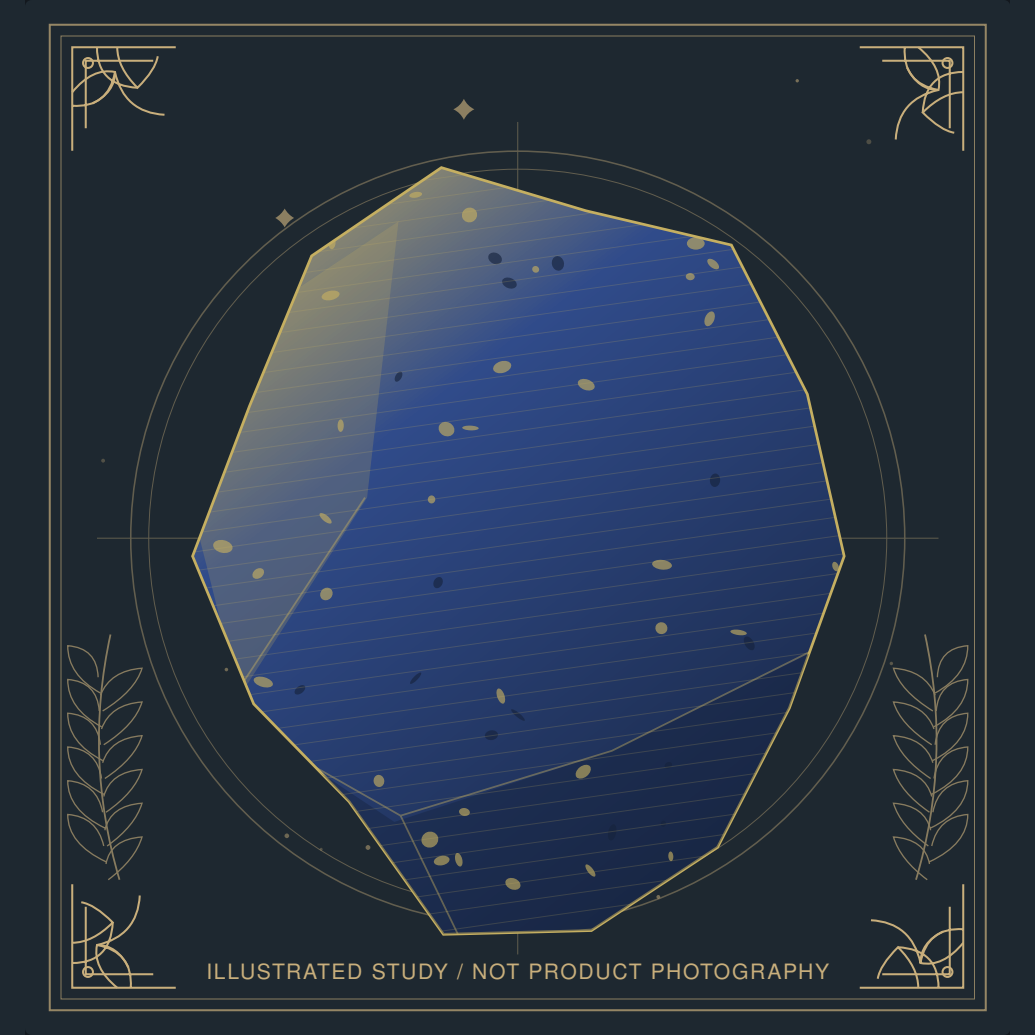
Material
A rock containing blue lazurite with variable calcite, pyrite and other minerals. [1]
Family
Lazurite-bearing rock [1]
Appearance
Blue rock with white calcite and gold-colored pyrite. [1]
Meaning & tradition
Egyptian lapis amulet history; Lembo: inner knowing. [3]
In this guide
Visual identity & plain-language name
Lapis lazuli is a rock rather than one blue mineral species. Lazurite contributes blue, with variable calcite, pyrite and other minerals. A polished piece is a mineral landscape: golden flecks are commonly pyrite, not native gold. White areas and differing blue intensity can be natural parts of that mixture. [1]
Earth story: formation, structure & color
GIA describes the mixture and a characteristic hardness around 5–6. Components do not all share one hardness, so that range cannot act as a purity test. A dark blue cabochon and a pale patterned carving may be related lapis materials without sharing identical proportions. Their identity differs from sodalite and blue glass. [1]
Lapis lazuli is a rock rather than one mineral species. Its blue component is associated with lazurite in the sodalite family, while calcite, pyrite and other minerals can contribute pale areas, gold-colored flecks or different textures. The complete assemblage has no single ideal mineral formula. A thin vein, granular patch or conspicuous pyrite crystal represents a separate constituent, and the proportions affect both appearance and the properties measured on the object. [1]
GIA places lapis around Mohs 5–6 and describes the color and mixture as central to its value and identification. Those summary values should not be read as a promise that every constituent resists abrasion equally. A dense blue region, a softer pale vein and a metallic inclusion can polish differently. Color distribution is a useful observation, but the prestige of a rich blue appearance does not establish untreated status, country or exact mine. Gemological and geological descriptions answer different parts of the same object's identity. [1]
Varieties & look-alikes
Blue-dominant, calcite-rich and pyrite-bearing material are descriptions. Dyed, resin-impregnated and reconstructed are condition categories. An attractive blue imitation may contain another mineral or glass. A named national or mine origin needs documentation beyond color intensity or visible pyrite. [1]
- Lapis lazuli
- The parent name belongs to the blue ornamental rock assemblage. It does not require every specimen to contain visibly large calcite veins or obvious pyrite crystals. Distinguish a description of the entire rock from a determination of one blue mineral. A quality grade, cultural story or shop name is not a substitute for that compositional distinction. [1]
- Pyrite-rich lapis
- Gold-colored pyrite can appear as scattered grains, clusters or more concentrated areas in a lapis assemblage. Its abundance influences the pattern but does not create a separate blue mineral species. Identify the metallic constituent rather than treating every golden speck as proof of natural lapis. Mineral boundaries and signs of binder or assembly matter as well as sparkle. [1]
- Calcite-veined lapis
- White or pale calcite-rich areas can contrast strongly with the blue rock. A vein is a component and texture description, not a universal measure of authenticity or provenance. Pale material may change how the object wears or responds to cleaning. The rock's beauty can include that contrast, while a seller's quality grading remains separate from geological identity. [1]
Human story: objects, names & cultural context
The Met records Egyptian lapis amulet 22.1.60, dated about 1981–1640 BCE, from Lisht North. It grounds one specific material use without proving a modern correspondence. GIA also discusses long-distance trade and carving history. Object, trade and modern symbolic interpretations should remain distinct threads. [5][4]
The Metropolitan Museum's identified lapis amulet from Lisht North provides a dated archaeological object, rather than an unnamed ancient tradition. GIA's historical overview also discusses the long cultural attraction of the blue rock and its use as a source of ultramarine pigment. These are distinct material histories: carving an amulet, trading a stone and preparing a pigment require different skills and contexts. A modern polished palm stone participates in that continuing interest in blue without automatically sharing the documented meaning or function of an Egyptian amulet. [5][4]
Meaning & practice: attributed traditions
Margaret Ann Lembo places lapis lazuli with intuition and inner knowing in her 2013 framework. This is a contemporary interpretation. [3]
An editorial inner-knowing practice can ask what you know, what you assume and what evidence might change your mind. The varied mineral landscape provides a visual reminder to keep those categories distinct; it does not make wearing lapis a source of insight.
Material truth: trade names & treatments
GIA distinguishes dye and impregnation from underlying gem identity. Disclose treated or reconstructed lapis. Calcite-containing material should not be assumed resistant to acidic cleaning. An ordinary photograph may show mineral colors but cannot prove treatment status or source. Retain a written product description with a valuable carving. [2][1]
GIA lists lapis among materials that can be dyed. Impregnation and surface treatments may also alter appearance or workability, so a complete description should distinguish bodycolor from treatment findings. A lapis-like object with blue binder, assembled particles or another colored material is a different identification question from whether genuine lapis was dyed. Gold-colored glitter does not authenticate the rock: the constituent must be identified and its relationship to the blue groundmass understood. [2][1]
Use the rock as an exercise in component observation. Describe the blue areas, the amount and pattern of pale material, and whether metallic grains are scattered, concentrated or crossing veins. Examine several sides instead of grading a whole object from its most saturated face. Prefer provenance and examination records over a rule that all high-quality lapis must contain an exact amount of glitter. The visual balance can be personally appealing while the geological account remains an honest account of a mixed rock.
For an individual ornament, preserve a condition photograph as well as the identification. Thin edges, drilled holes and joins may matter more to its immediate handling than a general rock description. If the blue face is only one layer of an assembled object, record the whole construction. A cultural association can remain part of the object's story while these practical observations clarify what the owner actually has.
Sources & related specimens
GIA establishes material identity and trade history. The Met supplies a dated object, and Lembo documents modern symbolism. Compare sodalite before equating two blue ornamental materials.
- GIA: Lapis Lazuli
Gemological Institute of America · Identity and natural history · Accessed October 9, 2026
- GIA: An Introduction to Gem Treatments
Gemological Institute of America · Treatment categories, with specimen-specific disclosure still required · Accessed October 9, 2026
- Margaret Ann Lembo: Colors, Enlivening the Rainbow Body (2013)
Llewellyn Worldwide · Margaret Ann Lembo’s contemporary color and intention correspondences · Accessed October 9, 2026
- GIA: Lapis Lazuli History and Lore
Gemological Institute of America · Historical reception and named cultural or literary contexts · Accessed October 9, 2026
- Met: Lapis lazuli amulet 22.1.60
The Metropolitan Museum of Art · Material and dating of one identified Egyptian lapis amulet · Accessed October 9, 2026