
Deep copper blue
Azurite
Blue copper carbonate hydroxide.
Mineral species; ornamental specimens may include other minerals
Azurite is the blue copper carbonate hydroxide Cu3(CO3)2(OH)2.
Geology · Human history · Attributed traditions
Explore the specimen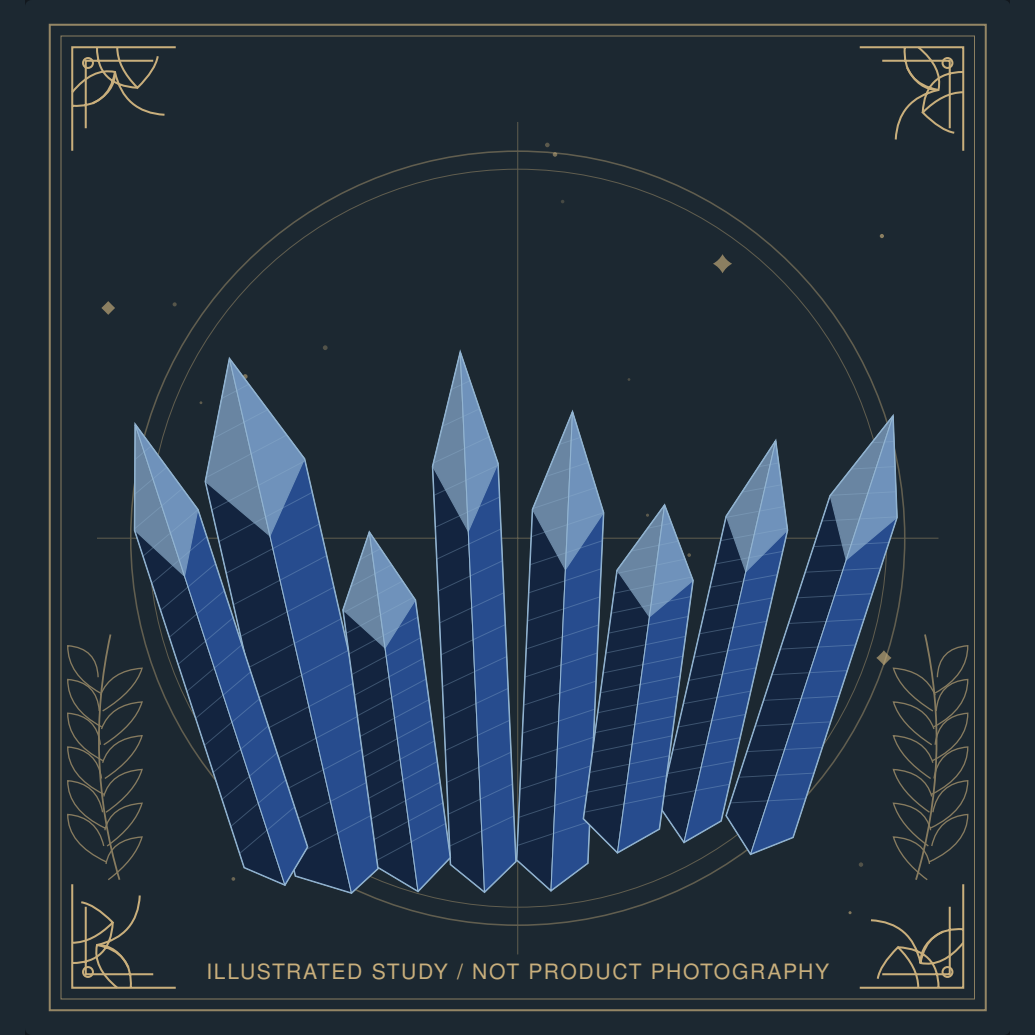
Material
Blue copper carbonate hydroxide. [1]
Family
Copper carbonates [1]
Appearance
Deep blue crystals and masses, often with malachite. [1]
Meaning & tradition
Kynes: communication in a modern framework. [2]
In this guide
Visual identity & plain-language name
Azurite is the blue copper carbonate hydroxide Cu3(CO3)2(OH)2. Sharply faced crystals, rounded growths and earthy aggregates all belong to its visual range. Blue beside green malachite creates a mineral assemblage, not necessarily one mineral with two colors. [1]
Earth story: formation, structure & color
Identified azurite is monoclinic, brittle and about 3.5–4 on the Mohs scale. It develops in oxidized copper deposits with minerals including malachite and chrysocolla. Cleavage and conchoidal fracture are different forms of separation. Polishing conceals some of these clues, whereas raw specimens may expose them. [1]
Azurite's ideal formula Cu3(CO3)2(OH)2 differs from malachite's even though both are copper carbonates with hydroxyl. It is monoclinic and can produce complex tabular or prismatic crystals, radiating aggregates, small sparkling coatings and earthy masses. Copper-bearing oxidizing conditions help explain its occurrence with malachite, cuprite and other secondary copper minerals. Their proximity reflects shared ingredients and changing environments; the mere presence of both does not prove which formed first in one piece. [1]
The Handbook records Mohs hardness 3.5–4 and density about 3.77. Perfect but interrupted cleavage and brittle behavior make fine terminations vulnerable even when a dark blue crystal looks solid. Vitreous to exceptionally bright luster is possible, while a powdery aggregate has a different appearance. The pale-blue streak distinguishes the powdered color from the deeper bodycolor, but performing a streak test destroys material and is usually inappropriate for an intact display crystal. Mineralogical properties should guide identification without becoming an invitation to damage a specimen. [1]
Varieties & look-alikes
Blue nodules, crystal groups and azurite-malachite are descriptive gallery categories. Keep both names on mixed material. Lapis lazuli is a rock and sodalite a feldspathoid; shared blue does not imply shared chemistry. A colored coating on matrix is a product condition rather than another natural variety. [1]
- Azurite crystals
- Well-developed crystals show the monoclinic architecture through natural faces and angular terminations. Their intense blue may be nearly black in thicker areas and lighter at thin edges. Shape and translucency are observations, not sufficient authentication. A documented matrix and mineral associations add context, while suitable laboratory measurements can resolve ambiguity with other dark-blue crystals. [1]
- Azurite–malachite
- This label appropriately records a two-mineral association. Blue azurite and green malachite may occur as separate patches, coatings or intergrown aggregates. Polishing can reveal a decorative pattern while removing small surface crystals. Calling the mixture a single variety of azurite loses information about which mineral supplies each area and how durability varies across the object. [1]
- Azurite in matrix
- Matrix is the surrounding rock or other mineral substrate. Its identity may remain unknown even when the blue crystals are confidently determined. A careful label can say azurite on unidentified matrix rather than invent a host rock. Documenting which crystals are attached naturally and which areas have been repaired matters especially for fragile collector specimens. [1]
- K2 trade comparison
- K2 is a commercial geographical label that requires its own host-rock and blue-component identification. It should not automatically become a synonym for all azurite in matrix. A photographed pale rock with blue spots establishes neither an exact locality nor a bulk mineral formula. Keep this comparison as a naming question until specimen-specific evidence supports a more precise description. [1]
Human story: objects, names & cultural context
The Handbook relates the name to the Persian blue-color word lazhward. This linguistic connection helps explain the traveling vocabulary of blue mineral materials. A historical color name does not prove a modern chakra or divination correspondence. [1]
Azurite's name preserves the association with blue through the historical language of azure. That naming account is more defensible than assigning every blue mineral today's intuition correspondence. A collector's label with a locality and acquisition history also documents human relationships with the mineral. An unprovenanced blue object, however, cannot be assigned to a culture merely from its color. Specific historical pigment or ornament claims need evidence that the material was actually azurite and that its use is securely contextualized. [1]
Meaning & practice: attributed traditions
Sandra Kynes associates azurite with communication in her 2018 article. This records a contemporary spiritual interpretation. [2]
An editorial communication reflection can use the blue-green contrast to recall two different voices in a discussion. Record what each person actually said before assigning meaning. Appearance provides a reminder, without assigning an effect on speech to copper chemistry.
Material truth: trade names & treatments
Azurite’s low hardness and brittleness matter for display. Protect faces from harder stones and support fragile matrix specimens. Record natural rough, polished rock, repair and coating as separate conditions. Blue-green appearance alone cannot determine the exact copper-mineral mixture or establish mine provenance. [1]
Dark blue areas in a mixed stone do not by themselves identify azurite. A confirmed azurite-bearing rock can contain contrasting minerals that change its density, polish and durability. The identification of the blue component and the classification of the host are separate questions. For a raw cluster, conserve crystal faces and fragile matrix rather than applying vigorous cleaning. For polished material, any resin, filling or coating belongs in the description even when the underlying azurite is genuinely natural. [1]
To read a specimen, note whether blue sits in discrete faceted crystals, rounded coatings, tiny scattered grains or large compact zones. Green edges may invite a comparison with malachite, but an apparent color transition does not establish a complete reaction sequence. Keep observations and interpretations separate in the label. A photograph taken under strong saturation can obscure pale-blue surfaces and make black-looking interiors seem uniform. Neutral illumination and several views create a more useful record than a single dramatic sales image.
Sources & related specimens
The mineralogical reference gives composition, structure and occurrence. Kynes supplies the attributed modern association. Read malachite alongside azurite to distinguish related formation settings from mineral identity.
- Handbook of Mineralogy: Azurite
Mineralogical Society of America · Identity and natural history · Accessed October 9, 2026
- Sandra Kynes: 365 Days of Crystal Feng Shui for Your Home (2018)
Llewellyn Worldwide · Sandra Kynes’s contemporary crystal-placement and intention framework · Accessed October 9, 2026