
A radiating star
Aragonite
A calcium-carbonate polymorph distinct from calcite.
Orthorhombic calcium carbonate mineral species and aggregate forms
Aragonite is calcium carbonate with a structure distinct from calcite. Star-like clusters, branches and banded masses show that one mineral can have many external forms. A radiating cluster is an aggregate rather than one simple pointed crystal.
Geology · Human history · Attributed traditions
Explore the specimen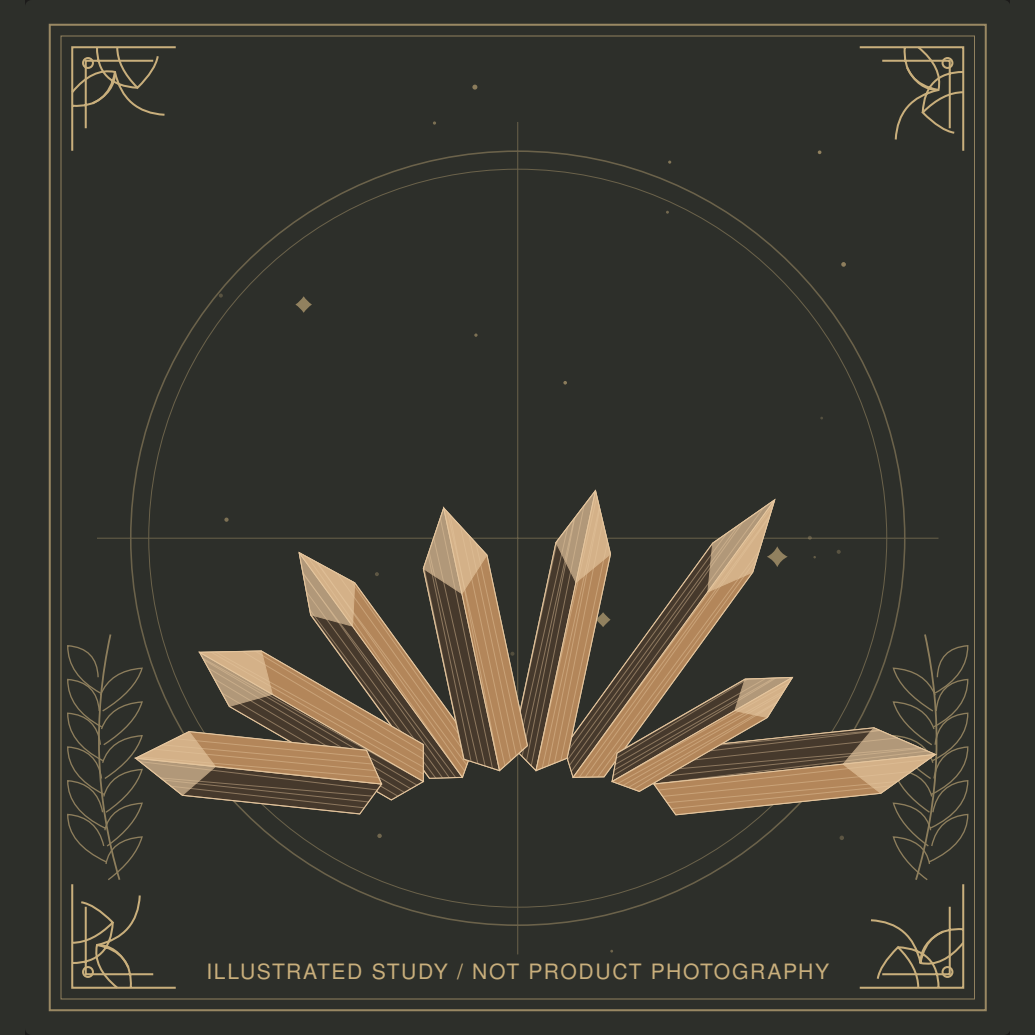
Material
A calcium-carbonate polymorph distinct from calcite. [1]
Family
Calcium carbonate [1]
Appearance
Lengthwise face markings [1]
Traditions
Margaret Ann Lembo’s 2013 chart places aragonite in grounding and stability symbolism. [3]
In this guide
Visual identity
Aragonite is calcium carbonate with a structure distinct from calcite. Star-like clusters, branches and banded masses show that one mineral can have many external forms. A radiating cluster is an aggregate rather than one simple pointed crystal. [1]
Radiating sprays and repeated twins can create forms that look hexagonal even though the underlying structure is orthorhombic. A cluster’s apparent symmetry is therefore not a simple guide to its crystal system. Brown or pale radiating material may be sold as a star cluster, while other occurrences are more compact, fibrous or branching. The object’s actual texture should remain visible in the artwork. A polished blue piece supplies a very different visual presentation from a sharply pointed, naturally intergrown cluster. [1]
Earth story: geology and formation
The Handbook of Mineralogy describes orthorhombic symmetry and common repeated twinning that can appear pseudohexagonal. It records marine precipitation, shells, caves and other settings. Aragonite can convert to calcite over geological time, illustrating that composition and crystal structure both matter to identity. [1]
Aragonite is CaCO₃ with orthorhombic symmetry, hardness 3.5–4 and measured density about 2.95 grams per cubic centimetre. Its structure differs from calcite despite shared composition. Repeated twins can resemble six-sided forms even though the individual symmetry is not hexagonal. Needles, columns, branching forms and internally banded aggregates are all recorded habits. A shell and a cave deposit illustrate biological and inorganic contexts in which the same carbonate structure can occur; their human meanings and object histories remain different from that mineral identity. [1]
Aragonite and calcite have the same overall calcium carbonate composition but different crystal structures. Aragonite is orthorhombic, whereas calcite is trigonal. The Handbook records aragonite in carbonate sedimentary, biological and cave-related settings. It may later be replaced or transformed as geological conditions change. The comparison is a useful example of why a formula alone does not supply a complete mineral identity: the arrangement of the atoms affects form, properties and stability even when the chemical constituents are the same. [1][2]
Varieties and lookalikes
These names describe different levels of information: a mineral species, a visual variety, a crystal habit or a retail label. The distinctions below keep the recognizable shop vocabulary alongside its material explanation.
Blue aragonite is a color designation rather than a separate species. Star and Sputnik cluster names describe a familiar radiating display form in retail use; they do not establish that every point is one isolated perfect crystal. Cave forms and biological carbonate also belong to the broad occurrence account, although a shop specimen needs its own source history before being identified as either. Calcite is the central comparison because composition overlaps while structure differs, and mixed carbonate goods may need more detailed testing than a color name provides. [1][2]
- Brown star clusters
- Repeated twins and radiating crystals create the familiar shape. The aggregate is not a new star-shaped species. [1]
- Blue and white aragonite
- Color describes appearance, while confirmation of the carbonate mineral remains a separate question. [1]
- Banded aragonite
- A worked banded mass can include more than one carbonate. Its components should be identified rather than assumed from a shop label. [1]
Human story: history and naming
Its name relates to the Aragon region of Spain. This is a documented naming history, separate from any modern interpretation of a star-like cluster. A mineral occurrence and a cultural ritual cannot be inferred from the same geographic word. [1]
The name’s association with Aragon in Spain preserves a specific geographical naming history. That is different from saying all aragonite was collected there. The mineral’s wider occurrence in sedimentary, cave and biological settings supplies many other contexts in which people encounter it. A labelled specimen can retain a record of one collection event, whereas an unlabelled cluster cannot recover that location simply through its symmetry. Supported naming and collecting information give the species a human history without adding an unrecorded ancient star-cluster ritual. [1]
Meaning and practice: attributed traditions
Margaret Ann Lembo’s 2013 chart places aragonite in grounding and stability symbolism. This is contemporary practitioner interpretation. A radiating form can serve as a chosen image of connection without providing evidence of a measured stabilizing effect. [3]
An optional stability reflection can identify the people or routines that support a chosen goal, using the radiating cluster as a personal metaphor.
Lembo places aragonite among materials used for grounding and stability within her modern color-based framework. A radiating cluster may provide a visual metaphor of many connections sharing one center, but that interpretation belongs to the participant rather than to mineral stability calculations. A person can choose to pause and consider an intention while observing the specimen. The physical account separately explains twinning, crystal structure and brittle projections. Neither the geometry nor the calcium carbonate formula demonstrates a guaranteed stabilizing effect on a person or home. [3]
Material identity and trade terminology
Calcite and aragonite share composition but are not identical structures. Decorative carbonate names may cover mixtures. A blue color or a star cluster cannot identify every component, source or treatment. The natural twin relationship should be distinguished from a carved star-shaped object. A repeated twin can mimic the outline of a higher-symmetry crystal. Pseudohexagonal appearance therefore concerns the aggregate’s external form rather than changing aragonite’s orthorhombic structure. A polished banded object may omit the original crystal surfaces completely. The form seen on a shop shelf should be interpreted at the correct scale: one crystal, a twin, an aggregate, a mixed rock or a manufactured shape. [1]
The Handbook gives hardness about 3.5–4 and measured density near 2.95 grams per cubic centimeter. Brittle behavior and the narrow projections of a cluster can make impact more relevant than hardness alone. The properties of a species also do not certify the composition of every blue carbonate ornament marketed with its name. A source declaration, mineral identification and enhancement statement each add different information. A striking radiating shape can be described accurately without using it as a substitute for testing an ambiguous polished material. [1]
Sources and related specimens
The references below distinguish mineral identification and physical properties from historical interpretation and practitioner symbolism. A cited material category describes a kind of stone; it does not certify the identity, treatment or provenance of an untested individual retail specimen.
- Handbook of Mineralogy: Aragonite
Mineralogical Society of America · Mineral composition, structure, physical properties and occurrence · Accessed October 9, 2026
- Handbook of Mineralogy: Calcite
Mineralogical Society of America · Mineral composition, structure, physical properties and occurrence · Accessed October 9, 2026
- Margaret Ann Lembo: Colors, Enlivening the Rainbow Body (2013)
Llewellyn Worldwide · Contemporary practitioner symbolism and retailer terminology; distinct from mineralogical evidence · Accessed October 9, 2026