
Luminary Oddities · Natural history & art
Balinta octonotata cicada
Balinta octonotata
Hemiptera / Cicadidae
Cream spots on dark wings give this small Asian cicada a moth-like appearance. A specimen-based study shows how much those spots can vary, and provides a useful example of the difference between an observed resemblance and a tested ecological explanation.
Explore this insect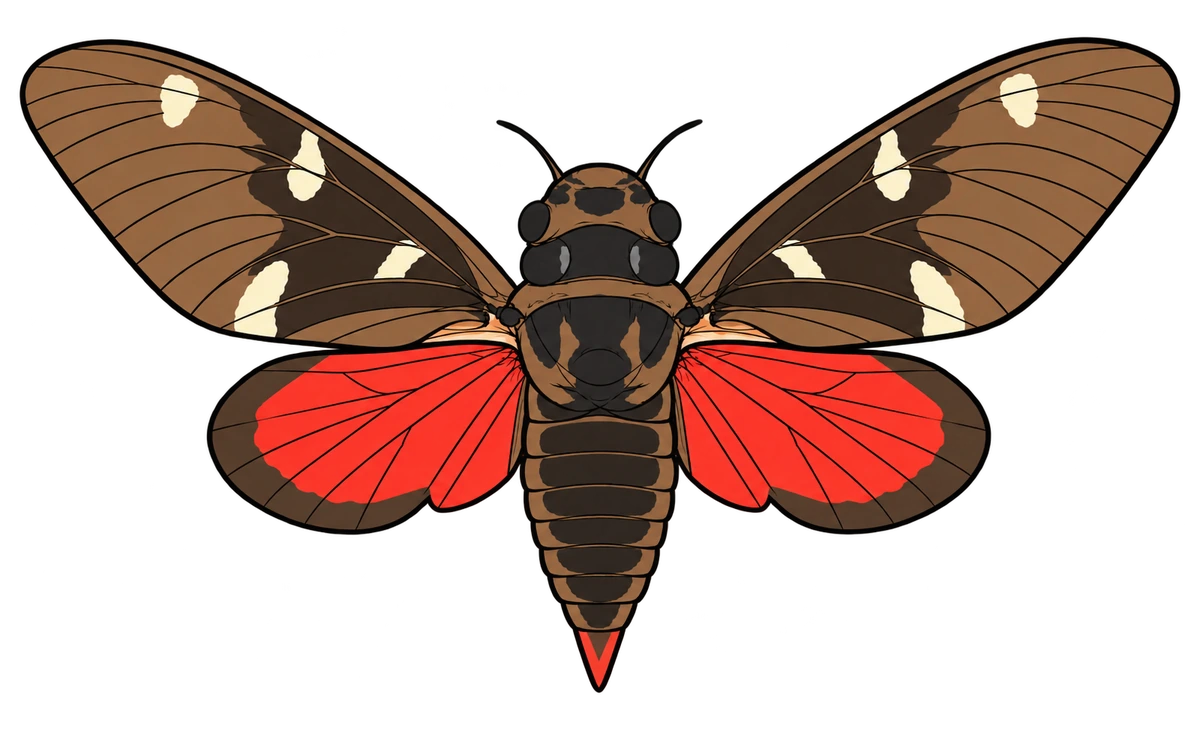
At a glance
- Field records ↘
- Assam and Uttarakhand specimens underpin the 2021 study. [1]
- Variation ↘
- Named spot-pattern forms remain one species. [1]
A cicada with a moth-like pattern
Balinta octonotata is a cicada described by Westwood, subsequently placed in Balinta. [2]
The World Auchenorrhyncha Database identifies it as the originally designated type species of Balinta, the genus established by Distant in 1905. [2]
Its current genus and species distinguish it from the moth used for comparison in the field study.
Count the cream marks carefully
The typical form has four cream forewing spots: one near the base, two farther out, and one near the apex. Other forms lose spots, merge them into a band, or split one into two. [1]
Compare both wings before counting. Position and shape reveal more than a spot total alone, particularly when a specimen has damage or its wings overlap.
A documented westward record
Kafley and Smetacek studied thirteen Assam specimens and a Ranibagh male from Uttarakhand, extending the documented range westward. [1]
The locality labels identify individual occurrences. They should remain visible in a research record rather than being compressed into a claim that the species occupies every intervening forest.
The underground chapter
The cicada life cycle passes through egg, nymph and adult stages. Newly hatched nymphs enter the ground and grow there before emerging for the final moult. [3]
Adult records fall in April–May in Assam and June in Uttarakhand. [1]
These seasonal observations concern the visible adult stage. They do not reveal the duration or survival of the underground population.
Forest habitat is not a host record
Cicadas feed on plant sap through piercing mouthparts, and their underground nymphs feed from roots. [3]
The study records sal forest in Uttarakhand but does not establish Shorea robusta as this cicada's food plant. [1]
A host claim needs direct feeding evidence with the plant and life stage identified.
Build observations around dated adults
The examined Assam series was collected at Gangmouthan on 20 May 2019; the Ranibagh male dates to 26 June 2007. [1]
Those dated specimens offer a starting point for field comparisons. A stronger behavioural account would connect observation notes and recordings to similarly documented individuals.
Variation is part of the identity
The 2021 paper adds three spot-pattern forms to the already described variation, all within Balinta octonotata. [1]
A form is a convenient description of appearance here. It does not create a separate species, a fixed sex difference or a new conservation unit.
A resemblance worth testing
The authors suggest possible mimicry of female Lymantria semicincta moths, but explicitly state that the cicada's palatability is unknown. [1]
Resemblance motivates a test; it does not show which predator responds, what advantage follows, or whether both insects share a defensive property.
A name with a long paper trail
The nomenclatural record links the species to its original Cicada combination and to Balinta's type designation. The database derives the genus name from Balinta in Gujarat. [2]
Historic combinations help trace records across literature. They are alternate placements of the same taxon rather than additional species to count in a catalogue.
Protect the evidence behind a range
Museum and field records can guide repeat surveys at the documented localities. Compare like seasons and methods before interpreting differences in encounter rates.
A small specimen series supports an occurrence and variation study. It cannot establish global abundance, a decline or a formal threat category by itself.
Upper and lower surfaces tell different stories
Cicadas have a broad head, small bristle-like antennae, a stout body and two pairs of wings; their feeding beak lies beneath the head. [3]
A dorsal comparison emphasises wing markings and the upper body; a ventral comparison also exposes the underside structures. Keep the view label attached throughout identification.
Read the arrangement, not just the palette
Use the cream spots as landmarks against the dark wing ground. Retain the relationship between spots, veins and margins rather than making every individual conform to a perfectly balanced diagram. Variation and asymmetry are useful information.
Keep specimen and label together
Store physical specimens with their original collection and identification records. Protect them from moisture, sunlight and unnecessary handling; photograph labels before moving a specimen. An intact provenance record makes later re-identification possible.
From resemblance to evidence
Does a predator respond similarly to this cicada and the compared moth? Which plants support the nymphs? Are spot forms distributed differently across localities? Each question requires observations tied to identified specimens rather than inference from colour alone.
Separate records from interpretation
The 2021 field paper provides the specimens, forms and tentative mimicry proposal. The taxonomic database supplies nomenclatural context, while the museum account supplies general cicada anatomy and development. The proposed ecological explanation remains a question rather than a conclusion.
- Description of further individual variations of the cicada Balinta octonotata and extension of its known distribution in India ↗
Kafley and Smetacek; Bionotes 23(1), 2021, pp. 2–5 · Accessed 2026-10-09
Primary field specimens and labelled dorsal/ventral photographs; within-species forms, Assam and Uttarakhand records, and an explicitly untested moth-mimicry suggestion.
- Balinta Distant, 1905 ↗
World Auchenorrhyncha Database, Species File Group · Accessed 2026-10-09
Generic nomenclature and original type-species designation. Authority-date disagreement with other literature is retained privately and not resolved by choosing one unsupported year.
- Cicada — Superfamily Cicadoidea ↗
Australian Museum · Accessed 2026-10-09
Cicada-wide anatomy, sap feeding, egg–nymph–adult development and food-web context; Australian examples and durations are not transferred to these species.
Continue exploring
Sources checked 2026-10-09. Illustrations · Luminary Oddities.
Return to the Entomological Atlas ↑