
Luminary Oddities · Natural history & art
Delias henningia
Delias henningia
Lepidoptera / Pieridae
A Philippine and Bornean jezebel whose documented use of Glochidion gives a concrete example of a host shift away from the mistletoe associations often discussed for Delias.
Explore this insect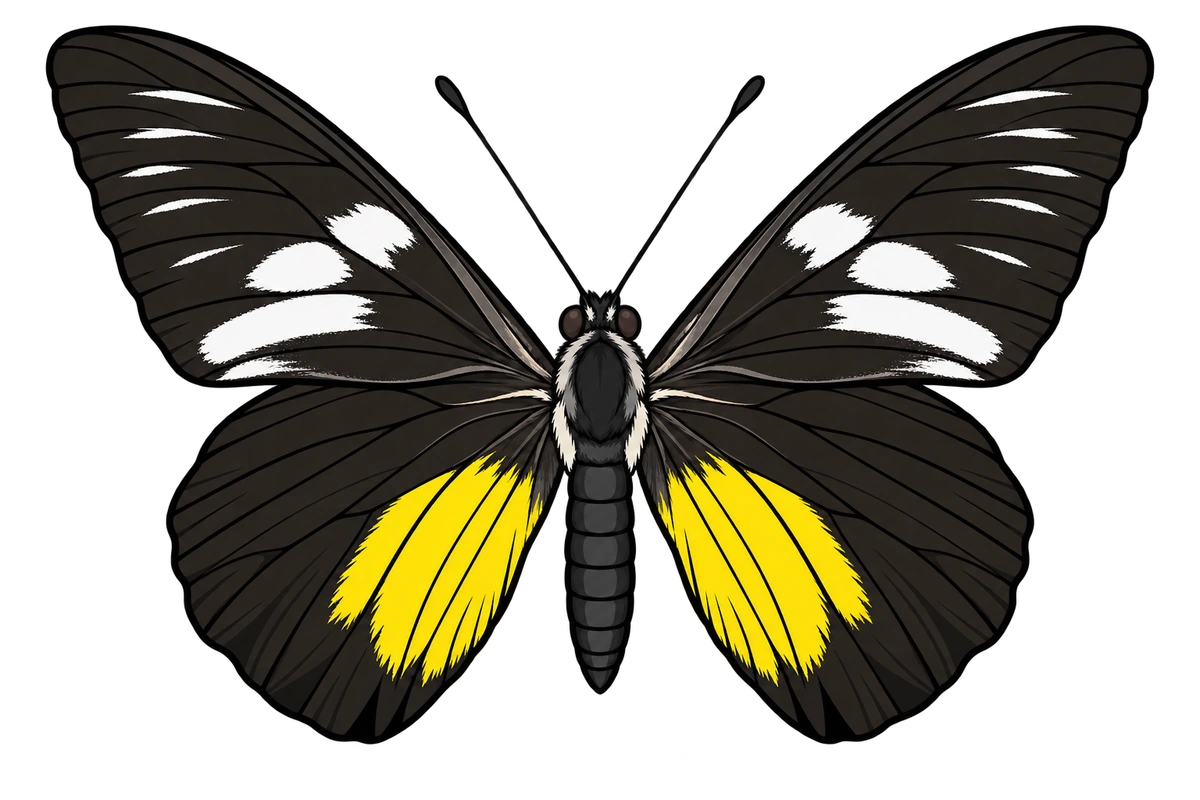
At a glance
- Range context ↘
- Philippines and northern Borneo [2]
- Identification detail ↘
- Male forewing band bluish grey [2]
- Biological reference ↘
- Glochidion zeylanicum confirmed host [3]
Identity and close relatives
Delias henningia is a jezebel in the pasithoe comparison group. The current catalogue recognizes the species. Related Philippine names include hidecoae and ottonia, but their biological information should remain separate: evidence obtained from henningia is not a host record for either relative. [1]
How to look at the wings
The specialist comparison describes a bluish-grey forewing band in males and a white band in females, with a large yellow hindwing area. On the underside the forewing band is white in both sexes. That reversal of the sex comparison makes the viewing surface particularly important. [2]
Range and living habitat
The specialist account lists the Philippines and northern Borneo. Its living Bohol photograph identifies the local form voconia. A regional name in a caption represents geographic variation within the listed species, rather than another species to add to the Atlas. [2]
A life in four stages
A 2025 primary study describes and illustrates immature henningia. It supplies a biological connection between larvae and their plant, rather than only an adult portrait. The regional evidence should remain attached to its Philippine localities when describing development elsewhere. [3]
Leaves for larvae, food for adults
The study confirms Glochidion zeylanicum, in Phyllanthaceae, as a larval food plant from Luzon and Mindanao, alongside an earlier Palawan Glochidion record. This is a documented exception to simply assigning a mistletoe host from the genus's reputation. [3]
Behaviour in the living landscape
The Bohol photograph records a living adult, while the host study addresses larval feeding. Keep those observations distinct. Adult flower visits, movements and courtship would require their own dated field evidence; a larval food plant is not automatically an adult nectar source.
A closer scientific story
The host shift is the article's strongest scientific detail. A confirmed association with Glochidion changes the question from which mistletoe to which plant lineage supports development. Comparing related species could reveal whether this is a shared evolutionary transition or a more restricted association.
Connections in the ecosystem
The confirmed plant makes reproduction visible in the ecosystem: a henningia population needs more than a place where adults are photographed. Investigating the distribution and condition of the documented host would help distinguish a breeding site from a flight corridor.
Names and natural-history records
The scientific name connects mainland Philippine study records with differently named island forms. Preserve those form names in source captions rather than treating every difference in band colour as another species. The sex-and-surface comparison also prevents two appearances from receiving two unrelated labels.
Habitat and conservation context
The checked sources do not supply a current global threat category. The documented host association provides a more specific conservation starting point: survey breeding evidence and host availability at named sites. Occupancy and population trend still require repeat observations with known effort.
Reading the specimen views
Compare the dorsal forewing band between males and females, then inspect the underside from each. A caption should specify surface and local form. A white band in an underside photograph does not by itself identify a female, because both sexes share it there.
From biological reference to artwork
Keep the forewing band and yellow hindwing field faithful to the reference sex and surface. Pairing a consistent adult illustration with a short plant caption can communicate the host shift without inventing larval details. Retain the Philippine locality of the biological study.
Caring for a framed specimen
Inspect the enclosure periodically for pests. Keep the adult reference, locality and food-plant study linked in the collection record. The Glochidion association should retain its publication date and geographic scope when reproduced on a display label. [4]
Questions worth asking
Which other Philippine populations use Glochidion zeylanicum? Do hidecoae and ottonia use the same plant lineage? Are there alternative hosts in Borneo? Answering those questions would turn one well-supported host shift into a broader explanation of ecological diversity within the group.
Sources and further reading
The 2025 primary paper is the central ecological source. The specialist page supplies sex comparisons and a locality-labelled living photograph, while the catalogue supports classification. Read the host study's geographic evidence before generalizing the association across the species' entire reported range.
- Delias classification and museum-image catalogue ↗
University of Florida Lepiverse; Catalogue of Life 2026-08-26 XR · Accessed 2026-10-09
Indexed genus classification lists the named taxon at species rank; this supports catalogue status, not a resolved species boundary.
- Delias henningia: specialist records and comparison plates ↗
Delias of the World; international Delias specialists · Accessed 2026-10-09
Specialist collection comparisons and localized photographs support distribution and sex-specific forewing bands.
- Novel host plant shifts in the subtribe Aporiina and Phyllanthaceae use by Delias henningia ↗
Braby, Hsu, Lin and Lin; Journal of Natural History (2025) · Accessed 2026-10-09
Primary life-history study: henningia on Glochidion zeylanicum in the Philippines; related hidecoae and ottonia host use is unresolved.
- Caring for natural history collections ↗
Canadian Conservation Institute; Fiona Graham · Accessed 2026-10-09
Preventive care of fragile biological collections; the brief enclosure-handling and environment recommendations are general collection practice. Species-label recordkeeping recommendations are editorial.
Continue exploring
Sources checked 2026-10-09. Illustrations · Luminary Oddities.
Return to the Entomological Atlas ↑