
Luminary Oddities · Natural history & art
Delias hidecoae
Delias hidecoae
Lepidoptera / Pieridae
A jezebel associated with Mindoro's Mount Halcon, whose place beside henningia and ottonia makes its still-undocumented host relationship a focused biological question.
Explore this insect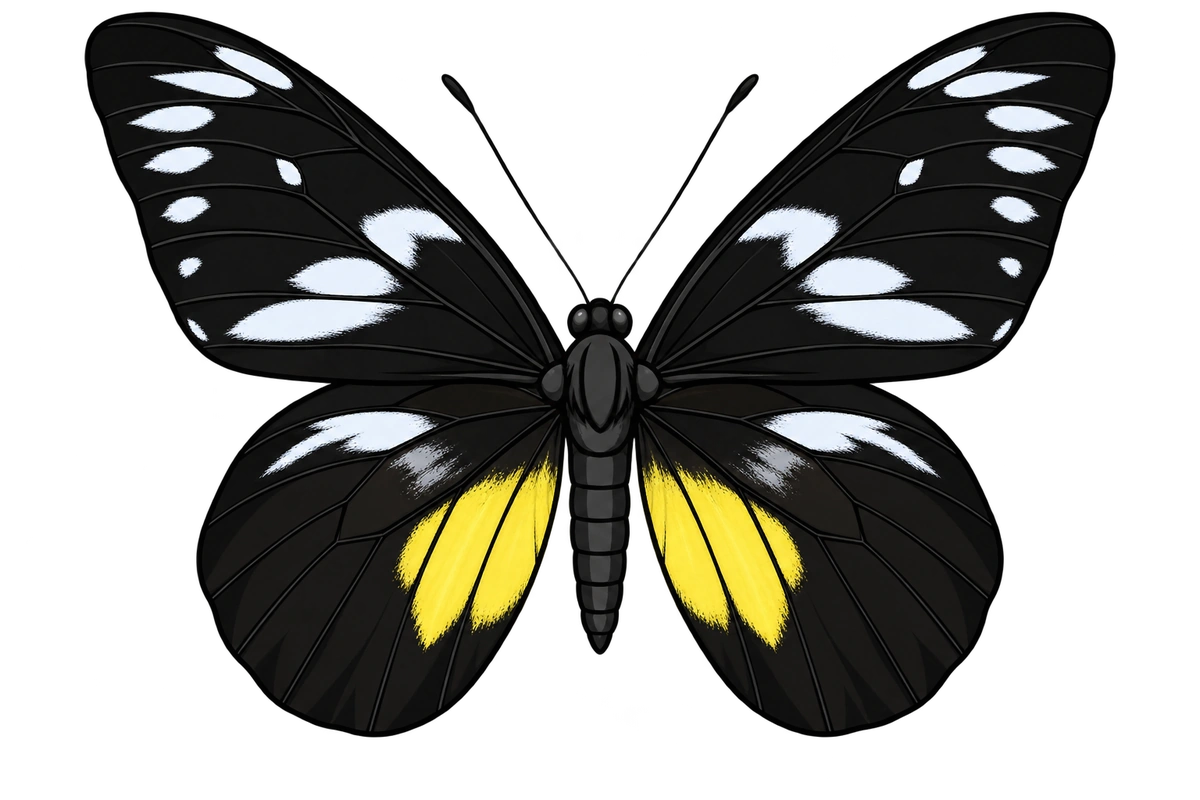
At a glance
- Range context ↘
- Mount Halcon, Mindoro [2]
- Identification detail ↘
- Compare with henningia and ottonia [2]
- Biological reference ↘
- Host unknown in the 2025 review [3]
Identity and close relatives
How to look at the wings
Use the identified male and female comparison plate for appearance. A reliable determination should record the shape and position of pale markings, dark borders and the hindwing pattern on the appropriate surface. The checked text does not supply a secure short colour-only diagnosis against its closest relatives.
Range and living habitat
The specialist account associates hidecoae with Mount Halcon on Mindoro. Keep the mountain and island together in the record. A named mountain locality identifies a useful geographic anchor; it does not establish a measured elevation limit, continuous occupancy or a complete habitat classification. [2]
A life in four stages
A complete developmental series was not established in the sources checked here. The most useful addition would be immature stages linked to an identified Mindoro adult. Because the group contains similar species, an adult determination should be retained alongside any caterpillar description.
Leaves for larvae, food for adults
The 2025 host-plant review reports the host of hidecoae as unknown. Henningia's confirmed Glochidion association suggests a question worth testing on Mindoro; it does not provide an answer. Direct feeding and rearing evidence would distinguish a local host from a plausible botanical search target. [3]
Behaviour in the living landscape
The adult plate documents form, not behaviour on Mount Halcon. A field account could use repeated, georeferenced observations to separate resting, feeding and reproductive activity. Recording vegetation and the observed action would be more useful than assigning a generic mountain-butterfly behaviour.
A closer scientific story
A missing host record can be scientifically specific. Here it sits beside a recently confirmed association in a related species, creating a testable comparison. Discovering hidecoae's plant could help clarify whether related Philippine jezebels share an ecological transition or differ despite their grouping.
Connections in the ecosystem
The ecological network remains incomplete until reproduction is connected to a plant and place. An adult photograph identifies an encounter; larvae feeding on a determined plant identify a resource. Those different observations should be preserved separately so that later work can assemble the connection.
Names and natural-history records
The original description and subsequent catalogue treatment need to be kept distinct when reconstructing the name's authorship. Current online sources differ in the author attribution. This article therefore does not choose an original author without checking the description itself; the scientific binomial remains the identification anchor.
Habitat and conservation context
A Mount Halcon association makes local habitat knowledge valuable, but this article assigns no global threat category. Conservation inference should begin with confirmed localities, repeat sampling and breeding evidence. A short published range list is not a population estimate or a quantified decline.
Reading the specimen views
Read the male and female plates separately and keep the surface label in view. Compare with corresponding views of henningia and ottonia. When differences are subtle, locality and source determination help define the comparison but cannot replace the morphological evidence.
From biological reference to artwork
A biological reference should be rendered with its sex, surface and Mindoro provenance intact. Avoid filling an unclear marking with a feature borrowed from henningia. Close relatives make useful comparisons, while the artwork itself should preserve the individual pattern on which it is based.
Caring for a framed specimen
Keep the frame away from damp conditions. Retain the comparison plate, original locality wording and determination history in the catalogue. If an original-description check resolves the author attribution, update the record while keeping the earlier reference available. [4]
Questions worth asking
Which plant supports hidecoae larvae on Mindoro? Are eggs or larvae found at the documented adult sites? Which characters consistently separate both sexes from henningia and ottonia? Those questions connect the present adult-based knowledge with a genuinely species-specific life history.
Sources and further reading
The specialist account supplies the Mindoro context and comparison plate; the catalogue establishes the current rank. The 2025 primary review explicitly identifies the host gap. Its henningia results are valuable comparative evidence, not a substitute for observations of hidecoae itself.
- Delias classification and museum-image catalogue ↗
University of Florida Lepiverse; Catalogue of Life 2026-08-26 XR · Accessed 2026-10-09
Indexed genus classification lists the named taxon at species rank; this supports catalogue status, not a resolved species boundary.
- Delias hidecoae: specialist records and comparison plates ↗
Delias of the World; international Delias specialists · Accessed 2026-10-09
Specialist account identifies Mount Halcon, Mindoro; comparison plate and taxon account.
- Novel host plant shifts in the subtribe Aporiina and Phyllanthaceae use by Delias henningia ↗
Braby, Hsu, Lin and Lin; Journal of Natural History (2025) · Accessed 2026-10-09
Primary life-history study: henningia on Glochidion zeylanicum in the Philippines; related hidecoae and ottonia host use is unresolved.
- Caring for natural history collections ↗
Canadian Conservation Institute; Fiona Graham · Accessed 2026-10-09
Preventive care of fragile biological collections; the brief enclosure-handling and environment recommendations are general collection practice. Species-label recordkeeping recommendations are editorial.
Continue exploring
Sources checked 2026-10-09. Illustrations · Luminary Oddities.
Return to the Entomological Atlas ↑