
Luminary Oddities · Natural history & art
Great Orange-tip
Hebomoia glaucippe
Lepidoptera / Pieridae
An Asian pierid with two very different visual identities: a bright orange-tipped upper wing and an intricately mottled underside. Its wing chemistry adds an unexpected connection to a marine snail.
Explore this insect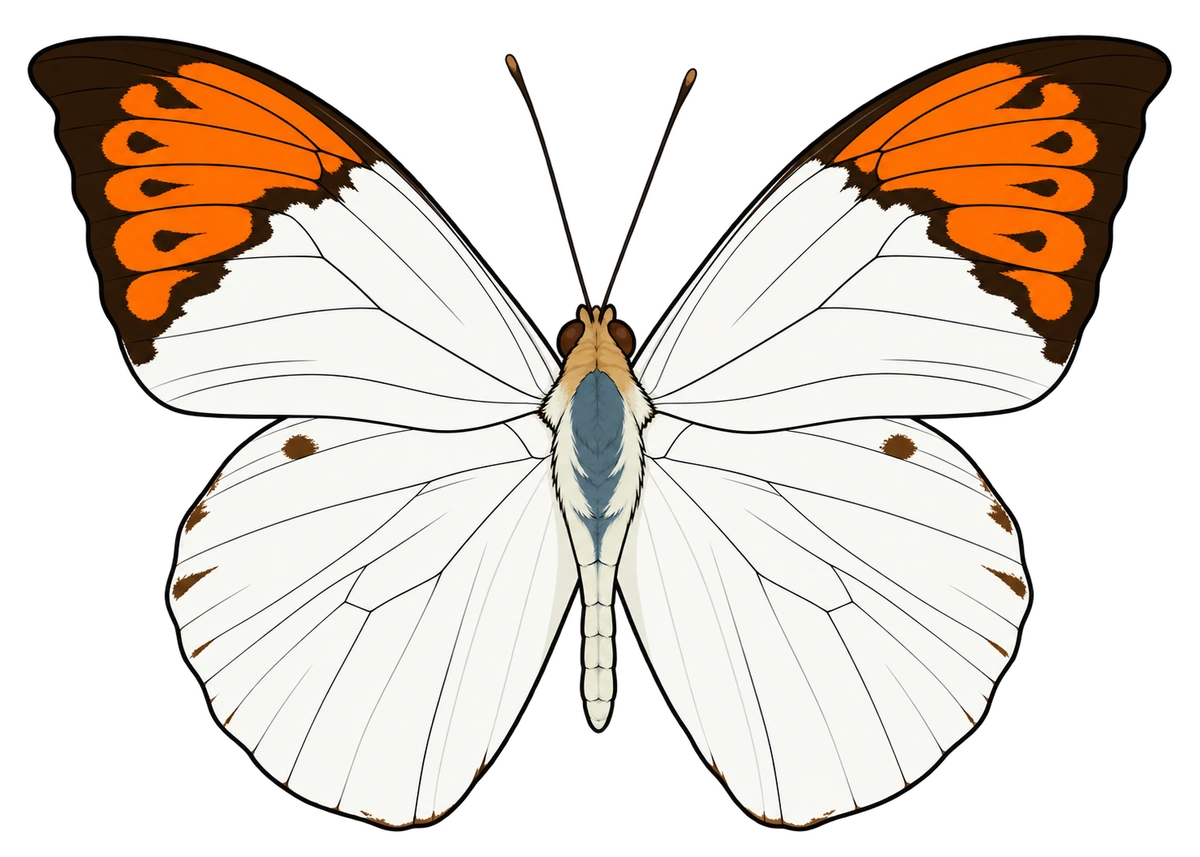
At a glance
- Wing surfaces ↘
- Orange-tipped upper forewings; mottled, leaf-like undersides [2]
- Larval hosts ↘
- Documented Capparis and Crateva hosts in India [3]
- Research detail ↘
- A 2012 study reported glacontryphan-M in wing extracts [4]
Identity and close relatives
Hebomoia glaucippe is the Great Orange-tip, a large pierid butterfly. The binomial retains the species name that Linnaeus published as Papilio glaucippe in 1758; the change of genus explains the parentheses around his authorship in a formal citation. “Orange-tip” alone is ambiguous because it also names other butterflies. The two-part name is the useful anchor when comparing an Asian specimen, a regional field account and a work of art. The species belongs with the whites and yellows, rather than with the tailed Papilio butterflies. [1]
How to look at the wings
The Taiwan museum describes formosana males with creamy upper wings and a large orange-red area at the forewing tip, enclosed by dark markings. Females have a yellower ground color and more extensive dark patterning. Underneath, fine dark mottling covers the outer forewing and hindwing, with a darker line extending across the wing. [2]
The contrast between the surfaces is striking: the closed-wing butterfly can look much quieter than its open-wing portrait.
The Florida Museum photographs include identified males, females and a chrysalis. Its exhibit guide gives a wingspan of 2.5–3.5 inches, approximately 6.4–8.9 centimetres. This is a reference range, not a measurement of the illustrated subject. To compare images, follow the orange region’s position and the wing contours before assessing overall brightness. A color swatch gives less information than a full pattern, especially when photographs or artistic treatments have different lighting and contrast. [5]
Range and living habitat
The species occurs across parts of South and Southeast Asia, with the Taiwan account also recording southern Japan and areas of China. In Taiwan it is reported from plains into low and middle mountain elevations and from several offshore islands, mainly in evergreen broadleaf forest. A wide range can contain many local settings; it does not imply continuous occupancy of every forest or island between documented records. [2]
On Zamami Island in Japan, an official nature guide reports Great Orange-tips in gullies and beside streams through much of the year, with a short winter interruption. It links larvae to Crateva formosensis. This small-scale view connects a recognizable adult to a local landscape and a local host. A visitor can therefore look for the right vegetation and setting rather than rely only on a general distribution map. [6]
A life in four stages
Badon and Burlace’s 2021 observations of boholensis on Bohol Island follow a green caterpillar into the pupal stage. The larva had small colored projections and conspicuous markings near the head; the prepupa became paler and the pupa later showed an orange area over the developing wings. Their photographed larva was found in a densely vegetated garden at about 300 metres elevation. These details describe that observation, rather than a universal developmental timetable or the identity of every regional form. [7]
The progression from a leaf-eating larva to a pupa and then a winged adult is easiest to understand through a sequence of photographs. Give each early-stage picture its own record. A larval observation in Bohol and an adult illustration of unknown locality can illuminate the same species without documenting one individual. The changing wing region in the Bohol sequence is a particularly useful bridge between the less familiar pupa and the familiar orange-tip adult.
Leaves for larvae, food for adults
Butterflies of India records Capparis and Crateva hosts, distinguishing literature references from named observers’ records. Its list includes Capparis moonii, C. sepiaria, C. zeylanica and Crateva adansonii, all in Capparaceae. A host relationship concerns feeding by the larval stage; it is more specific than finding an adult perched on a plant. Locality and evidence remain useful parts of the record even when plant nomenclature is revised. [3]
The Chicago Botanic Garden associates caterpillars with Crateva, Capparis and Cleome and describes adult preference for Lantana. This makes the difference between larval leaves and adult flower resources easy to see. For a butterfly garden, the question is both what will feed the caterpillar and what will attract the adult. A nectar display may be visually rewarding while offering no evidence of a local breeding cycle. [8]
Behaviour in the living landscape
The Taiwan account describes powerful, rapid flight, flower visitation and males taking water at wet ground. The Zamami guide also emphasizes strong flight with wings held in a V-shaped attitude. These observations give movement back to the still image: the broad wings belong to a fast-moving animal. The wet-ground behavior is a regional observation of males; it does not determine the sex of an illustration. [2][6]
For observation, record whether the butterfly is flying, visiting a flower, taking liquid from the ground or resting. A short sequence often explains posture better than a single frame. When interpreting a picture of the wings, separate the animal’s action from the artist’s decision to spread, rotate or isolate its silhouette.
A closer scientific story
A 2012 PNAS study by Bae and colleagues reported glacontryphan-M in wing extracts of Hebomoia glaucippe from Malaysia, the Philippines and Indonesia. This peptide had previously been identified in the cone snail Conus marmoreus. The researchers combined protein separation, mass spectrometry and antibody tests. Their chemical result cannot be seen in an orange wingtip or measured from a print. [4]
The authors proposed a role in predator defence, while leaving functional and evolutionary questions open. Chemical detection and a proven effect on every predator are different claims. Their observations included predators that treated the wings differently, making the story more interesting than a simple “poisonous butterfly” label. The colors do not reveal concentrations or demonstrate that an individual butterfly has been chemically tested. [4]
Connections in the ecosystem
Nitin and colleagues’ Western Ghats host compilation attaches references or named observations to regional plant associations. That structure lets later researchers distinguish a new feeding observation from a repeated citation. For this butterfly, those records connect the early stages with caper-family vegetation. Read the plant relationship alongside the adult’s movements: a photographed flower visit, a caterpillar feeding record and a museum occurrence each answer a different ecological question. [9]
Names and natural-history records
Papilio glaucippe is the original combination, while Hebomoia glaucippe is the heading used here. Regional names such as formosana, australis and boholensis appear in the cited sources below the species level. They are useful search terms, but brown mottling or an intensely colored image alone does not assign a regional form. A descriptive name should stay attached to its supporting record rather than migrate casually between visually similar specimens. [1][3][7]
Habitat and conservation context
The accounts reviewed here document distribution, hosts and regional observations; they do not establish a current global population estimate or a global threat category. Conservation inquiry can still be concrete: identify the locally documented host plants, whether their habitat persists and whether early stages are being recorded. The combination of regional forest and streamside accounts gives a better starting point than assuming that a wide Asian range guarantees security at every locality.
Reading the specimen views
An underside portrait is a useful companion to this butterfly’s orange-tipped name. Look for the layered mottling and the line across the hindwing before searching for a conspicuous orange patch. Dorsal means upper surface; ventral means underside. Compare equivalent surfaces first. A spread composition can reveal both undersides simultaneously, offering a different view from an insect resting with closed wings. Digital enlargement helps examine the drawing but supplies no measurement of the actual butterfly.
From specimen to artwork
Scott Schubr’s Luminary Oddities artwork invites attention to the Great Orange-tip’s patterned underside. Color, line weight and simplified texture belong to the artistic treatment, while the placement of recognizable wing features connects the composition with its subject. The difference between surfaces does not create a second species. Use the museum photographs as biological comparisons and the gallery work as an artistic interpretation; neither an edition title nor a palette assigns a sex, locality or regional form.
Caring for the display
For a physical insect display, preventive care includes controlling light, moisture, pests and handling damage. Handle the enclosure rather than the wings and inspect without disturbing the specimen. [10]
For a print or digital edition, follow the medium and maker’s care instructions. Retain the original digital file and species label with the work. The finely mottled underside rewards a larger view, while a thumbnail offers a quick impression of shape.
Questions worth asking
Why can a Great Orange-tip look mostly brown? The underside differs greatly from the bright upper forewing. Can color alone identify a subspecies? It offers a character to compare, but a regional assignment needs a fuller record. Does the cone-snail connection mean the butterfly injects venom? The study reports a chemical constituent and discusses defence; it does not describe a venom-injection apparatus. Is an adult flower visit a larval host record? They concern different feeding stages and should be recorded separately.
Sources and further reading
Museum accounts provide comparable wing surfaces. Regional observers and host compilations connect the butterfly to places and plants. The PNAS study supplies a chemical result, with its proposed ecological function kept distinct from the experimental finding. Scientific photographs linked below are research references rather than gallery artwork.
- Hebomoia glaucippe taxonomy ↗
NCBI Taxonomy · Accessed 2026-10-09
Current binomial, Papilio glaucippe basionym and family placement.
- Hebomoia glaucippe formosana, TMIN1898-001 ↗
National Taiwan Museum · Accessed 2026-10-09
Regional appearance, distribution, habitat and behavior; indexed institutional description checked.
- Hebomoia glaucippe — Great Orange-tip ↗
Butterflies of India · Accessed 2026-10-09
Indian subspecies and individually referenced host records; indexed account checked.
- Peptide toxin glacontryphan-M is present in the wings of Hebomoia glaucippe ↗
Bae et al., PNAS, 2012 · Accessed 2026-10-09
Protein detection, geographic samples and proposed predator defence.
- Great Orange Tip — Butterfly Rainforest guide ↗
Florida Museum of Natural History · Accessed 2026-10-09
Photographed sexes and pupa; approximate exhibit wingspan.
- Zamami nature guide: Great Orange-Tip ↗
Japan Tourism Agency · Accessed 2026-10-09
Local streamside habitat, flight, Crateva formosensis host and seasonality.
- Life history notes on Hebomoia glaucippe boholensis from Bohol Island ↗
Badon and Burlace, News of the Lepidopterists’ Society, Spring 2021 · Accessed 2026-10-09
Original Bohol larval and pupal observations; indexed article excerpt checked.
- Great Orange Tip ↗
Chicago Botanic Garden · Accessed 2026-10-09
Exhibit account of larval plant genera and adult Lantana preference.
- Larval host plants of the butterflies of the Western Ghats ↗
Nitin et al., Journal of Threatened Taxa, 2018 · Accessed 2026-10-09
Regional host compilation and evidence attribution; relevant indexed entries checked.
- Caring for natural history collections ↗
Canadian Conservation Institute · Accessed 2026-10-09
General preventive care for physical natural-history collections.
Continue exploring
Sources checked 2026-10-09. Illustrations · Luminary Oddities.
Return to the Entomological Atlas ↑