

Luminary Oddities · Natural history & art
Alpine black swallowtail
Papilio maackii
Lepidoptera / Papilionidae
The alpine black swallowtail carries an intensely patterned dark surface whose green and blue reflections reward a change of light. It is also an unusually good doorway into plant chemistry: the cues a female uses to select a host are not the same thing as a caterpillar’s ability to eat it.
Explore this insect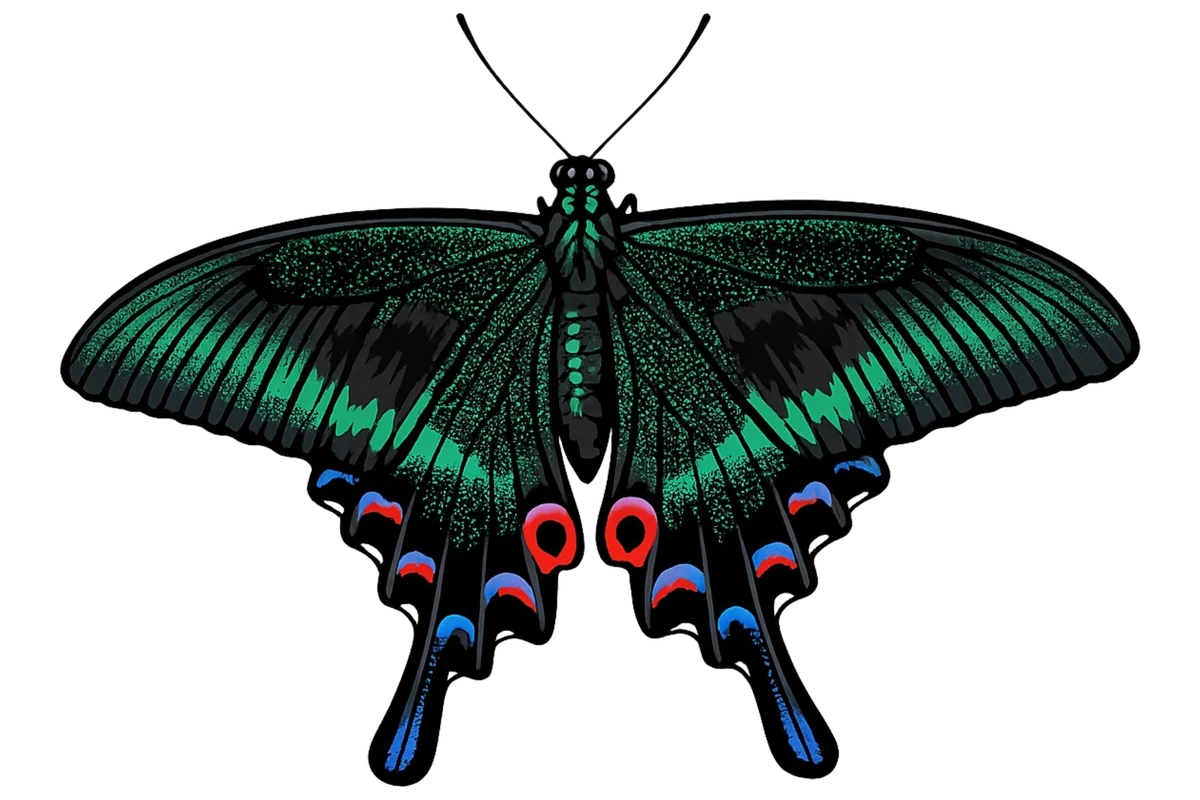
At a glance
- Recorded host ↘
- Phellodendron amurense, in a primary egg-laying study. [2]
- Remarkable detail ↘
- Primary optical research models microscopic wing-scale structures. [3]
A black swallowtail with an iridescent surface
Papilio maackii is a swallowtail butterfly in Papilionidae, represented here by the collection's specimen-derived digital artwork. Alpine black swallowtail is the English name used for those pieces. The scientific name provides the connection to primary host-selection and wing-optics research. A dark, shimmering swallowtail should still be identified through its source record and comparison rather than by a colour impression alone. The Atlas does not assign a sex or regional form to the artwork from the palette surrounding it. [1][3]
Dark wings and green-blue reflection
The optical study of Papilio maackii examines different coloured sections of the wing and links their green and blue appearances to microscopic scale structure and measured reflection. This is more informative than calling the wing simply metallic. A photograph records a particular arrangement of illumination and viewing, while a digital interpretation can emphasize or transform that appearance. For close looking, compare the broad dark field with the smaller reflecting areas, then return to a whole specimen view rather than reading an isolated coloured crop. [3]
East Asian context and a historical outlier
The Taiwanese fauna calls Papilio maackii widespread in East Asia but treats the single historical Taiwanese record as an accidental occurrence. That record concerns a male collected in 1935, followed by no further island observations in the account's review. Japanese experimental work studied individuals from Honshu and Kyushu. Together these sources illustrate two different geographic roles: a living regional study population and a historical outlier. They do not place the artwork's source specimen at either location or justify calling it a Taiwanese resident. [1][4]
Host choice begins before the caterpillar feeds
The butterfly passes through egg, caterpillar, pupa and adult. For Papilio maackii, host-selection research draws attention to the start of that sequence: a female's decision about where to lay an egg can determine the plant encountered by a young larva. Adult choice and larval performance are different observations. The primary comparison described below is especially useful because it examined both. The guide retains that mechanism without assigning a universal development duration or adult lifespan from general butterfly background. [6][2]
Amur cork tree and a chemical comparison
A primary chemical-ecology study reports that Papilio maackii females accept Phellodendron amurense, Amur cork tree, a plant in Rutaceae. The compared swallowtail Papilio protenor did not use this plant in nature in the study context, although larvae of both species performed well on it in the laboratory. This shows why a host list is not merely a test of whether a caterpillar can chew a leaf: female egg-laying responses are part of the relationship too. [2][4]
Japanese research also includes Zanthoxylum ailanthoides, Phellodendron amurense and Orixa japonica in its discussion of oviposition records and plant preferences. The observations and experiments carry their own regional scope. They should not become an instruction that every Rutaceae plant is acceptable or a claim that maackii and other dark Papilio all use precisely the same host menu. [2][4]
Antennae and plant information
The Japanese study compared behavioural responses and antennal electrical responses to leaf volatiles from several plants. Its experimental setup makes an invisible aspect of plant–insect interaction available for study: the butterfly can respond to chemical information that a photograph cannot show. A measured antennal response is not automatically an egg-laying decision or successful larval development. Those tests answer different questions. The study is therefore read as evidence about sensory and behavioural responses, with its plants and laboratory conditions retained. [4]
A wing surface with microscopic architecture
The optical researchers used microscopy to examine scale structure, chemical analysis to investigate composition and spectroscopy to measure reflected light. They simplified the observed architecture into three-dimensional models and compared calculated properties with the reflection spectrum. The study links differences between green and blue wing sections to their small-scale architecture. Its interest lies in connecting a visible adult colour with a structure at a very different scale. A decorative macro image and a scientific microscopic model are complementary, not interchangeable. [3]
The model is a representation designed to test a physical explanation. It should not be described as a complete reproduction of the living wing or a guarantee that the colour is unaffected by exposure, handling or moisture. Scientific fascination and preventive care remain separate subjects. [3]
The same plant compound can give different signals
The host-selection study investigated phellamurin, a compound in Phellodendron amurense. It acted as an egg-laying stimulant for Papilio maackii and a deterrent for the compared Papilio protenor under the experiments. This is a particularly clear example of species-specific plant responses. A chemical in one leaf is not simply good or bad for all butterflies. Its biological significance depends on the insect and the response being measured, which helps explain why related species can have different host relationships. [2]
Scientific spelling and an artwork name
The main searchable name is Papilio maackii, including the double a and final ii. The collection's alpine black swallowtail title is an English name for the digital subject, not a precise measurement of its collecting altitude. The Taiwanese fauna retains the species in its discussion of accidental historical records. Scientific names, common names and artwork titles each serve a different purpose; keeping them visible together helps connect the art archive to research without inventing a provenance or cultural tradition. [1]
An accidental record is not a status assessment
The Taiwanese account's accidental-occurrence treatment is a statement about the evidence for residency on that island. It is not a global threat category. Nor do wing-colour experiments or host-selection studies assess every population's security. This guide avoids a global badge from those sources. Its strongest living connections are to particular plants, experimental populations and documented regional records. Information about the source of the photographed individual belongs to the collection's own records and cannot be reconstructed from its common name. [1]
Read reflection without handling the wing
Start with a complete specimen view and locate the green-blue areas within the darker surface. Compare photographs made under different lighting if the source set includes them. A difference in brightness can reflect photographic conditions, so do not rush to treat it as a different species or sex. Look at the underside as another surface with its own details. Use enlargement on screen; experiments involving solvents or scale manipulation are not a suitable way to examine a framed insect.
A dark surface made luminous
The digital pieces can amplify the green-blue reflections or draw attention to the wing's dark structure through background and texture. Those are deliberate artistic treatments of a specimen-derived subject. Added symbols, coloured borders or celestial elements belong to the composition and are not assigned as inherited meanings of Papilio maackii. Compare gallery pieces by asking what each one makes easier to see: the outline, the band, a reflection or the contrast between the butterfly and its surrounding field.
A digital interpretation and a physical specimen
Preserve the original digital work and use the care guidance appropriate to its print medium for a printed copy. A physical specimen needs enclosed display and frame handling, with a position away from direct sunlight, persistent damp and strong heat. Structural colour is not proof of invulnerability. Canadian Conservation Institute guidance treats brittle insect material as sensitive to physical stress and identifies environmental and pest concerns. Record a loose fragment or shifting mount before seeking advice rather than cleaning or wetting a wing. [5]
Host acceptance and reflected colour
If both species' larvae can eat Amur cork tree in a laboratory, why is host use different? The cited study separates larval performance from female egg-laying responses. Is every black swallowtail's host list identical? Related species can respond differently to plant compounds. Is the green simply a green paint layer? The optical work studies microscopic architecture and measured reflection. Does alpine in a common name prove the source altitude? It is not a collecting record. [2][3][1]
Two kinds of experiment, one butterfly
The host-selection paper supplies the Amur cork tree and phellamurin comparison. The Japanese sensory study provides a different laboratory perspective on plant information. The optical paper connects wing appearance with microscopy and modelling, while Taiwan's fauna supplies a carefully interpreted historical regional record. Each source is linked for the question it answers. General metamorphosis and preventive-care references provide background without replacing species-specific biology or assigning unverified facts to the artwork's individual. [2][4][3][1]
- Butterfly Fauna of Taiwan, Volume I: Papilionidae, second edition ↗
Taiwan Forestry Bureau · Accessed 2026-10-09
Regional taxonomy, examined specimens, adult patterns, distribution, host records and seasonal biology. Papilio maackii is discussed as an accidental historical occurrence; Graphium doson is treated as postianus in Taiwan.
- Modulation of oviposition response of Papilio maackii and P. protenor to Phellodendron amurense ↗
Journal of Chemical Ecology · Accessed 2026-10-09
Primary chemical-ecology study of host recognition and phellamurin.
- 3D Modelling for Photonic Crystal Structure in Papilio maackii Wing Scales ↗
Materials · Accessed 2026-10-09
Primary microscopy, spectroscopy and modelling of wing scales.
- Behavioral and Electrophysiological Study on Eight Japanese Papilio Species with Five Hostplant Volatiles and Linalool ↗
Insects · Accessed 2026-10-09
Laboratory leaf-volatile responses; not proof of all wild host associations.
- Caring for natural history collections ↗
Canadian Conservation Institute · Accessed 2026-10-09
Preventive care of organic collections, including brittle insect material.
- About Butterflies ↗
Smithsonian Gardens · Accessed 2026-10-09
General butterfly metamorphosis, anatomy and stage distinctions; not species-specific timings.
Artworks in the collection
Explore the framed works and digital art connected with this insect. Etsy shows current availability, options and prices.
Continue exploring
Sources checked 2026-10-09. Artwork © Scott Schubr / Luminary Oddities.
Return to the Entomological Atlas ↑