
Luminary Oddities · Natural history & art
King Swallowtail
Papilio thoas
Lepidoptera / Papilionidae
A bold American swallowtail with pale yellow markings, and a caterpillar whose outward resemblance and hidden defensive organ tell a very different visual story.
Explore this insect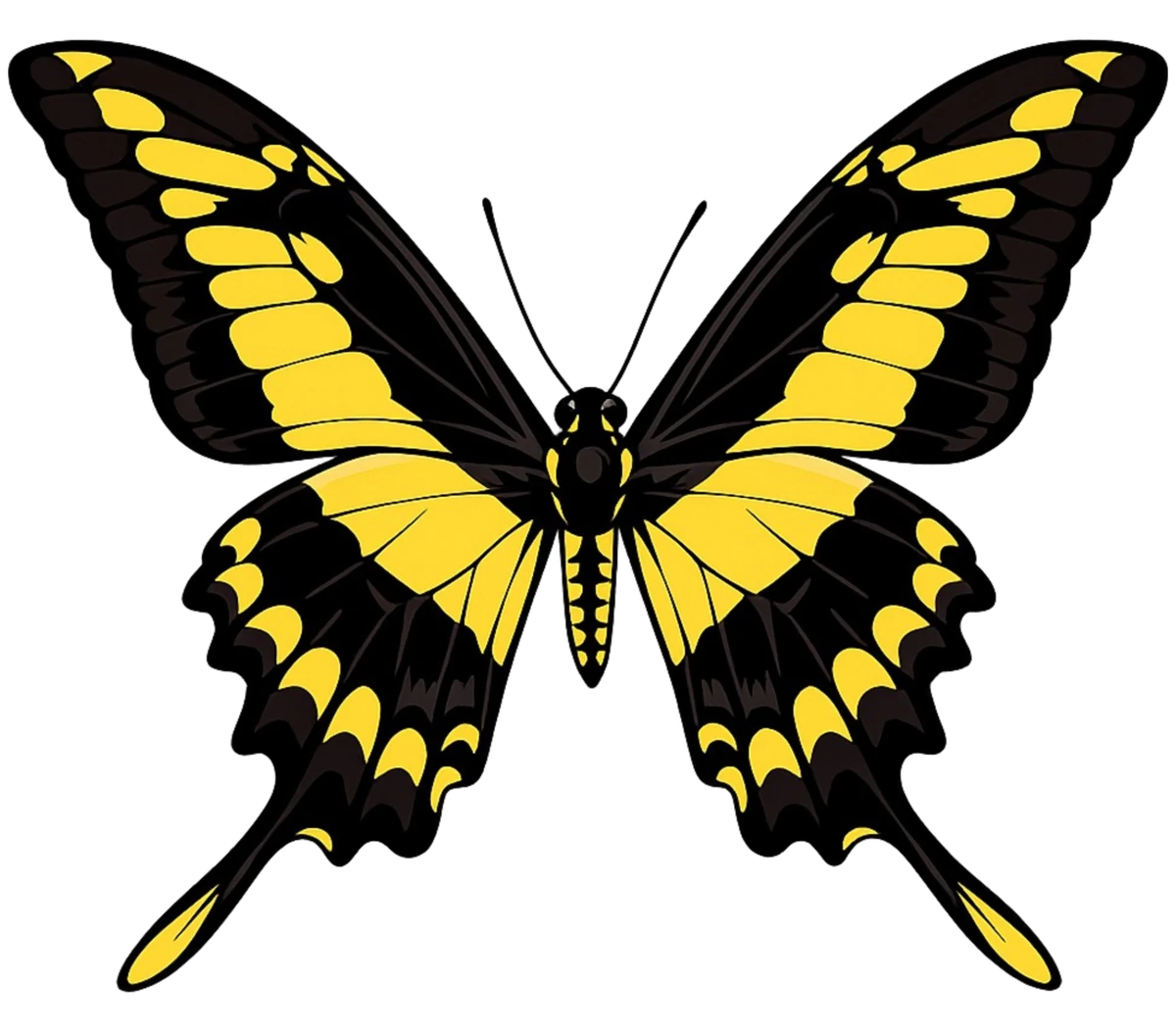
At a glance
- Size in account ↘
- 10.5–12.8 cm wingspan [1]
- Larval hosts ↘
- Rutaceae and Piperaceae records [1]
- Larval defence ↘
- Retractile osmeterium studied in 2018 [3]
Identity and close relatives
Papilio thoas belongs to Papilionidae. Heraclides thoas is an alternative generic combination used by some resources, not an additional species for a second page. King Swallowtail and Thoas Swallowtail are familiar English names. The pale-on-dark pattern is striking but should be compared with a reliably identified whole specimen: several American swallowtails have broadly similar colors. An artwork’s King title introduces the butterfly without establishing a royal cultural history. [1][2]
How to look at the wings
The North American account identifies a neat diagonal forewing band of relatively square yellow spots and gives a wingspan of about 10.5–12.8 centimetres. Tailed hindwings complete the silhouette. The stated size is a species account’s range, not a measurement of the insect pictured in an artwork. An enlarged detail is most useful when it remains connected to the complete wing, where the row of spots can be followed from its inner to outer portions. [1]
Range and living habitat
The reviewed account describes a range from south Texas through tropical America to Brazil, with very rare strays reaching Kansas and Oklahoma. It places the butterfly in mid-elevation tropical forest and lowland edges. Those different occurrence types matter: a distant stray is not evidence of a resident northern population. The geographic summary introduces the living setting without identifying the collecting locality of a separately framed or photographed specimen. [1]
A life in four stages
Like other butterflies, this species develops through an egg, a feeding caterpillar, a pupa and a winged adult. The pupa is a living developmental stage, not a resting adult wrapped in a case. A framed butterfly represents the adult stage. Its wing pattern cannot stand in for a photograph of the caterpillar or establish how long the individual spent developing. Local studies are most informative when their climate, host plant and observation conditions accompany the measurements. [6]
The larva can resemble a bird dropping and may rest exposed on leaves, according to the species account. Its appearance is strikingly different from the mature yellow-and-dark wing pattern. A larval defence study examined an organ that can be extended behind the caterpillar’s head, giving a second developmental story beyond the familiar adult. A stage label is essential in an illustration: the organ belongs to the caterpillar and is not a hidden structure possessed by the framed butterfly. [1][3]
Leaves for larvae, food for adults
The North American account lists larval associations in Rutaceae and Piperaceae, the rue and pepper families. Adults use flower nectar. These are distinct kinds of feeding at different stages. The named family records offer useful botanical connections, but they are not a claim that every plant in both families was tested or that the art specimen developed on a particular one. The field or rearing context behind a precise host name gives the record its meaning. [1]
Behaviour in the living landscape
Adult flower visits are part of the account’s living picture, with nectar sources including Lantana. The source gives year-round tropical flight and an April–July window for south Texas; these are regional seasonal statements. A framed insect shows the pattern clearly, while a living flower photograph can show a feeding posture and environment. The two views complement each other without making the adult’s local calendar a universal schedule across the range. [1]
A closer scientific story
The osmeterium is a retractile defensive organ of swallowtail larvae. A 2018 paper studied its anatomy and chemistry specifically in Papilio thoas, while the Montevideo natural-history presentation illustrates the orange organ being extended. The evidence turns a memorable caterpillar feature into a research story about both structure and substances. It does not make the caterpillar invulnerable, and it should not be confused with a sting, antenna or adult wing appendage. [3][4]
Connections in the ecosystem
The caterpillar’s bird-dropping-like appearance and its osmeterium represent different ways in which a young swallowtail meets the problem of predation. One concerns how the animal looks; the other involves a structure examined in a dedicated anatomy-and-chemistry study. The adult then enters a different feeding setting at flowers. Following these stages shows why an ecological profile should not assign one behaviour or defence to the insect’s whole life simply because the adult is the form most often displayed. [1][3][4]
Names and natural-history records
Papilio and Heraclides reflect differing generic arrangements in the consulted resources. Keeping Heraclides thoas searchable helps readers connect a collection label or research paper with the chosen Papilio heading. The 2018 osmeterium study is a modern scientific chapter in that record. It offers documented context for the artwork without inventing a mythological interpretation from the English name King or claiming that an individual specimen participated in the cited research. [2][3]
Habitat and conservation context
The North American database carries a NatureServe-style global rank, which is a different assessment system from the IUCN Red List. This guide does not relabel that rank as an IUCN category or use an undated field-guide conclusion as proof about every regional population. The supported habitat and seasonal occurrence provide natural-history context, while an individual specimen’s source and permissions remain separate documentary questions. A broad range is not itself a complete conservation assessment.
Reading the specimen views
Dorsal means the upper surfaces of the wings; ventral means their undersides. Start with the whole silhouette, then follow the boundary between the forewing and hindwing and inspect the inner and outer margins. A closely cropped detail is most useful beside a complete view, where its position is clear. Comparing equivalent surfaces prevents an underside pattern from being mistaken for a color variant of the upper wing. A digital enlargement is a way to examine the artwork; it does not supply a microscopic scale or a measurement of the original insect.
From specimen photograph to artwork
The collection includes bold black-and-yellow treatments and a celestial work titled The Universe. Those titles name compositions or editions, not forms recognised by biological taxonomy. The palette and hindwing outline can support very different artistic atmospheres while the species association remains Papilio thoas. Interpretive symbols belong to the artwork; the caterpillar’s documented defence and the adult’s regional natural history remain source-linked biological subjects.
Luminary Oddities’ artwork begins with photography of a living or formerly living specimen, as documented by the artists. The resulting digital treatment can emphasize color, symmetry, movement or atmosphere while retaining that photographic starting point. Read each gallery caption for the named work and the view being presented. An artwork title describes an edition or composition; it is not an additional biological species. The natural-history account identifies the taxon represented, while the art invites a more personal response to its shape and pattern.
Caring for a framed specimen
Display a framed insect in an interior location away from direct daylight, dampness and frequent temperature or humidity changes. Handle the enclosure rather than the specimen, and inspect it periodically for loose parts, pest activity or moisture. Preventive conservation guidance treats physical damage, pests and light as important risks for organic natural-history collections. A glazed frame reduces handling and dust exposure but does not make delicate material immune to deterioration. Follow the maker’s instructions for the enclosure; concerns inside it are best addressed without touching the wings. [5]
Questions worth asking
Are Papilio thoas and Heraclides thoas separate species? The consulted resources use them as alternative generic combinations. Does the adult have an osmeterium? The organ discussed here belongs to the caterpillar. Is its yellow-and-black pattern enough to authenticate every specimen? A full comparison and supporting specimen records provide a stronger basis than color alone. Is the database rank an IUCN badge? The assessment systems should be kept distinct. [1][2][3][4]
Sources and further reading
The linked sources combine taxonomic records, natural-history observations and scientific studies. Regional results are identified in the text because a single population does not describe every butterfly carrying the same name. Historical collection records document those museum objects, and are not provenance records for the artwork’s photographed specimen. Scientific source images are linked for study; their citation does not transfer image rights to this gallery.
- Thoas Swallowtail Papilio thoas Linnaeus, 1771 ↗
Butterflies and Moths of North America · Accessed 2026-10-09
Reverified square spots, 10.5–12.8 cm, southern Texas–Brazil, forest/edges, Rutaceae/Piperaceae, nectar. G5 is not an IUCN category.
- Heraclides thoas, Hodges 4169 ↗
Mississippi State University, Moth Photographers Group · Accessed 2026-10-04
Taxonomic note explains Heraclides/Papilio synonym treatment; use as alternative combination.
- Larval osmeterium anatomy and chemistry in Papilio thoas ↗
Protoplasma, 2018 / PubMed · Accessed 2026-10-04
Exact URL retained. Retractile larval osmeterium; distinguish larval structure from adult specimen.
- Naturaleza extravagante: un arma secreta llamada osmoterio ↗
Centro de Fotografía, Municipality of Montevideo · Accessed 2026-10-04
Official illustrated account names Papilio thoas and explains bird-dropping-like larvae plus orange retractile osmeterium behind the head.
- Caring for natural history collections ↗
Canadian Conservation Institute · Accessed 2026-10-09
Preventive care of organic natural-history specimens; not a guarantee about a particular frame.
- About Butterflies ↗
Smithsonian Gardens · Accessed 2026-10-09
Butterfly development, caterpillars, pupae and adult mouthparts; general butterfly context.
Artworks in the collection
Explore the framed works and digital art connected with this insect. Etsy shows current availability, options and prices.
- 8×8 Black Midnight ↗Framed work
- Large King Swallowtail presentation ↗Framed work
- The Universe ↗Framed work
- King Yellow Swallowtail PNG Pack 1 of 2 | 22 Papilio thoas 300 DPI Butterfly Clipart Files ↗Digital artwork
- King Yellow Swallowtail PNG Pack 2 of 2 | 23 Papilio thoas 300 DPI Butterfly Clipart Files ↗Digital artwork
Continue exploring
Sources checked 2026-10-09. Artwork © Scott Schubr / Luminary Oddities.
Return to the Entomological Atlas ↑