

Luminary Oddities · Natural history & art
Common Mormon
Papilio polytes
Lepidoptera / Papilionidae
The common Mormon is more than a single black-and-white wing pattern. Different female forms make it a celebrated subject of mimicry research, connecting a butterfly seen in gardens with the genes and developmental processes that shape its adult appearance.
Explore this insect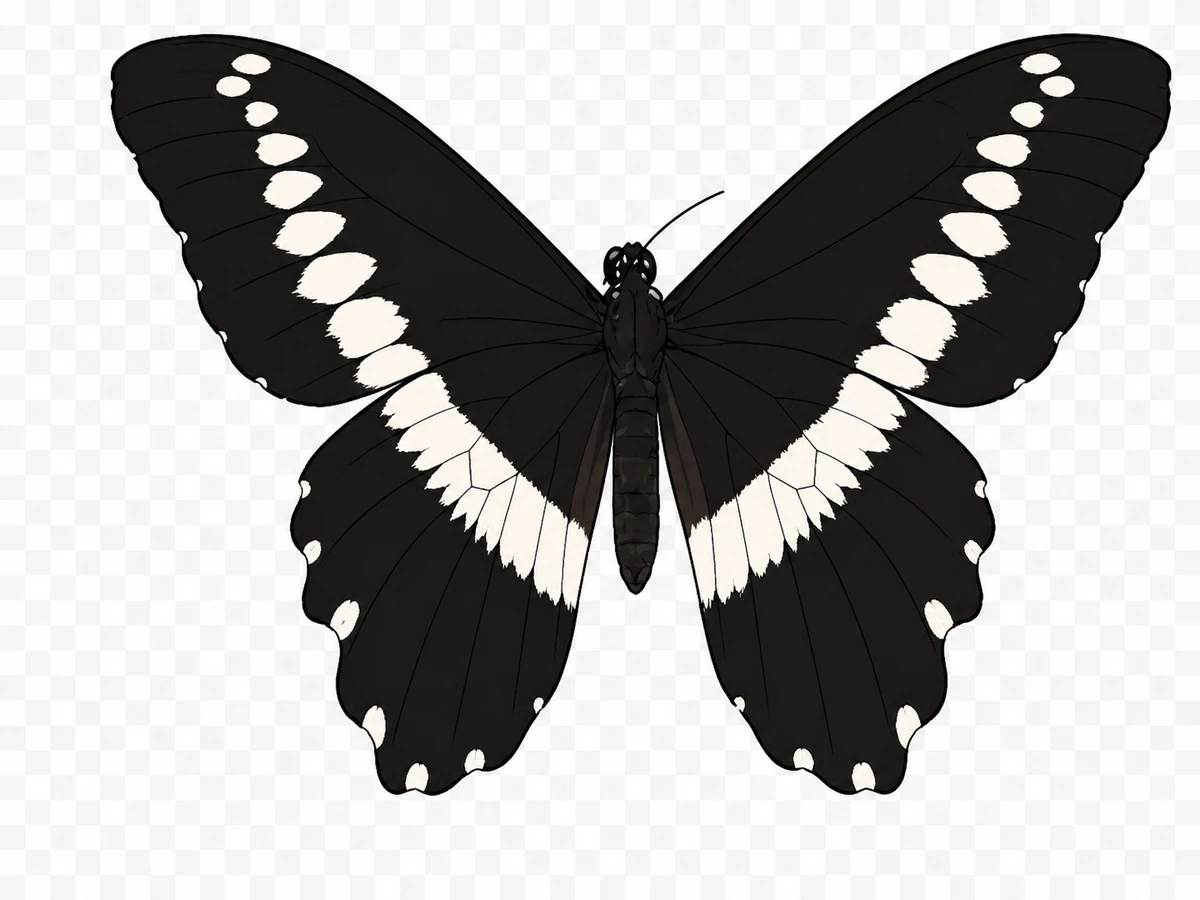
At a glance
- Variation ↘
- Females can have male-like or mimetic wing patterns. [6][1]
- Larval plants ↘
- Citrus, including lime, in the Singapore account. [1]
- Research ↘
- doublesex-associated regulation helps control female mimetic patterns. [2][6]
A garden butterfly and a research subject
Papilio polytes is a swallowtail butterfly in Papilionidae, widely discussed under the English name common Mormon. The Singapore government account concerns Papilio polytes romulus; the research literature examines named study populations rather than every possible regional form. This guide keeps the species heading and the regional scope visible. The butterfly's value as a scientific model grows from its variation: different-looking females can belong to the same species, so one adult image is not its whole visual identity. [1][6]
Several female appearances within one species
In Singapore, the government account distinguishes female form cyrus, which is very similar to the male, from a mimetic form polytes. The male has a dark upper surface and a white band across the hindwing. The mimetic female recalls a common rose butterfly, with white and red hindwing details, while retaining a black abdomen rather than the common rose's red one. This is a regional identification comparison, not a full list of every female form throughout the species' distribution. [1][6]
A male-like pattern therefore does not establish that an individual is male. Similarly, resembling another butterfly is not enough to identify a mimetic specimen without looking at its body and other characters. A complete upper view, underside and body view are useful companions, especially when an artwork emphasizes wings and hides the abdomen within the composition. [1][6]
South and Southeast Asian settings
The developmental study describes a distribution through southern and southeastern Asia, with Okinawa included in its context. Singapore's account places common Mormons in parks, gardens, urban areas, forests and nature reserves. These settings explain why a butterfly involved in sophisticated research can also be encountered in familiar planted surroundings. A broad overview does not assign an exact modern boundary, a subspecies or a geographic origin to the artwork's individual specimen. [6][1]
A leaf-chewing larva before a patterned adult
The university-hosted account describes young caterpillars with a bird-dropping-like appearance and greener later stages. As swallowtail larvae, they possess an osmeterium that can be extended defensively. The adult female mimicry story belongs to another stage. Complete metamorphosis links egg, larva, pupa and adult, but the caterpillar's defensive appearance and organ should not be confused with the adult's resemblance to a different butterfly. Each stage presents a different body and a different set of interactions. [3][8]
Citrus leaves and adult nectar
The Singapore account records egg laying on citrus plants, including lime, and adult nectar feeding at a variety of flowers. The leaf relationship supports caterpillar development, while the flowers provide an adult food visit. This separation matters for gardeners and for image captions. A flowering plant shown beside a common Mormon is not automatically a larval host. The regional citrus connection is useful and approachable without being expanded into an unrestricted diet for every population or citrus-family plant. [1]
Courtship is more than a wing still
Experiments on mate selection have examined behaviour alongside visual wing patterns. Their study framework treats moving individuals and different female forms, adding a dimension absent from a single spread-specimen photograph. The research also notes that the relative frequencies of mimetic and non-mimetic females vary between populations. An individual in a gallery can illustrate one form, but it cannot tell us which form is most frequent everywhere or how every male chooses a mate. [4]
A developmental switch, not a chosen disguise
Research in 2014 linked female-limited mimicry to doublesex, a gene involved in sexual differentiation. Later experimental work examined how its mimetic version regulates other genes during wing development. The 2019 study identified roles for Wnt1 and Wnt6 in red and white patterning and repression of a network associated with the non-mimetic pattern. The adult result is inherited developmental variation. A butterfly does not look at another species and consciously select a disguise. [2][6]
The useful everyday explanation is that a small genetic difference can affect an organized set of developmental events, producing a different adult pattern. The detailed paper remains available for readers who want the experimental methods. The guide does not reduce that evidence to a claim that one gene independently paints every marking without interacting with a wider developmental system. [2][6]
A resemblance shaped by predators
Batesian mimicry describes a palatable animal resembling a model that predators find unpalatable. Papilio polytes is a female-limited example: mimetic females resemble rose swallowtails, while other females and males can retain the non-mimetic pattern. Field tests have investigated this relationship, so the topic is more than a human impression that two attractive butterflies look alike. The resemblance belongs within an interaction with predators, and its effectiveness is a research question rather than a decorative explanation invented for the frame. [5][6]
Form names help describe variation
Names such as cyrus and polytes are used for female forms in the Singapore account. They do not represent different artwork editions or separate species in this guide. A subspecies name such as romulus identifies another taxonomic layer. Keeping species, subspecies and form distinct helps a reader navigate a specimen caption and search the literature. The familiar common name is a label for the butterfly; it is not used here to invent a cultural or religious meaning for a particular artwork. [1]
Garden occurrence and status are different questions
The Singapore account encourages butterfly observation that contributes local data. That is a practical connection between enjoying a familiar insect and learning about its population. Parks and garden occurrence does not itself supply a global conservation category, and the Atlas does not add one from this account. Recording form, date, place and behaviour can make an observation more useful. The specimen's own collecting history remains separate from the ecology described in the guide. [1]
Look beyond the wings
Start with the hindwing pattern, then examine the abdomen rather than stopping at a resemblance to the common rose. If more than one common Mormon is pictured, compare the forms without assuming that a male-like specimen must be male. An underside and a full body photograph can add details that a decorative crop hides. The gallery's image enlargement helps the viewer read the specimen while leaving the physical wings enclosed and untouched.
Variation as a visual conversation
Different documented forms can inspire different compositions within the same species gallery. A dark-and-white pattern and a red-accented mimetic pattern offer different rhythms to the artist. The added background, title and symbols belong to each artwork's interpretation. Scientific mimicry is a predator-related biological resemblance, not a metaphor that automatically determines the meaning of the finished piece. Viewing art and research side by side allows each to contribute its own kind of insight.
Protect a delicate research subject
The scientific interest of a wing pattern does not make the wing less fragile. Keep a framed insect enclosed, handle the frame and choose a position away from direct sun, persistent damp and strong heat. Natural-history conservation guidance emphasizes avoiding physical stresses on brittle insect material and watching for environmental and pest damage. If the mount moves or a fragment appears, document the change and seek suitable help. Do not brush scales or clean a wing surface. [7]
Female forms and genetic regulation
Can a female look like a male? The Singapore account explicitly includes a male-like female form. Can another female resemble a common rose? Yes; the abdomen is part of that regional comparison. Does the butterfly choose the pattern? The research concerns inherited developmental regulation. Are two female forms the whole story everywhere? Local populations and studies differ, so the regional set should remain identified as regional. Does citrus nectar establish a host? A larval or egg-laying record concerns host use; nectar alone does not. [1][6]
From a regional guide to experimental biology
Singapore's current government page supplies a grounded field introduction. The 2014 doublesex paper and 2019 gene-network study explain development, while field mimicry and mate-selection research address living interactions. The university-hosted overview is used narrowly for larval appearance and the osmeterium rather than for a universal lifespan. These sources are linked so the reader can follow the particular question of interest without confusing a local form description with the full distribution of the species. [1][2][6][5][4][3]
- NParks Singapore: Common Mormon ↗
National Parks Board, Singapore · Accessed 2026-10-09
Updated 15 September 2026. Singapore population and female forms; lime/citrus hosts; parks, gardens and forest. Regional context is essential.
- Kunte and colleagues 2014: doublesex and butterfly mimicry ↗
Nature · Accessed 2026-10-09
Papilio polytes female-limited mimicry and doublesex-associated supergene.
- University of Michigan Animal Diversity Web: Papilio polytes ↗
University of Michigan, Animal Diversity Web · Accessed 2026-10-09
Student-authored 2013 account used narrowly for caterpillar appearance and osmeterium. Not relied on for exact lifespan or modern full range.
- Behaviour before beauty: mate selection in Papilio polytes ↗
Behavioral Ecology · Accessed 2026-10-09
Experimental courtship results, population-specific female form frequencies.
- Experimental field tests of Batesian mimicry in Papilio polytes ↗
Ecology and Evolution · Accessed 2026-10-09
Primary field experiments, sex-limited mimicry and model relationships.
- Papilio polytes doublesex-orchestrated gene network ↗
Communications Biology · Accessed 2026-10-09
Primary developmental study of mimetic wing-pattern regulation.
- Caring for natural history collections ↗
Canadian Conservation Institute · Accessed 2026-10-09
Preventive care of organic collections, including brittle insect material.
- About Butterflies ↗
Smithsonian Gardens · Accessed 2026-10-09
General butterfly metamorphosis, anatomy and stage distinctions; not species-specific timings.
Artworks in the collection
Explore the framed works and digital art connected with this insect. Etsy shows current availability, options and prices.
- The Lovers ↗Framed work
Continue exploring
Sources checked 2026-10-09. Artwork © Scott Schubr / Luminary Oddities.
Return to the Entomological Atlas ↑