
Small emerald green prisms
Dioptase
Hydrated copper silicate, often emerald green.
Mineral species; ornamental specimens may include other minerals
Dioptase is a hydrated copper silicate, CuSiO3·H2O.
Geology · Human history · Attributed traditions
Explore the specimen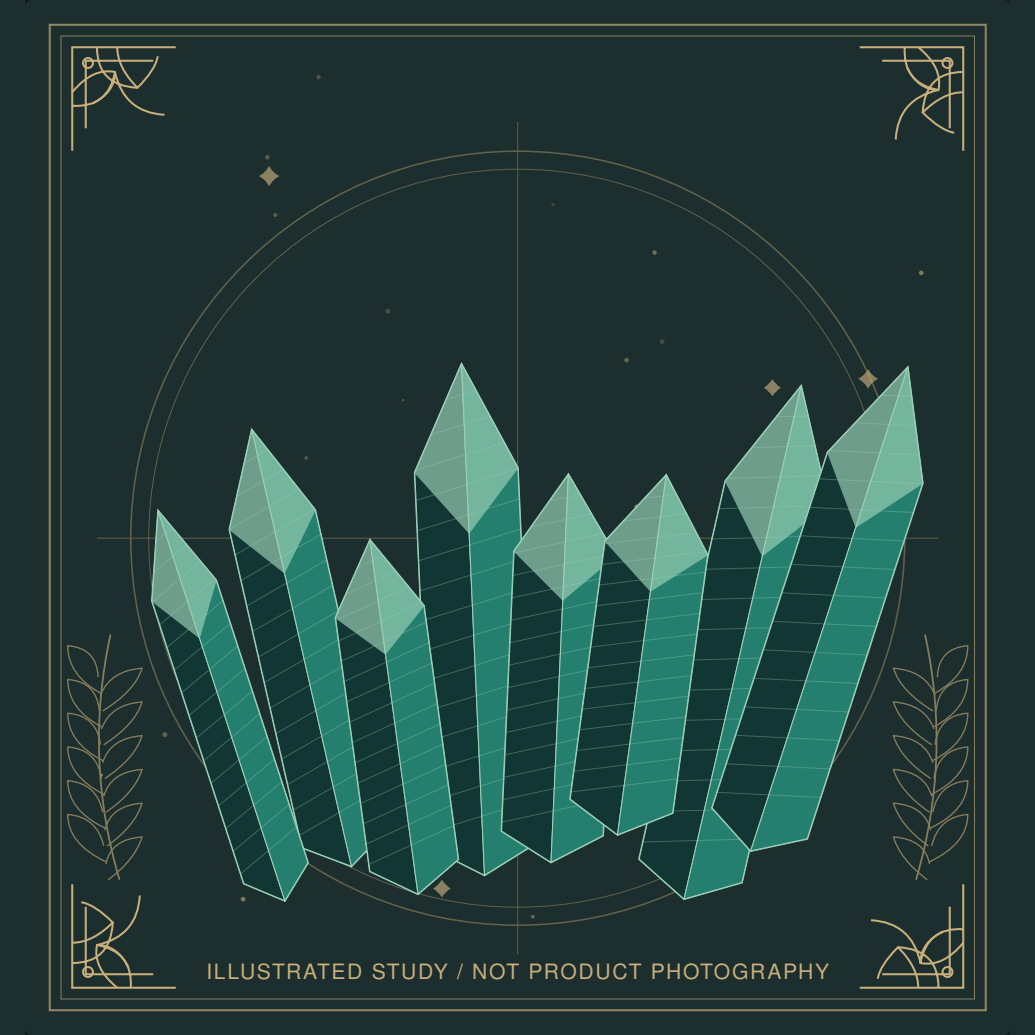
Material
Hydrated copper silicate, often emerald green. [1]
Family
Copper silicates [1]
Appearance
Brilliant emerald-green crystals and crystalline aggregates. [1]
Meaning & tradition
Kynes: balance. [2]
In this guide
Visual identity & plain-language name
Dioptase is a hydrated copper silicate, CuSiO3·H2O. Its intense green can resemble emerald from a distance, but chemistry, structure and physical behavior are different. A crystal group on matrix is the natural specimen format most informative here; the matrix is part of the display rather than proof that every grain is dioptase. [1]
Earth story: formation, structure & color
The Handbook places it in the trigonal crystal family, with prismatic to rhombohedral crystals, hardness 5 and perfect cleavage. It develops in oxidized copper deposits. Transparent green crystals and aggregates illustrate how crystal habit and transmitted light can change the appearance of the same mineral. [1]
Dioptase is a copper silicate containing structural water, conventionally written CuSiO3·H2O or in a ring-based structural expression. The Handbook records trigonal symmetry in the hexagonal crystal system and space group R-3. A crystal can form short bright prisms and rhombohedral terminations, with transparent to translucent emerald-green or blue-green color. The name should not be shortened to emerald: emerald is a beryl variety with different composition and properties. [1]
The reference lists hardness 5, density about 3.28–3.35, perfect cleavage and brittle tenacity. Brilliance and rich green color do not negate that mechanical vulnerability. Dioptase occurs in oxidized portions of copper deposits, alongside minerals such as chrysocolla, malachite, quartz and several secondary lead or zinc minerals. Documented localities include Kazakhstan, Congo and Namibia. These occurrences supply geological context, but a green crystal's country cannot be determined from hue or its similarity to a famous locality photograph. [1]
The mineralogical sheet gives different refractive indices for the ordinary and extraordinary rays, roughly 1.65 and 1.70–1.71, consistent with its uniaxial optical description. Those are measured identification properties rather than a description of spiritual intensity. The bright green appearance and relatively strong light response are visually appealing, but the structure's perfect cleavage still governs how it can break. A collector record that retains both optics and mechanical limitations tells a fuller material story than emerald-like alone. [1]
The green streak belongs to powdered mineral, while emerald-like bodycolor describes a crystal's appearance. These are different observations. Protect intact terminations rather than creating powder from a collector specimen merely to compare them. [1]
Varieties & look-alikes
Compare discrete green crystals, tightly packed drusy surfaces and more massive material. Emerald is beryl; malachite is a carbonate, despite being another green copper mineral. A vivid hue alone cannot separate them. An unusually clean crystal photograph does not disclose all fractures, repairs or the condition of its supporting matrix. [1]
- Dioptase crystals
- Short green prisms and rhombohedral-looking terminations can reveal natural crystal architecture. Thin edges may transmit light even when the body appears dark. Color and shape are useful observations, but a confirmed species requires a stronger identification basis. Fine crystals need protected storage because brittleness and perfect cleavage remain present despite their vivid gem-like appearance. [1]
- Dioptase in matrix
- The green mineral can sit on or among other constituents of an oxidized deposit. Matrix identity and crystal identity are separate determinations. Document whether the specimen is naturally intact, repaired or assembled when known, and avoid attributing every pale or brown patch to a guessed mineral. Handling by a stable base protects both crystals and their geological arrangement. [1]
Human story: objects, names & cultural context
Greek roots referring to seeing through underlie the name, connected to cleavage directions visible through crystals. This is a mineral-observation story. It does not establish a historical practice of spiritual sight or a universal green-stone correspondence. [1]
The species name derives from Greek words referring to seeing through, linked in the Handbook to visible cleavage directions. The type-material record includes a specimen in the Natural History Museum in Paris. Such details anchor a naming account in actual mineralogical collections rather than an invented legend. Fine dioptase is now especially familiar in collector specimens because natural crystal faces can be so striking. That present-day appreciation remains distinct from whatever symbolic meaning a named modern practitioner chooses to assign. [1]
Meaning & practice: attributed traditions
Sandra Kynes gives dioptase a balance correspondence in her 2018 account. This is attributed modern symbolism. [2]
An editorial balance intention can pair the object with a decision that has two competing demands. Record a workable boundary for each demand. The mineral acts as a visual reminder of the chosen balance, not an agent that produces it.
Material truth: trade names & treatments
Hardness 5 and strong cleavage make exposed crystals a careful-display material. A specimen can scratch or split even when the color looks gemlike. Support matrix groups and avoid rubbing faces against harder objects. Report repair or coating when known, and do not call green dioptase emerald simply because the color overlaps. [1]
A vivid green aggregate with an attractive matrix can be genuine dioptase while still including repairs or other minerals. A good collector description separates crystal identity, matrix identity, condition and any restoration. Adhesives and reconstructed clusters require disclosure when present. Do not use hardness, streak or acid experiments on fine terminations: those tests can permanently damage an otherwise useful specimen. Material suitable for a protected mineral display is not automatically suitable for daily jewelry simply because its color resembles a durable gem. [1]
Study how light passes through thin crystal edges and how flat faces meet. Cleavage surfaces created by breakage can resemble growth faces, so an angular outline is not always an intact termination. Note chipped tips, attached grains and the specimen's most stable supporting base. If a report identifies only the green mineral, leave unknown matrix constituents unresolved. The distinction improves a description without diminishing the visual impact of an exceptionally bright green cluster.
Sources & related specimens
The Handbook provides structure, properties, occurrence and naming. Kynes documents the modern belief. Compare emerald and malachite to distinguish visually similar green specimens.
- Handbook of Mineralogy: Dioptase
Mineralogical Society of America · Identity and natural history · Accessed October 9, 2026
- Sandra Kynes: 365 Days of Crystal Feng Shui for Your Home (2018)
Llewellyn Worldwide · Sandra Kynes’s contemporary crystal-placement and intention framework · Accessed October 9, 2026