
Small lights in dark rock
Nuummite
Iridescent amphibole-bearing metamorphic rock associated with Nuuk, Greenland.
Ornamental amphibole-rich metamorphic rock
Nuummite is a rock associated with anthophyllite and gedrite amphiboles, rather than one standalone mineral species.
Geology · Human history · Attributed traditions
Explore the specimen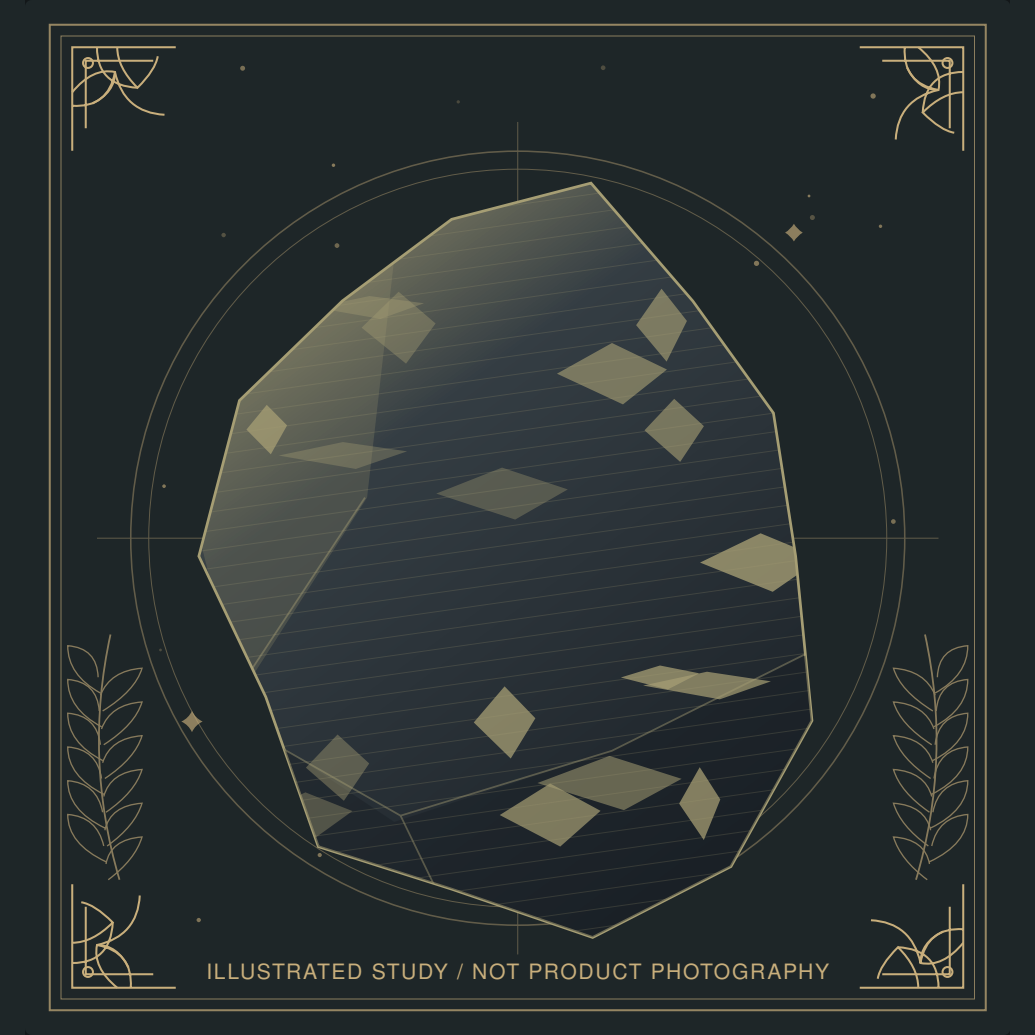
Meaning & tradition
The Crystal Council: spiritual exploration and reflection. [1]
In this guide
Visual identity & plain-language name
Nuummite is a rock associated with anthophyllite and gedrite amphiboles, rather than one standalone mineral species. Its gold, blue and other iridescent flashes are part of a fine mineral intergrowth. An apparently plain dark area can become reflective at another angle, so a static photograph captures only one view. [2][3]
Earth story: formation, structure & color
GEUS describes Greenland material and its amphibole composition; research links iridescence with microscopic intergrowth textures. Geological age belongs to the documented deposit, not automatically to every dark stone under the name. The 2023 IGC account also emphasizes occurrence-specific mineral assemblages and study. [2][3]
Nuummite is an ornamental amphibole-rich rock, especially associated with intergrown anthophyllite and gedrite in Greenland material. It is not a single mineral species or a synonym for any dark stone with flashes. GEUS, the Geological Survey of Denmark and Greenland, describes black-brown material that can show gold, blue and other directional colors on suitable polished surfaces. Its reported hardness around 6 characterizes the discussed material, not every similarly named product. [2][3]
The geological context involves old metamorphic rocks, with mineral intergrowth and deformation contributing to the assemblage. The modern gemological account of a further Greenland occurrence highlights anthophyllite-gedrite relationships and specimen-specific examination. Flash color, locality and the rock's component identities remain different questions. A shop's statement that every nuummite is exactly the same age or came from one Nuuk locality exceeds what color alone can establish. A polished slab can reveal striking reflection while obscuring the rock's original field context. [2][3]
Varieties & look-alikes
Compare documented Greenland rock, different flash colors and dark rocks sold under similar labels. Labradorite is a feldspar, while arfvedsonite-bearing rock has different amphibole identity. Flash direction or color alone cannot establish a Nuuk origin. A locality claim needs records, particularly when a retailer emphasizes extreme age. [2][3]
- Nuummite
- The parent commercial rock identity should be connected with examined amphibole-rich material. Directional reflections and dark bodycolor are familiar observations, not complete species or origin tests. GEUS provides a documented Greenland context, but an unprovenanced product cannot inherit that whole account automatically. Preserve component identification and locality evidence independently. [2][3]
- Documented Nuuk material
- Nuuk-region provenance is valuable when tied to a collecting record or reliable source. The locality relates the object to a specific geological and craft history rather than an abstract magical antiquity. A place-derived commercial name alone is weaker evidence. Keep the acquisition and identification records with the polished specimen as it moves between owners. [2][3]
- Pseudo-nuummite comparisons
- Other dark reflective materials can be sold under nuummite-like labels. They need independent rock or mineral determinations rather than a conclusion from flash color. A substitute may be an attractive natural assemblage in its own right. Describe the actual material and manufacture when known; the commercial similarity is a comparison, not an equivalence claim. [2][3]
Human story: objects, names & cultural context
GEUS records collection in the nineteenth century and renewed recognition and marketing in the 1980s, with the name tied to Nuuk. That history connects field geology, laboratory observation and local lapidary work. It is distinct from modern claims that an old rock automatically preserves personal past-life memories. [2][3]
GEUS records Giesecke's collection in 1810, Bøggild's later observation of the iridescence, and Peter Appel's recognition of ornamental material in 1982. The account traces commercial naming and the development of a local Greenland craft market, including the name Nuummit meaning from Nuuk. This is a specific documented human story rather than an invented ancient shamanic lineage. A geographical name and regional geological age should still be connected to a particular piece through provenance rather than treated as properties of every dark retail palmstone. [2][3]
GEUS's craft-history account ties the naming and marketing of ornamental material to particular Greenland discoveries and local work. That evidence supplies a regional commercial chronology, while the geological age relates to the associated rocks. The carved object's production date and individual source remain separate matters. [2]
Meaning & practice: attributed traditions
The Crystal Council assigns nuummite spiritual-exploration and past-life themes. These are contemporary beliefs, not geological evidence of memories or supernatural information. [1]
An editorial exploration practice can write a question about personal history and identify a real record or conversation that might answer it. The flashes can remind you that changing perspective reveals different features, without claiming the rock transmits a past life.
Material truth: trade names & treatments
Request geological identity and provenance rather than treating all dark flashing material as genuine Nuuk nuummite. An origin certificate and a mineral identification answer different questions. Coating, repair and shaping should remain in the product record. A regional Archean age is not a blanket age guarantee for every trade piece. [2][3]
Nuuk material, other documented occurrences and a pseudo-nuummite substitute require different descriptions. A dramatic golden flash is insufficient to prove the amphibole assemblage or Greenland origin. If a product has been filled, coated, repaired or assembled, that intervention belongs beside the material determination. A seller's magical age story cannot replace component identification and source records. The name should retain its geological and commercial context while a contemporary practitioner meaning remains explicitly a belief. [2][3]
Turn a polished piece gently under one light source and record the direction of flashes and the visible grain pattern. Compare several faces, since the cut can emphasize or suppress the effect. A careful caption states confirmed amphibole-rich ornamental rock and any established source, then distinguishes the reported trade designation. Avoid assigning every small golden fleck to one mineral from its color. The beauty of the intergrowth can be described richly while its exact composition and locality remain tied to real evidence.
Sources & related specimens
GEUS and the IGC reference ground composition, discovery and occurrence. The Crystal Council supplies modern symbolic language. Compare arfvedsonite and labradorite to distinguish different sources of dark-stone flash.
- Nuummite: contemporary meanings
The Crystal Council · Contemporary symbolic associations attributed to The Crystal Council · Accessed October 9, 2026
- Nuummit: composition, discovery and Greenland commerce
Geological Survey of Denmark and Greenland · Mineralogy, geology, naming and documented material history · Accessed October 9, 2026
- A nuummite occurrence from Kangerluarsuk in the Maniitsoq Region, West Greenland
International Gemmological Conference · Mineralogy, geology, naming and documented material history · Accessed October 9, 2026