
Yellow black and honest names
Bumblebee Stone
Carbonate-rich Indonesian decorative rock, despite the common jasper label.
Carbonate-rich ornamental rock assemblage
Bumblebee stone is a carbonate-rich mixed material, despite the common jasper trade name.
Geology · Human history · Attributed traditions
Explore the specimen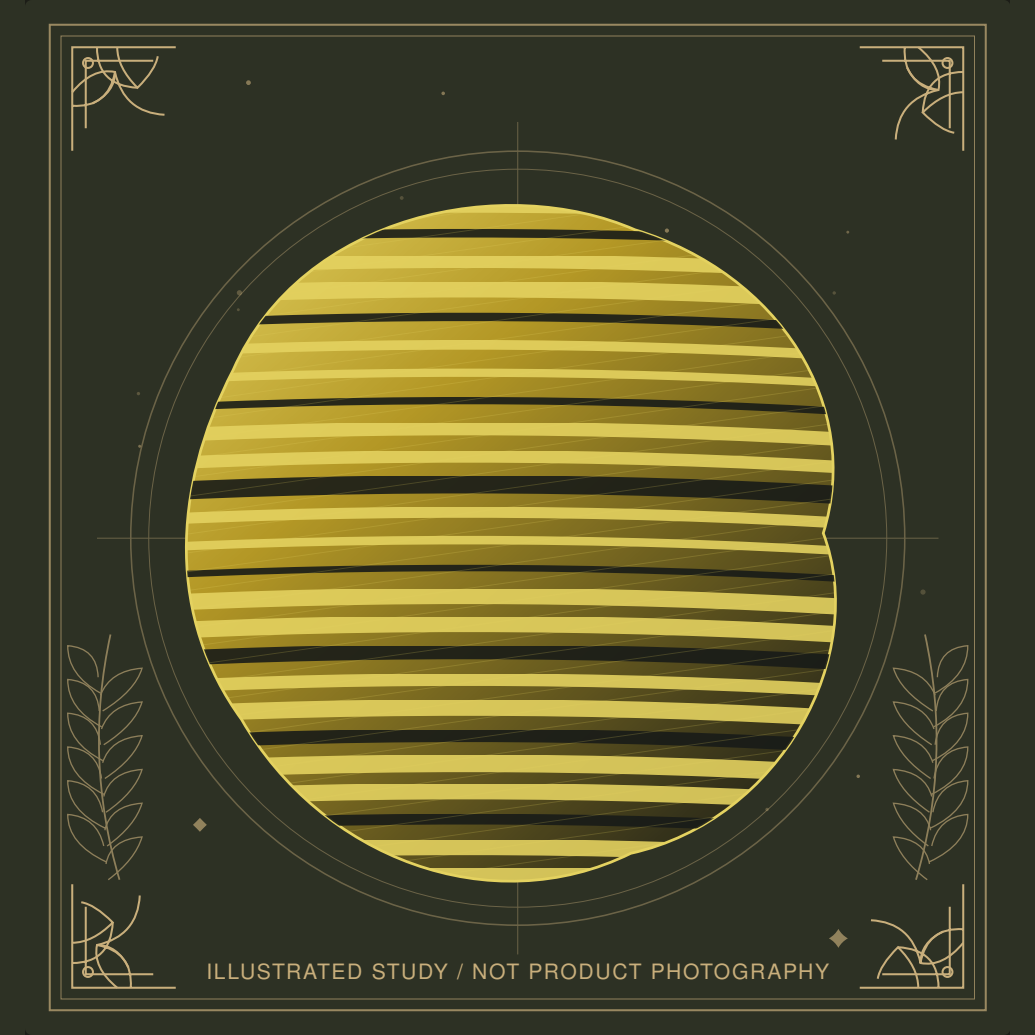
Meaning & tradition
The Crystal Council: purpose and motivation. [1]
In this guide
Visual identity & plain-language name
Earth story: formation, structure & color
Gem-A’s account of studied material places the deposit near Mt Ciremai/Cereme in West Java, in a sulfurous volcanic-vent setting. Laboratory work identifies calcite with yellow pararealgar and orange realgar, both arsenic-bearing phases, and other constituents. That primary account is more precise than a simple yellow-equals-sulfur explanation. [2][3]
The studied Bumblebee material is a carbonate-rich rock or aggregate from a volcanic-vent setting near Mt Ciremai, also spelled Cereme, in West Java. Gem-A's account draws on laboratory and field investigation and identifies calcite as a major constituent. The memorable color pattern is consequently not proof that the material is quartz-rich jasper. This distinction affects classification, physical properties and handling. [2][3]
Yellow pararealgar and orange realgar are arsenic-bearing phases identified in the research, while dark areas involve additional constituents including sooty pyrite. Sulfur occurs in the geological setting but the rule yellow equals sulfur is inadequate for the studied ornamental material. Mineral identity requires examination, not a color analogy. The bands and mixtures are components of an assemblage rather than several colors of one ideal mineral species. [2][3]
GIA's lapidary report records relatively soft, porous material and the frequent use of resin filling to make attractive polished products. A carbonate-rich body with mineral pigments, pores, fractures and filling has variable properties across its surface. It cannot be given one crystal system or an ideal jasper formula. The exact mineral inventory of another retail piece and its treatment history still require specimen-specific information; a matching black-yellow photograph cannot transfer all results automatically. [2][3]
Varieties & look-alikes
Compare the yellow-orange dark bands, paler carbonate layers and filled polished material. Genuine jasper, yellow calcite and other colorful rocks have different identities. A retail Papandayan or another specific volcano claim should not override documentation of the studied deposit. Each product needs its own provenance. [2][3]
- Bumblebee jasper alias
- The familiar jasper suffix is misleading as geological classification for the studied carbonate-rich material. Preserve it as a commercial name and state the examined assemblage plainly. Yellow, orange and dark zones involve different constituents, not simply colors of one silica species. The alias cannot establish treatment, exact origin or the identity of every layer. [2][3]
- Bumble Bee stone
- The spaced spelling is another trade presentation of the same comparison category rather than a new species. An individual product still needs its own identity, provenance and treatment account. Pattern alone cannot verify the source or mineral inventory. A carbonate-rich natural substrate can coexist with resin filling and a manufactured carved form. [2][3]
- Eclipse jasper comparison
- This evocative alias should be retained separately from a supported material determination. Dark and vivid yellow-orange contrast does not prove quartz-rich jasper or a different geological formation. Ask what components and processing were established for the actual object. The name can remain useful commercial history while the scientific account stays specific about its evidence. [2][3]
Human story: objects, names & cultural context
The name follows the insect-like color pattern. Gemological work corrected and detailed the mineral assemblage behind a striking lapidary product. This is a modern scientific and trade history, without requiring an ancient tradition for a recently named decorative material. [2][3]
The commercial name follows the bee-like yellow-orange and dark pattern. Its supported human story includes discovery and trade in a dramatic lapidary material and subsequent gemological work that clarified composition. The field location in the scientific account should not be replaced by a different volcano named in modern practitioner marketing. A product's own source record remains important, especially when a seller gives a precise locality. An ancient lineage is unnecessary where the documented history is a modern ornamental trade and analytical investigation. [2][3]
Meaning & practice: attributed traditions
The Crystal Council associates its Bumblebee Jasper material with purpose and motivation. These are contemporary beliefs; its mineral and locality statements are not the scientific authority used here. [1]
An editorial purpose intention can select one action you want to complete today and set a realistic time for it. The bold pattern can recall that decision without promising energy, mood change or a bodily effect.
Material truth: trade names & treatments
GIA reports porous material often filled with resin; disclose that condition where known. Arsenic-bearing components make casual cutting, sanding or powder tests inappropriate. Treat the piece as a display object, avoid creating dust or using it in drinking-water preparations, and wash hands after handling rough material. Product condition and responsible lapidary practice matter more than its cheerful color. [2][3]
Bumblebee jasper and eclipse jasper are trade aliases, not confirmation of a silica-jasper substrate. Known resin filling should be disclosed alongside the natural assemblage. Arsenic-bearing mineral components make casual sanding, cutting, powdered tests or drinking-water preparations inappropriate. The practical distinction is material-specific: a handled display object and a dust-producing lapidary operation are different exposures. Preserve the piece as a specimen, keep rough surfaces from unnecessary abrasion and wash hands after handling rough material. The cheerful appearance does not settle composition or product suitability. [2][3]
Describe yellow, orange, dark and pale zones separately, and identify components only where examination supports the name. Note visible pores, fractures and any documented filling. A smooth polish may be a successful lapidary finish rather than evidence of a hard quartz material. Provenance can preserve the relationship to the studied deposit, while a seller's confident location story remains attributed until supported. Personal motivation symbolism belongs to the modern practitioner or owner; the mineral account remains a record of a mixed carbonate-rich material and its handling considerations.
Sources & related specimens
Gem-A supplies detailed mineralogy and deposit context; GIA documents lapidary processing. The Crystal Council supplies modern symbolism only. Compare jasper and calcite before treating a retail name as a mineral classification.
- Bumblebee Jasper: contemporary meanings
The Crystal Council · Contemporary symbolic associations attributed to The Crystal Council · Accessed October 9, 2026
- Gem-A: Bumble Bee Stone from Indonesia
Gemmological Association of Great Britain · Documented carbonate rock with arsenic-bearing yellow phase; exact specimen composition still varies · Accessed October 9, 2026
- Bumble Bee jasper: Gem News International, Summer 2014
Gemological Institute of America · Mineralogy, geology, naming and documented material history · Accessed October 9, 2026