
Violet silk currents
Charoite
Complex silicate mineral usually sold as purple charoite-bearing rock.
Mineral species; ornamental specimens may include other minerals
Charoite is a complex silicate mineral, commonly presented as a purple charoite-bearing ornamental rock.
Geology · Human history · Attributed traditions
Explore the specimen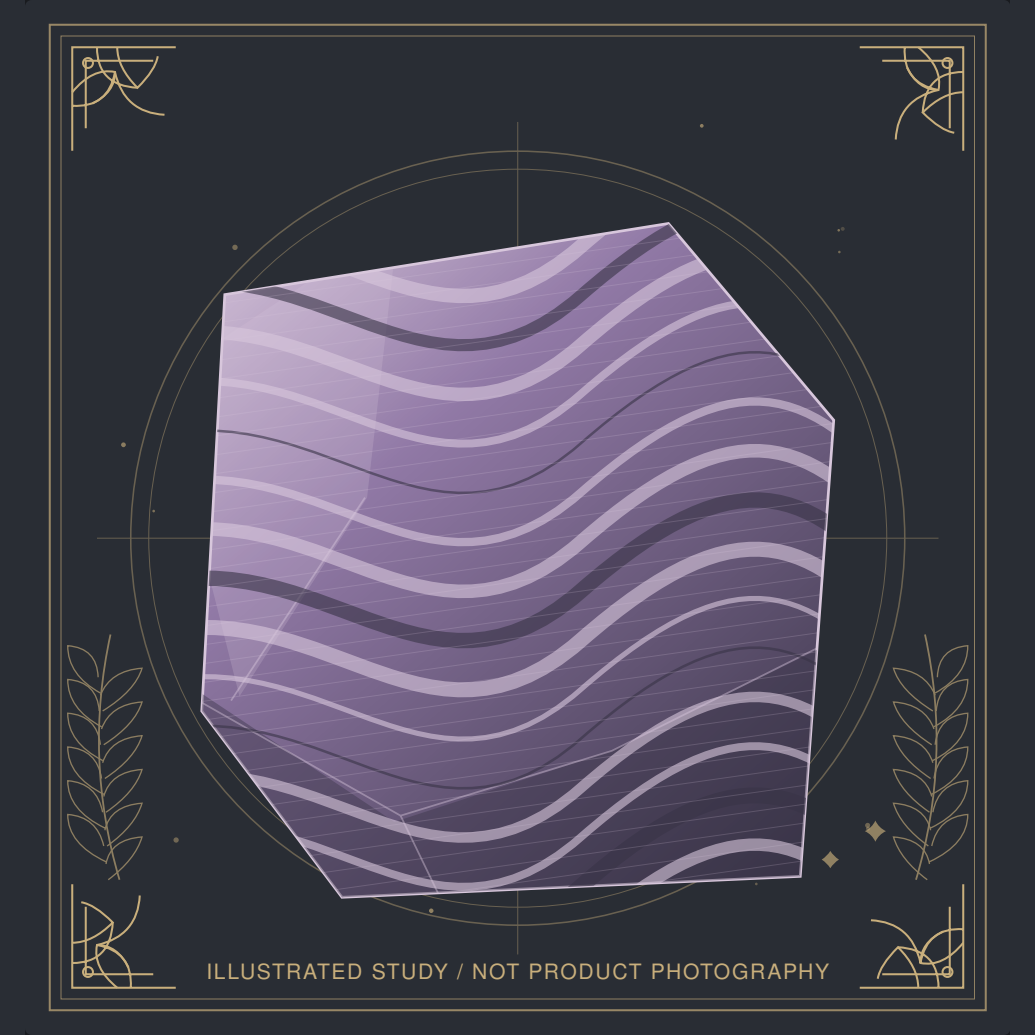
Material
Complex silicate mineral usually sold as purple charoite-bearing rock. [2]
Family
Complex silicates [2]
Appearance
Lilac-violet fibrous swirls in a complex mixed rock. [2]
Meaning & tradition
The Crystal Council: contemplation and spiritual exploration. [1]
In this guide
Visual identity & plain-language name
Charoite is a complex silicate mineral, commonly presented as a purple charoite-bearing ornamental rock. Pale, dark and yellow-brown areas can belong to associated phases. The polished swirl is a textural view through that mixture, not a collection of newly named purple species. [2]
Earth story: formation, structure & color
The revised Handbook describes monoclinic, fibrous or massive charoite with a complex calcium-potassium-silicate composition. It occurs in potassic metasomatic rocks where specialized syenitic material meets limestone in the Murun massif. Canasite and tinaksite are documented companions. This local geological reaction setting matters more than a purple-only identity test. [2]
Charoite is a complex silicate with potassium, calcium and several substituting constituents, rather than purple quartz or a mineral defined solely by a lavender swirl. The revised Handbook formula accommodates strontium, barium, manganese, sodium, hydroxyl, fluorine and water in a complicated structure. Its monoclinic material is usually fibrous and massive; the flowing, silky pattern of an ornamental piece reflects aggregate texture. Dark, pale or yellow areas can be accompanying minerals rather than differently colored parts of one pure crystal. [2]
The geological context is unusually specific. The Handbook places charoite in altered potassium-feldspar-rich rocks associated with nepheline and aegirine syenites and limestone contacts in the Murun region of Russia. Metasomatism means chemical exchange as fluids and rocks interact; it is a more useful explanation than calling every swirl a frozen energy wave. Canasite and tinaksite are among documented associates. The revised sheet gives measured density 2.54 and notes cleavage, while leaving hardness undetermined there. That source's uncertainty should remain visible instead of being replaced with an unverified precise value. [2]
The revised mineral sheet distinguishes observations that were measured from those left undetermined. That reporting practice is useful for a complicated fibrous silicate: an unknown hardness in the chosen reference should not be filled by borrowing a figure from an unsourced sales listing. Describe aggregate texture and documented density while allowing a specimen-specific examination to add further verified properties. [2]
Varieties & look-alikes
Fibrous purple material and more host-rich pieces belong in the same comparison with clearly described proportions. Lepidolite is mica, while charoite has different structure. Sugilite can also be purple but is chemically distinct. Yellow or black patches in a carving need individual phase identification; a photograph cannot assign them conclusively. [2]
- Charoite
- The parent material is a complex fibrous silicate commonly encountered in massive ornamental form. Purple to lilac color and directional silky texture are characteristic observations, while confirmation belongs to mineralogical examination. A polished tumble is not a single perfect crystal simply because its whole outline has one familiar shop name. Record the texture and any documented identity basis. [2]
- Charoite with accessory minerals
- Black, pale or yellow areas may be separate minerals within the charoite-bearing assemblage. The Handbook identifies canasite and tinaksite among regional associates, but a particular grain still needs determination before receiving a name. Describe visible components neutrally if they are unknown. Their arrangement contributes to the pattern and can alter polish and durability across a carving. [2]
Human story: objects, names & cultural context
The Handbook names the Chara River as the naming reference and cites the 1978 description of the new mineral and jewelry stone. This is a modern mineralogical and lapidary history. The date of scientific description does not automatically determine whether any earlier people encountered the rock, but it does prevent ungrounded claims of a named ancient charoite system. [2]
The name refers to the Chara River, and the Handbook cites the 1978 publication introducing the mineral as a new species. This documented naming and scientific description are modern. They do not substantiate an ancient civilization's charoite healing practice. The distinction is particularly useful for a material whose dramatic purple appearance encourages imaginative marketing stories. A contemporary object can have an engaging maker or collector biography, while the regional geology and scientific naming remain their own historically supported accounts. [2]
Meaning & practice: attributed traditions
The Crystal Council discusses charoite in contemporary meditation and spiritual-exploration language. This is the publisher’s belief framework, not evidence of changes in anatomy or a mineral mechanism. [1]
An editorial contemplation practice can use the swirling texture to observe how attention moves. Record one question and one observation without requiring a supernatural explanation. The pattern can support a personal ritual while the geology remains separately documented.
Material truth: trade names & treatments
Describe a charoite-bearing rock rather than implying every swirl is chemically pure. Keep product origin and treatment records with a valuable carving. Visual similarity to purple mica, sugilite or colored imitation material is not enough to settle identity. Support edges and avoid destructive testing on a finished object. [2]
A charoite-rich ornamental rock can include black, white and yellow constituents, cracks and variable textures. Its visual character should not be compressed into a pure-mineral formula for the entire carved object. Any repairs, impregnation or assembly need separate disclosure if established. Purple color and a flowing pattern also cannot exclude colored substitutes or another fibrous material. Authenticating a valuable piece requires appropriate examination and provenance, rather than an absolute rule that one distinctive swirl makes all other evidence unnecessary. [2]
Compare a broad polished face with its edges and any unpolished areas. Do silky fibers change direction across the stone? Which zones are opaque and which permit some light through? Are dark grains sharply bounded or diffuse? These observations help describe an assemblage without inventing a mineral for each color. A collection label may honestly retain charoite-rich rock and leave an accessory constituent unidentified. The resulting uncertainty concerns a component, not the viewer's ability to appreciate the purple pattern.
Sources & related specimens
The revised Handbook supplies composition, geological setting and naming. The Crystal Council provides the attributed contemporary framework. Sugilite and lepidolite are useful purple-material comparisons.
- Charoite: contemporary meanings
The Crystal Council · Contemporary symbolic associations attributed to The Crystal Council · Accessed October 9, 2026
- Handbook of Mineralogy: Charoite
Mineralogical Society of America · Mineralogy, geology, naming and documented material history · Accessed October 9, 2026