
Dense violet mosaic
Sugilite
A complex potassium-sodium lithium silicate mineral, often sold in mixed massive material.
Mineral species; ornamental specimens may include other minerals
Sugilite is a complex silicate containing potassium, sodium and lithium among other elements.
Geology · Human history · Attributed traditions
Explore the specimen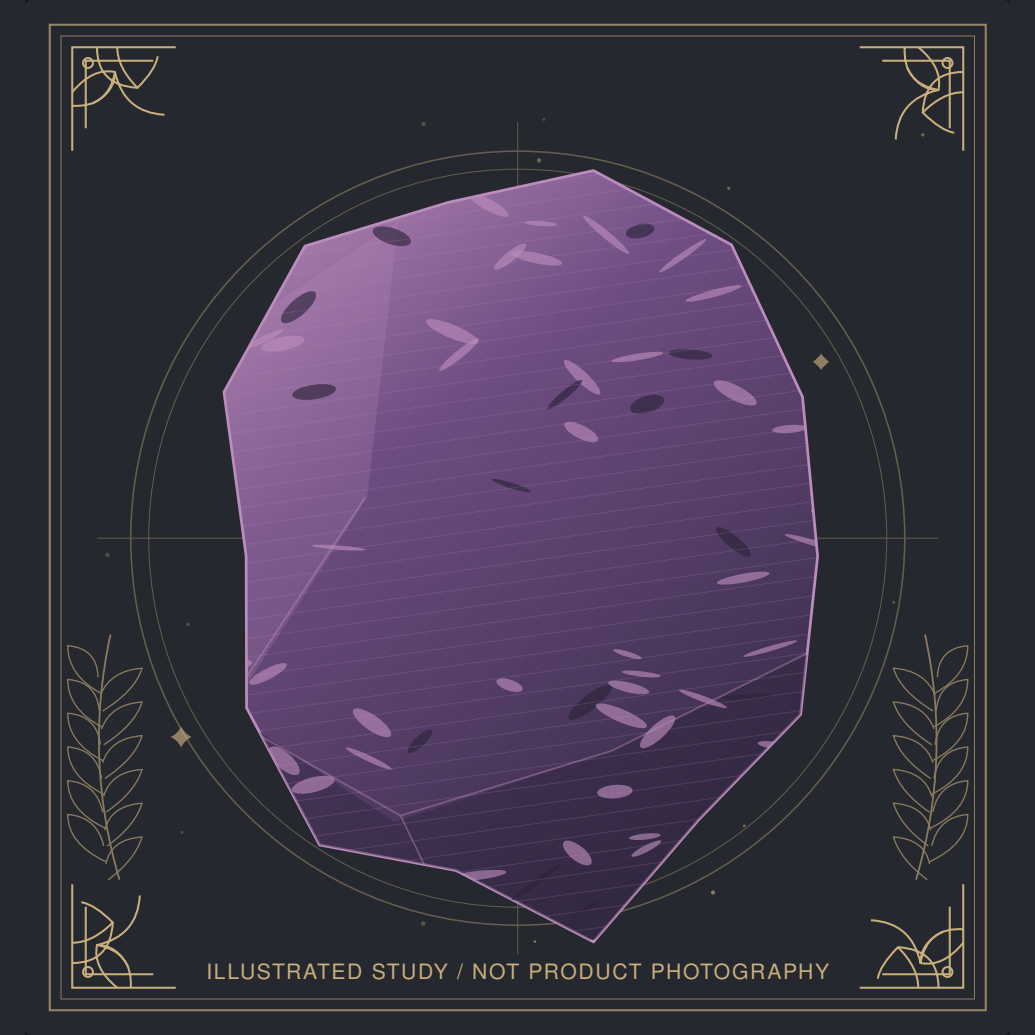
Material
A complex potassium-sodium lithium silicate mineral, often sold in mixed massive material. [1]
Family
Complex silicates [1]
Appearance
Purple-magenta massive mineral material and mixed rock. [1]
Meaning & tradition
Kynes: romance. [2]
In this guide
Visual identity & plain-language name
Sugilite is a complex silicate containing potassium, sodium and lithium among other elements. Familiar purple lapidary pieces often contain mineral mixtures. A bright color does not establish purity, and a nearly opaque tumble differs visually from a small identifiable crystal. The rock and its sugilite component deserve distinct descriptions. [1]
Earth story: formation, structure & color
The Handbook lists a hexagonal structure and composition represented by KNa2(Fe,Mn,Al)2Li3Si12O30. Hardness is about 5.5–6.5. Compact grains and massive aggregates are more familiar than crystals. Documented occurrences include specialized Japanese and South African mineral assemblages; a locality-specific geological account should not be assigned to every unproven purple piece. [1]
Sugilite is a lithium-bearing silicate in the milarite group, with potassium and sodium and variable iron, manganese and aluminum in its composition. The Handbook gives a hexagonal structure and a formula showing those substitutions rather than treating purple as an essential chemical element. Rare prismatic crystals occur, while familiar gem material is more commonly compact or massive. Its documented color range extends from light brownish yellow to strong magenta; the original species description and purple ornamental material need not look identical. [1]
The geological record includes an aegirine-bearing syenite stock on Iwagi Islet, Japan, and manganese deposits in the Kuruman region of South Africa. These different settings are part of one species' occurrence history. The Handbook lists Mohs hardness 5.5–6.5, poor basal cleavage and density about 2.74–2.79. Interlocking grains and associated minerals affect the behavior of an ornamental aggregate. A seller's exceptionally vivid purple name does not establish pure sugilite, exact manganese concentration or an untreated surface. [1]
Poor cleavage and interlocking grains help explain why massive material can differ visually from rare prisms. The documented hexagonal structure belongs to sugilite itself, while a mixed ornamental rock can contain grains with other crystal systems. A component formula should therefore remain a component account, not a complete analysis of every purple carving. [1]
Varieties & look-alikes
Purple massive material, host-rich material and unusually translucent pieces are useful categories. Charoite is another silicate with different structure and texture; lepidolite is mica. Purple dye, resin composites and other imitations may reproduce color. A darker patch can be an associated mineral rather than another sugilite variety. [1]
- Purple sugilite
- Purple to magenta ornamental material is the familiar retail presentation, but the species has a wider documented color range. An aggregate can contain other minerals that change its pattern and bulk properties. Confirmed identity should be separated from hue, translucency, treatment and origin. A beautiful saturated color is a quality observation rather than a complete authentication result. [1]
- Lavulite trade term
- Lavulite is retained as a commercial alias rather than a separate mineral species in this directory. A seller using it should explain the underlying material determination. Colorful trade vocabulary can be useful for finding a product but does not replace sugilite chemistry or component identification. Preserve the scientific name and any treatment disclosure alongside the alias. [1]
- Wesselite naming ambiguity
- A name referring to the Wessels commercial context can be applied ambiguously and should not automatically denote one pure mineral. Sugilite is documented from the Wessels mine, but that occurrence does not authenticate every object sold under a similar word. Retain the trade wording separately and state the examined component or assemblage when it is known. [1]
Human story: objects, names & cultural context
The mineral honors Japanese petrologist Ken-ichi Sugi. The type-material and reference history belong to modern mineralogy. This scientific commemoration does not prove an ancient sugilite chakra system or that every purple carved object was historically recognized by its current name. [1]
Sugilite honors Professor Ken-ichi Sugi, the Japanese petrologist associated with discovery. The Handbook cites the 1977 description from Iwagi Islet and the 1980 report of a second occurrence at the Wessels mine. This sequence provides a concrete scientific history: identification of a species and subsequent recognition in a different deposit. The retained type-material records include museums and universities, demonstrating how documented specimens anchor a name. Modern romantic or spiritual associations should not be projected backward into that mineralogical account. [1]
Meaning & practice: attributed traditions
Sandra Kynes gives sugilite a romance correspondence in her 2018 article. This is her contemporary belief framework. [2]
An editorial romance reflection can begin with a chosen act of attention: ask a question, listen without planning a reply, or make time together. The object marks the intention, without promising that purple material creates love.
Material truth: trade names & treatments
Keep sugilite identity, mineral mixture and individual origin claims separate. A finished polish does not prove untreated condition. Ask about resin filling, dye or reconstruction where a seller’s description is unclear. Physical properties of the identified mineral cannot be assigned unquestioningly to every mixed rock under the trade name. [1]
Purple ornamental material may be sugilite-rich rather than one chemically uniform mass. A named mine and a color grade are not substitutes for examination of component identity and treatment. If a sales name such as lavulite or wesselite is used, retain it as trade terminology alongside the supported mineral description. The word natural should not silently answer separate questions about dye, fillers, assembly or repairs. A confirmed mineral can be present in a piece that also contains another material or has undergone an intervention. [1]
When recording a piece, note whether purple is distributed evenly, occurs in veins or sits among lighter and darker grains. A highly polished face may obscure interlocking aggregate texture, so several views are helpful. Distinguish a seller's origin statement from independent provenance. If the piece has a report, preserve its exact scope: species identification is different from origin determination or a complete treatment assessment. This avoids inflating a limited report into a promise it never made.
Sources & related specimens
The Handbook establishes composition, properties and naming; Kynes documents the modern correspondence. Compare charoite and lepidolite for how purple appearance crosses several different mineral categories.
- Handbook of Mineralogy: Sugilite
Mineralogical Society of America · Identity and natural history · Accessed October 9, 2026
- Sandra Kynes: 365 Days of Crystal Feng Shui for Your Home (2018)
Llewellyn Worldwide · Sandra Kynes’s contemporary crystal-placement and intention framework · Accessed October 9, 2026