
Luminary Oddities · Natural history & art
Luna Moth
Actias luna
Lepidoptera / Saturniidae
A green North American silk moth whose long tails have been tested as acoustic decoys. Its hidden life among leaves is as interesting as the adult silhouette.
Explore this insect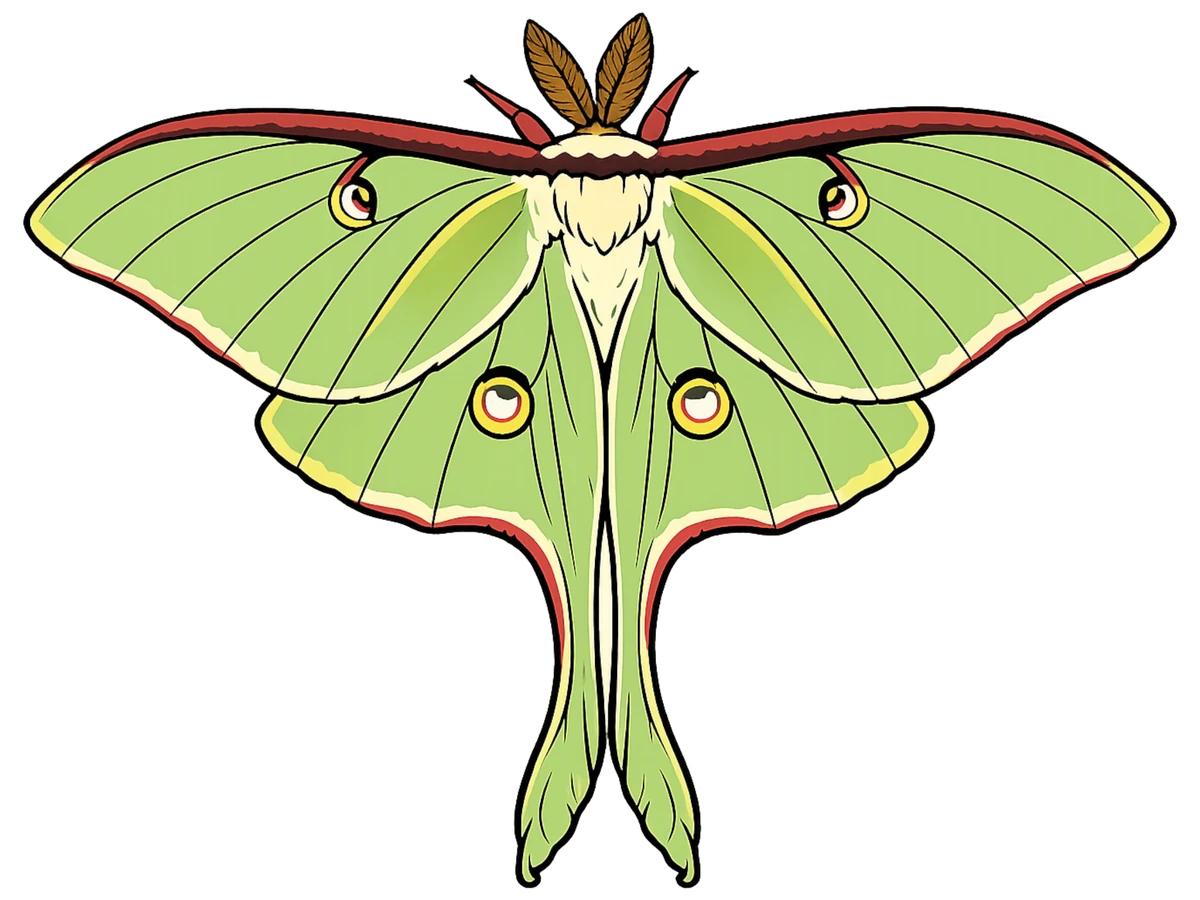
At a glance
- Adult food ↘
- The adult does not feed. [1]
- Tail science ↘
- Spinning tails diverted bat attacks in experiments. [6]
- Seasonal response ↘
- Day length influences pupal dormancy. [2]
Meet the species
Actias luna is the North American member of the moon-moth story represented here. It belongs to Saturniidae, the giant silk-moth family, and is distinct from the Asian Actias selene and Actias rhodopneuma guides. Shared green wings and tails can make the common names feel interchangeable, but the natural-history records and experimental results are attached to individual species. [1]
The scientific name also appears with the older genus Tropaea in the extension account. Historical combinations are useful search bridges, not reasons to create duplicate species. When following a reference from this guide, check whether its material is luna itself, another moon moth or a broader comparison across Saturniidae.
Look closely
The adult is green, with an eyespot on each wing and an elongated tail on each hindwing. The IFAS account describes comb-like antennae, larger in males. Look at the eyespots, the outer margin and the tail’s narrow shaft together. These features give the moth a recognizable form without making every green moon-moth image a luna identification. [1]
A spread artistic image reveals the full outline, while a resting moth may present a different angle and partially overlap its wings. Color also changes with lighting, capture and artistic processing. An illustration can make the tail appear perfectly straight even though the living structure moves during flight. Keep the image’s pose and purpose in mind before interpreting small differences.
Range and habitat
The extension account places the moth in forested eastern North America, from parts of southern Canada through the eastern United States. The number of generations varies geographically. That broad setting is more useful than a fixed emergence date applied to the whole continent. A photographed adult’s locality needs its own record and cannot be inferred from a digital artwork’s title. [1]
Life in stages
Luna moths develop through egg, caterpillar, pupa and adult stages. The caterpillar’s feeding precedes the adult’s short reproductive phase. In the classic photoperiod experiment, larvae from an Iowa egg batch were raised under different daily light exposures. Shorter light treatments favored pupal dormancy, while longer treatments supported direct development. The experiment shows a response to day length, not an identical calendar for every population. [2]
The cocoon and the pupa are different objects: the cocoon is the silk enclosure, while the developing insect is the pupa inside it. Priddle observed emerging luna moths and described structures used to cut an exit through the enclosure. Emergence therefore involves both leaving the pupal skin and getting through a protective material made earlier by the caterpillar. [3]
Food and host plants
Adults have reduced mouthparts and do not feed; their resources were accumulated as larvae. IFAS lists broadleaf hosts and emphasizes geographical variation in suitability. A named plant in a regional account is not automatically the best food for a caterpillar from another population. [1]
Lindroth’s study investigated host-plant effects on larval performance and detoxification enzymes. This brings plant chemistry into the story: leaves are not interchangeable packets of food. The larva must process the compounds in what it eats. A useful host list should therefore preserve the population, experimental conditions and outcome, rather than simply combine every reported tree into one universal menu. [4]
A living insect
A 2016 pheromone study identified compounds from female gland extracts, measured male antennal responses and tested synthetic blends in field trials in Ontario and Kentucky. Those steps connect a chemical signal to both sensory detection and attraction. The result is more precise than a dramatic claim about how many miles away any male can smell any female. [5]
Chemical mate finding is easy to miss when the moth is seen only as a wing pattern. The branched antenna is part of that sensory body. The study’s field trials also show why behavior belongs with a place and a method: a blend’s tested attraction is evidence from those trials, not a complete account of every population’s reproductive behavior. [5]
A remarkable detail
In the 2015 bat experiments, researchers filmed big brown bats pursuing luna moths with intact tails or with tails removed. Spinning hindwing tails drew attacks away from the central body, and moths with tails had a survival advantage in that experimental setting. The tail is therefore more than a beautiful trailing line: it can help create a misleading acoustic target for an echolocating predator. [6]
A later study varied tail form in luna moths and another moon moth to explore the sensory illusion further. Experimental alteration lets researchers ask whether a structure changes escape success, instead of simply assuming a purpose from appearance. These are studies of flying moths and bat attacks; a photographed tail’s exact length cannot by itself predict an individual’s fate in the wild. [7]
Connections in nature
A striking nocturnal defense raises another question: might the same long tail make a resting moth easier for a bird to find by day? Researchers tested that possibility with Carolina wrens and models made with real luna wings. The tailed models did not receive increased detection and attack in that experiment. The presumed trade-off was something to test, rather than an inevitable cost to assume. [8]
This does not mean a luna moth is safe from every bird, or that all predators perceive a tail in the same way. It means one proposed effect was not found under a defined test. A good ecological explanation can include both a demonstrated benefit and a carefully bounded negative result. [8]
Names and discovery
The name luna carries the moth’s lunar association. IFAS traces the North American species through early description and the later binomial name, and records its appearance on a United States postage stamp in 1987. That documented cultural use is different from assigning a universal spiritual tradition to the animal. [1]
Moon imagery can be a natural artistic response to the moth’s shape. In the Atlas, that response belongs beside a clearly named work. A scientific name, a historical illustration and a contemporary composition can coexist while retaining their distinct purposes: identification, documentation and interpretation.
Conservation context
The pheromone researchers describe chemical attractants as potential tools for monitoring insects that may be poorly represented in ordinary inventories. A method that helps detect a moth can improve the evidence available for population study. It does not itself establish a global threat category or prove that every luna population is increasing or declining. [5]
For an individual artwork, preserve the original specimen information where available. For a living encounter, location, date and a nonintrusive photograph are more useful than a broad claim that a moth is common or rare everywhere. A conservation conclusion should be tied to the population and assessment actually studied.
Reading the specimen
Dorsal and ventral captions identify which side of the wings is shown. Compare those orientations before comparing colors between works. The long tails need space around them, and their narrow shafts can disappear against a busy background. Enlargement is particularly useful for appreciating the relationship between the tail, the hindwing edge and the eyespot without handling a specimen.
In the artwork
The digital collection contains two saved luna-moth packs. Their specimen-derived compositions translate the adult’s outline into a series of artistic views. A change in pose, palette or finish belongs to the work, not to a new species. The gallery’s individual listing links keep those works identifiable while this guide supplies their shared biological context.
Care for the artwork
For a digital work, keep the original download and its license together, and make a backup before cropping or preparing a print. Choose paper, inks and framing for the display location; a bright screen preview and a paper print will not necessarily look identical. Avoid direct sunlight and damp locations for a finished print. The insect-derived artwork is an interpretation of the original photograph, so resizing it or changing its color balance changes the artwork rather than the biological specimen.
Questions worth asking
Does the adult drink nectar? Its reduced mouthparts and nonfeeding adult phase distinguish it from many familiar flower visitors. Is the long tail only decoration? Bat experiments demonstrate an acoustic diversion in luna moths. Does that defense make it safe from all predators? It does not. Do all populations produce the same number of generations? Geography and seasonal cues matter, and the day-length experiments are part of that evidence.
Explore the sources
The linked records serve different purposes: taxonomy establishes the name used here, field observations describe a place and population, and experiments explain a tested mechanism. Read those scopes alongside the photographs. A locality in a scientific paper belongs to its study material, not automatically to the insect behind a particular artwork.
- Luna Moth, Actias (=Tropaea) luna ↗
Donald W. Hall; University of Florida IFAS Extension · Accessed 2026-10-09
Species overview: morphology, broad range, nonfeeding adult, regional host and generation differences, name history.
- Effects of photoperiod on initiation of pupal diapause in Actias luna ↗
Wright; Journal of the Lepidopterists’ Society (1967) · Accessed 2026-10-09
Day-length experiment on a particular egg batch; not universal seasonal timing.
- Structures employed by Actias luna in emergence from the cocoon ↗
Priddle; Journal of the Lepidopterists’ Society (1967) · Accessed 2026-10-09
Observed adult emergence structures and exit behavior.
- Chemical ecology of the luna moth: host plants and detoxification enzymes ↗
Lindroth; Journal of Chemical Ecology (1989) · Accessed 2026-10-09
Experimental host-plant effects on larval performance and enzyme activity.
- Sex Attractant Pheromone of the Luna Moth ↗
Millar and colleagues; Journal of Chemical Ecology (2016), author university record · Accessed 2026-10-09
Female extracts, male antennal responses and synthetic-blend field tests in Ontario and Kentucky.
- Moth tails divert bat attack: evolution of acoustic deflection ↗
Barber and colleagues; PNAS (2015) · Accessed 2026-10-09
Experimental bat attacks on intact and tail-altered luna moths.
- The evolution of anti-bat sensory illusions in moths ↗
Rubin and colleagues; Science Advances (2018) · Accessed 2026-10-09
Tail manipulation and escape in tested moon moth species.
- Testing bird-driven diurnal trade-offs of the moon moth’s anti-bat tail ↗
Rubin and colleagues; Biology Letters (2023) · Accessed 2026-10-09
Carolina-wren experiment using models with real luna wings; no increased detection of tailed models under tested conditions.
Artworks in the collection
Explore the framed works and digital art connected with this insect. Etsy shows current availability, options and prices.
Continue exploring
Sources checked 2026-10-09. Artwork © Scott Schubr / Luminary Oddities.
Return to the Entomological Atlas ↑